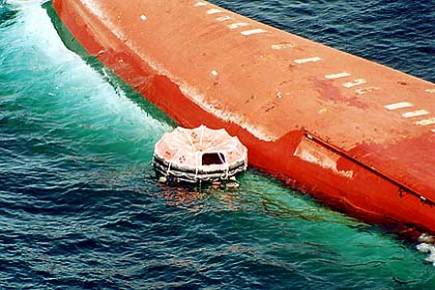
If any ship loads too much
weight, e.g. water, in its superstructure (or
garage) above waterline for any reason, it will
first heel and then suddenly capsize and float
upside down on its intact underwater hull full of
compressed air as shown right. Same applies to an
anchor
handling tug
being pulled upside down.
The ship cannot sink as it has
not lost any hull buoyancy and would float as shown
right. All the buoyancy, mostly now compressed air,
remains inside the upside down hull and more
buoyancy is added by the submerged deckhouse as
explained here!
The Swedish government decided
2005 that the ferry M/S 'Estonia' sinking
after capsize1994 should be explained by
scientists (sic)
based on the official 'facts' of the JAIC,
i.e. that water was loaded in the superstructure
while the hull was intact.
It is common knowledge that all
these 'facts' were in fact lies, so it was
very interesting to see how the scientists
proceeded. The project was directed by Swedish
innovation authority Vinnovaand Mr. John
Graffman. Mr
Graffman was a naval architect and ex Swedish Navy,
i.e. was working for the Swedish Navy when the
'Estonia' sank 1994. Mr Graffman was also a friend
of Mr Hans
Wermelin that was
the first expert (?) to announce, before
anybody else, that the 'Estonia' sank due to a lost
bow visor and water loaded in the superstructure.
There is no evidence that the
bow visor was actually lost, i.e. fell off the M/S
'Estonia' or that 1000's of tons of water was
loaded in the superstructure; it is cleverly
planted disinformation on part of the Swedish
authorities as described on other pages of this web
site.
It is quite disturbing that the man
in charge, John Graffman, of the latest 'M/S Estonia'
sinking explanation project 2007 was a friend of the person,
Hans Wermelin, that spread the false rumor about the
visor 1994 ... but Stockholm is a very small place. The
Estonia conspiracy cannot end.
In January 2006 Vinnova/Graffman decided
that SSPA Sweden AB - Strathclyde
University, Glasgow,
Scotland - MARIN, Delft, Holland should carry out the
study under the lead of SSPA at a cost of SEK 8
million!
Responsible persons were Claes
Källström,
Björn
Allenströmand
Jianbo Hua, SSPA (total 31 months work), Olle
Rutgersson, CTH (11 months
work ), Dracos
Vassalos and Andrzej
Jasionowski, Strathclyde
(total 30 months work) and Reint Dallinga, Jan Otto de Kat
and A.P. van't Veer, MARIN (total 17 months work).They explained:
"The loss of MV Estonia has
unraveled inherent weaknesses of ships with large
undivided spaces (in the superstructure and
deckhouse!!) when subject to hull
damage ... !" (This is a strange observation -
the MV Estonia hull was divided into 14 watertight
compartments and was undamaged and there was no
damage of the superstructure except that the bow ramp was
allegedly open permitting water to enter there).
"The official JAIC report with its
supplements, the SPF
study as well as
all other
available material
pertinent to the ship and the accident, will form the
basis for the detailed scrutinizing and reviewing study.
Classification of the information, qualification of its
pertinence, validation and ultimate synthesis will follow
specialists' expert reasoning process."
"The final report will summarize
and detail the approach, methodology, tools and results
of the investigation. ...
One
month after the project commencement, i.e. February 2006,
a public call will be made for any professional opinion,
analyses or other evidence to be made available in
writing to the
consortium. This
information will be scrutinized in WP2 along with any
other evidence available in archives. If deemed necessary
by this consortium, further dialog will be initiated with
the contributing parties. This step intends to ensure
that
transparency
of the investigation is maintained and no scope for
speculation exists
(sic).
Furthermore, a dialogue with the Industrial Panel of
Experts, IPE, will take place during the whole
project."
"An internet web site will be
developed where public communication will be facilitated
and the final report will be made available in an
electronic format.
Three months after the project end,
a special international symposium/workshop in Sweden on
the project results will be organized, to facilitate
public discussion on the findings."
The results of the study 2006 were to be
reported 15 September 2006, 15 March and 17 September 2007
and 15 March 2008 with a complete final presentation on 17
September 2008.
No public call for any professional
opinion, analyses or other evidence was made June 2006! A
back-dated (1 April) call was published on a web site in
July 2006 after the writer had asked where it could be
found.
The above scientists Claes
Källström, Björn Allenström and Jianbo
Hua, SSPA, Olle Rutgersson, CTH, Dracos Vassalos and Andrzej
Jasionowski, Strathclyde and Reint Dallinga, Jan Otto de Kat
and A.P. van't Veer, MARIN have on the other hand been fully
briefed by Heiwa Co that all essential 'facts'
suggested by the JAIC are lies:
The initial Lies
The Joint Accident Investigation
Commission, JAIC, of the MV Estonia sinking alleged 1994
-1997 that the front of the superstructure of the
ferry several meters above waterline hit big waves and so
the bow visor was ripped off; the visor then pulled open the
interior ramp and nobody aboard noticed these noisy
events!
Anybody who has been to sea on a ferry in
severe weather knows of course that, when a ferry slams its
bow into a wave causing an impact, this event is heard all
over the ship as a big bang - as you fire a canon -
followed by vibrations.
There is no way that you can continue at
given speed and course, because if you do, there will be a
second, noisy impact and vibrations! So you must slow down,
change course ... take action, which is standard practice.
Evidently the vessel bow/visor is designed to withstand the
wave impacts, but the noise and vibrations are infernal and
cannot be ignored.
In falsified
model tests JAIC/SSPA later
showed that the noisy impacts occurred almost every minute
with an upward and aft force of the order 300-700
tons.
The first lie of the
JAIC is that nobody heard or felt any impacts, and if they
did, no action was taken.
Actually there were no wave impacts at
all and only one or two big bangs ... and soon after the
ship got suddenly >30° list ... but the ship was
stable and the list was reduced to <15° ... people
could evacuate to open decks during about 10
minutes!
The second lie of the
JAIC was then that there was sudden capsize (big list,
sudden loss of stability and floating upside down) as stated
by the JAIC that you would have expected with a certain
amount of water loaded inside the superstructure on the car
deck 2.5 m above waterline (1 900 tons in the case of
the Estonia).
There is no evidence that the visor was
lost or the ramp was pulled open at this time! There are
many indications on the other hand that the visor was
removed from the wreck under water after the accident
with the knowledge of the JAIC! The three surviving
witnesses of the ramp after the sudden list all say
that it was CLOSED.
The third lie of the
JAIC was then that the visor was actually lost and the ramp
was pulled open and that these events contributed to the
accident! The Commission suggested that they
filmed the wreck and that the visor had
disappeared and was found
three weeks later a mile west of the wreck. These are clever
lies based on edited films and false facts without any
evidence!
The visor was simply removed from the
wreck under water after the accident by Swedish Navy forces
to support the first lie! There is no evidence that the
visor was found or salvaged a mile west of the
wreck!
The fourth lie of the
JAIC was then that a
ferry sinks, when water enters into the superstructure
through an open ramp
(door) 2.5 m above waterline and floods a watertight
car deck. Evidently water enters, if the opening is under
water, e.g. due to ship pitching, BUT as soon as the ship
stops and thge opening is above water,
all the
water simply flows out
again!According JAIC
the ship stopped after a few minutes with opening away from
the waves and above water and more water flowed in!
Confusing, isn't it?
The fifthlie of the
JAIC was thus that the water did not flow out! On the
contrary - more water flowed up and in through the opening
above water and on the side of the ship and caused the
vessel to list. It is correct that a weight in the side
lists a ship, but the JAIC conveniently forgot that this
(weight) water would have trimmed the vessel and flowed out
immediately when the ship stopped and pitched and trimmed on
the bow.
It was quite easy for the JAIC to get
away with all these lies - they bribed some experts to
support them and threatened other experts to shut up,
including the writer. Media just reported what they were
told by the officials! And as the JAIC got away with the
above five outrageous lies, they decided that they could lie
as the liked. All essential facts in the JAIC Final report
are simple lies. No evidence at all is presented! The sad
thing is that at least one of these 'experts' is now
in the SSPA team! And
SSPA falsified everything 2008.
33 more lies are described
below.
And there are many more. Thus the following:
E-mail to the scientists to explain
the Estonia sinking (23 April 2006)
----- Original Message -----
From: Anders
Björkman
To: d.vassalos@na-me.ac.uk ;
n.barltrop@na-me.ac.uk ; valanto@hsva.de ; Claes
Källström
Cc: VINNOVA ; Katarina
Stenström Ros ; John Graffman
Sent: Sunday, April 23, 2006 11:54
AM
Subject: Dnr 2006-00547
VINNOVA - Research Study on the Sinking Sequence of MV
Estonia
Gents,
I understand that you are now very
busy with subject at Swedish tax payers' expense, which
please confirm.
I assume that the events just
before the vessel started to load water in the
superstructurehttps://heiwaco.tripod.com/epunkt319.htm
will be included in the study, but I summarize them
anyway:
The MV Estonia was doing 15 knots
heading into 4.2 meters waves with a large relative
motion forward. The MV Estonia superstructure bow flare
was struck several times by heavy 350-700-1000 tons wave
impacts that nobody heard (no action taken on the bridge,
eg slow down).
You are recommended to test this
in full scale on any ferry yourselves. It is very simple.
Just ask the Master to head at full speed into heavy
waves and notice the first wave impact. You cannot avoid
hearing the BANG, feeling the VIBRATIONS in the structure
and seeing the BIG SPLASH. Ask yourself if the MV Estonia
crew was deaf, etc. allowing the following to
happen:
Then various steel structure parts
in the MV Estonia superstructure were damaged 10 meters
forward of the bridge during at least 10-20 minutes: the
visor side (deck 3) and bottom locks (main deck) were
ripped off due to wave impacts, the visor moved up-down
and damaged its bottom and the ship's main deck due to
waves and relative motion, the visor lifting arms were
ripped apart at the deck hinges on deck 4 due to wave
impacts, the lifting hydraulic foundations were also
ripped apart (deck 3) due to wave impacts, the hydraulic
pistons and lugs then cut the deck 4 steel plate and a
strong deck steel beam web and flange and the visor
started to hit against the ramp protecting the
superstructure, all ramp hooks and locks were ripped
apart, etc.
You are kindly recommended to
verify the damages and ask yourselves how they could
develop without being noticed by anybody - except as
noise from the bow.
Then the visor fell off (time is
01.15 hrs) and the ramp was fully open - the ramp top was
then below the waterline and the forward speed was 14-15
knots. Water could enter into the superstructure 2.5
meters above waterline, when the MV Estonia with forward
speed pitched the ramp opening below the waves. There is
no evidence for this - three crewmembers in the ECR saw
the ramp closed at 01.17 hrs, but assume that they are
lying (they had of course escaped from the ECR at that
time - https://heiwaco.tripod.com/epunk148.htm - after
having started the bilge pumps as they were standing in
water to their knees in the engine room).
So water started to be loaded on
the MV Estonia superstructure car deck (deck 2) and the
water ended up inside on starboard side and suddenly
listed the vessel. Then the MV Estonia turned 180°
port and stopped with the opening away from the waves.
There was no capsize (GZ<0, vessel floating upside
down) that you would expect with 1 900 tonnes of water in
the superstructure side (considering also trim, of
course) so less than 1900 tons of water were loaded. You
would now expect much water in the superstructure to flow
out again through the opening in the bow and the vessel
to upright. Evidently no more water could enter through
the bow opening at this time as it was high above the
waterline! Do you agree?
If you agree, you must conclude
that there are some basic errors in the JAIC analysis and
evidence of the MV Estonia accident that you shall base
your research study on.
Then the MV Estonia started to sink
- and maybe you will just concentrate on that in your
study? The time is 01.20 hrs and the ferry is more than a
mile from the position of sinking after 01.54 hrs. So the
MV Estonia was drifting at >2 knots speed while
sinking. Do you believe that? See
https://heiwaco.tripod.com/epunkt19.htm .
Anyway - the MV Estonia was
sinking. The hull below deck 2 is undamaged all the time.
All watertight doors are closed at 01.20 hrs. Most water
in the superstructure should now flow out through the bow
opening (easy to verify by model tests) and only a little
water should remain due to the original stern trim, and
this water should flow out through the scuppers. There is
no way that more water can enter the superstructure at
this time with the bow in lee and speed away from the
waves and you should expect the MV Estonia to upright due
to the buoyancy of the hull.
But in order for MV Estonia to sink
you must now flood at least three, four or five
watertight and undamaged hull compartments after which
the bulkhead deck comes under water and all the other
compartments fill up. How could it take place? I will
tell you.
Model tests!
Primo - start to
verify the model in calm weather and closed ramp with 0.5
meter stern trim as per MV Estonia original loading
condition at zero speed. Car deck is full of trucks and
cars. This is fun! Load water on deck 2 (car deck) just
by filling the compartment with a hose from above and
observe what happens (the ramp is closed); vessel lists
and trims more on stern, with 1900 tons of extra water on
the car deck (among all the trucks and cars) model turns
upside down. Capsize. Evidently the vessel does not float
on the deck house decks 4-9 (doors are open aft on deck
4, 5 and 6 and in the side of deck 7, the windows are
broken when coming below water) that is flooded
completely immediately.
Secondo - verify the
model in calm weather and open ramp and zero speed. Load
water on deck 2 with a hose and observe again what
happens; vessel lists and trims again on stern and
capsizes with 1900 tons of water on the car deck. The bow
was high over water all times. Same result as first
test.
Tertio - repeat the
second test in heavy weather, open ramp with opening away
from the waves, zero speed (the condition at 01.20 hrs);
fill the superstructure with a hose but due to vessel
pitching (>trim), you will find that the water flows
and sloshes forward and back on the car deck and out
through the bow opening in spite of original stern trim.
Interesting! The sloshing is in reality very
noisy.
Recommendation - when you visit a
ferry in heavy weather to check the bow impacts, also put
50 tons of water on the car deck and listen to it
sloshing around.
Fourth - open ramp
down below waterline, forward speed 14 knots into 4.2 m
irregular waves, big relative motion forward (no change
of heading during test); after 10-20 pitching movements
(1-2 minutes) up/down vessel stops and capsizes
quickly.
Fifth - like four but
with a 180° change of course prior to capsize;
vessel lists but after change of heading we are back to
test 3 - and the water flows out through the bow opening
due to the pitching.
Six - repeat two but
prevent the vessel from capsizing (cheating a little by
using an outside support) and allow the model to trim on
stern only due to the water in the superstructure until
the first opening on deck 4 (apart from the bow ramp deck
2-4) comes below water. What opening is first underwater?
Right - the aft vents on deck 4 into the superstructure
below. You do not have to fill the superstructure anymore
by hose - it fills itself. Release the support and see
what happens! Capsize of course! All the water in the
superstructure flows to the starboard side again and
model turns upside down.
Seven - ask yourself
how the clock on the bridge, starboard side deck 9, could
stop at 01.36 hrs. Did it stop when it came under water?
But the vessel didn't sink until 01.54!
Eight - like five but
no water flows out through the bow opening for some
reason at 01.20 hrs, no capsize takes place and the hull
compartments are being flooded one way or another (you
shall describe that) and the deck house decks 4-9 comes
under water. The vessel is drifting at >2 knots for 35
minutes while sinking. How? How can a sinking ferry drift
so fast?
Please keep me informed of your
progress of your study.
Kind regards
Anders Björkman, Heiwa
Co
(Prof Vassalos and Dr. Jasionowski have
later confirmed that they will consider above
information)
Actually - the scientists will not do
the above model tests! Instead they (task 3.2) will only
run a special model with forward speed into irregular seas
with an open ramp to see how much water enters into the
superstructure. This water is collected in a tank inside the
model to be measured after each test. That is all! The
'Bow water ingress ..." test results will then be
used in 'simulations' of the sinking. No tests will
be done at zero speed with the opening away from the waves
to demonstrate that the water flows out by itself. The SSPA
model tests and study are extremely limited in scope to
avoid revealing the Truth: That the water flows out by
itself as soon as the vessel stops and never sinks will
never be admitted by the SSPA scientists (September 2006)
because their job is to show that it sinks. Not that it does
not sink! Prove me wrong!
(In February 2007 the SSPA tested the
above model and noticed that at least four times more water
than suggested by the JAIC entered into the model! The model
collection tank thus has to be re-arranged for final tests
to be carried out later 2007! SSPA may also just fit a real
deck behind the ramp opening - in lieu of a collection tank
- and see what happens as suggested by Heiwa Co).
(In March 2007 the SSPA tested the model
almost as requested by Heiwa Co. The model listed 25°
within one minute and reached a stable condition with
46-47° heel after three, four minutes! An
incorrect model was used. A
correct model would have capsized already at 33-37°
heel).
Some
Comments on Research study on sinking sequence of MV Estonia
(31 August 2007)
The SSPA/Strathclyde consortium has
produced the above, un-dated report (Power Point
Presentation) probably spring 2007 and some relevant slides
are listed in the Appendix.
As suggested in slide 16 Heiwa Co - European Agency for
Safety at Sea provides the following substantive
information (31 August 2007):
Of the two main scenarios
(slide 23) the first one (lost bow visor and water loaded
in the Car deck superstructure) is not possible as the
vessel capsizes and floats upside down, when 1 600-2 000
tons of water is loaded on the Car Deck causing a heel of
33-37°, when GZ<0 assuming correctly that the
deck house is not buoyant. The Consortium is (again)
strongly recommended to verify the GZ righting lever
curves with various amounts of water loaded on the Car
deck.
Therefore, only the second scenario
is likely, i.e. underwater hull leakage that will be
explained below. Underwater hull leakage - several
compartments flooded abt 1 m - will cause an initial heel
of maximum 12-18°; further heel is evidently
prevented, if the Car Deck superstructure space is
weather tight.
Slide 26 is misleading in many
ways; a volume is not defined as tons, etc. It
should be emphasized that the vessel is only floating on
the hull - 12 200 tons of buoyancy - and that there is 7
700 tons of reserve buoyancy in the hull above waterline.
The Car Deck superstructure will only contribute to
residual stability (GZ) in heeled conditions as long as
it remains weather tight and GZ>0. The Deck
House does not contribute to buoyancy or residual
stability (GZ) as it is not weather
tight.
Slide 27 is correct in as much as
the vessel sinks, when the reserve buoyancy is reduced
due to hull water inflow (leakages), and disappears from
the surface when all reserve buoyancy is consumed..
However, if, e.g. the vessel trims on the stern during
sinking (reserve buoyancy aft lost first) and the hull
comes under water there and the Car Deck superstructure
is flooded, then the vessel sinks immediately with some
reserve buoyancy forward still available. In fact only
3000-4000 tons of reserve buoyancy may be lost until the
ship suddenly disappears below the
surface.
Slide 28 is correct and is fully in
accordance with slide 23 2nd scenario, i.e. as long as
the Car Deck superstructure is not flooded, the angle of
heel cannot exceed 12-18°. Later the heel can be
40°+, but in order for that condition to be stable,
hull decks 0/1 must be flooded with at least 1000-1500 t
of water due to hull leakages.
Slide 29 is wrong.
The Upper Decks deck house will not provide any support
(?) of any kind. Stability equilibrium is only achieved
by the hull (decks 0/1) and the Car Deck superstructure,
as long as the latter is weather tight.
Slide 30 is
misleading. Based on scenario 2 (slide 23)
sinking starts, when the hull leakages developed, and the
vessel first heels 12-18° due to flooding several
hull compartments. When the Car Deck superstructure is
submerged and water enters it (e.g. through a partly open
aft ramp, open starboard pilot door or any ventilator)
the angle of heel will increase >18° and soon
reach 40° and later 90°. Equilibrium is always
achieved by the hull (decks 0/1). The Upper Deck deck
house does not contribute to anything. The deck house is
just instantaneously filled with water.
Slide 32 - the JAIC scenario -
is evidently impossible. GZ becomes negative
already at 33-37° heel (it takes less than two
minutes according SSPA latest model tests) and the vessel
floats upside down and no further loss of buoyancy can
take place = no sinking can take place. The figure 2
should be vessel upside down!
Slide 34 - Heiwa Co has already
provided the SSPA consortium with a chain of events
leading to the known processes; (i) hull leakage,
probably due to a collision, starting the sinking, (ii)
flooding of several hull compartments deck 0/1 causing
negative GM and a new equilibrium with 12-18° heel,
(iii) flooding of the Car Deck superstructure, when it
becomes submerged while sinking, and increased heel to
90°, sinking vessel being in equilibrium all the
time.
The answer to the first question is
therefore available; the hull decks 0/1 was flooded first
and the Car deck superstructure later, when it was
submerged during the sinking.
The answer to the second question
is basic; the Upper deck deck house does not contribute
with any buoyancy at any time. It is instantaneously
flooded as it becomes submerged.
The SSPA consortium is kindly
requested to consider the above.
Anders Björkman
Heiwa Co - European Agency for
Safety at Sea
31 August 2007
Appendix
Slide 11:
Detachment of the bow
visor.
This slide is not
clear.
Slide 16:
Announcement
It is hereby announced that to aid
the proceeding of this study, the SSPA Consortium invites
any substantive information to be provided in written
form for the consideration in explaining the
circumstances of the loss of the MV
Estonia
Slide 23: Two main
scenarios
1. Due to water on the car deck
with an intact underwater part of the hull
2. A damage in the watertight hull
with consecutive flooding of the car deck
Slide 26: Total volume up
to 6th Deck 65,870 t
Ship mass/intact buoyancy 12,200
t
Deck house 26,000 t
Car deck 20,000 t
Reserve buoyancy deck 0/1 7,700
t
Slide 27: Vessel sinking
process
For the MV Estonia to sink some
7,700 tonnes much have reached below the car
deck
Slide 28: Vessel heeling
process
For the MV Estonia to heel to
40deg+, flooding of Car Deck spaces must take
place
For the M/V Estonia to retain
stable heel in excess of 40deg+, Upper Decks have to
provide temporary support
Slide 30: Loss process -
Summary:
MV Estonia sank. Therefore Car
Deck, Upper Decks and Decks 0/1 must have
flooded.
MV Estonia attained heel angle in
excess of 40 deg. Therefore, large scale flooding of the
Car deck spaces had to take place.
MV Estonia floated on her side,
Therefore flooding of Upper decks must have been slow,
taking place between 13-28 min.
Slide 32: Jaic Scenario
(figures)
1. Water enters Car
Deck
2. Vessel with 85° heel (car
deck and deck house 4, 5, 6 flooded)
3. Hull (not to scale) being
flooded
Slide 33: JAIC scenario
incomplete:
- how Estonia floated on her
side?
- how Estonia sank (Deck
0/1)?
Slide 34:
QUESTIONS:
No consistent explanation of the
chain of events leading to all these processes has been
provided to date
The 1st question remaining is: was
the Car Deck first to flood and the Decks 0/1 flooded
"from above" or were the Decks 0/1 the first to flood and
the Car deck flooded "from below"
The 2nd question is: what is the
time frame of the loss of buoyancy in the upper
decks?
The fundamental
Deficiency
The fundamental deficiency of the
Final report into the sinking of the 'Estonia' issued
1997 is of course that it does not explain how and
why the ferry actually sank as a result of the
published proximate causes of accident - defective locks
securing the visor protecting the ramp of the forward
opening in the superstructure, wave loads, structural
damages, ripped open ramp and finally water entering the
superstructure! If you, like Heiwa Co, ask that
simple question - why sink due to all those fairy tales -
the only reply you get is an insult; you are stupid,
unintelligent, unreasonable.
This is a normal reaction when
official people are caught with their pants down lying.
Because it is very easy to show that all info about
defective locks, wave loads, structural damages, water
inside the superstructure, etc., etc. are simple
lies.
The Commission evidently censored the
fact that the ferry floated on its undamaged
watertight hull according to the principle of
buoyancy of Archimedes developed circa 252 BC and that
sinking could only have started, when (or if) the
hull started to fill up with water. The Commission
never explained - they could not - how the undamaged hull
and 14 watertight compartments were filled with water so
that the ferry could sink. The now infamous Final
report does not mention or investigate watertight integrity,
watertight doors, bilge pumps and bilge alarms in the hull
preventing sinking and ignore crew statements to the effect
that the ship was leaking below waterline and being flooded
from below.
The Commission instead alleges (invents -
because nothing is true) that
the hull was undamaged all the times (all
watertight doors were closed and the hull was
intact and, indirectly the Commission confirmed, that the
Principles of Archimedes applied at all times), and
that
there was increasing amounts of water inside the
undamaged superstructuredue to pitching below
water of the open, forward ramp/bow door in the
superstructure on the watertight car deck
on top of the hull > 2,15 meters above
the waterline producing a heeling moment, which in
turn caused the ship with the undamaged hull (floating
according to good Greek principles) to list ... but not
trim. You would expect that the free water on the deck
would trim the vessel! If the vessel trimmed on the bow,
the water would simply flow out, when the ship stopped!
If the vessel trimmed on the stern, the water would
collect at the aft end and the opening forward would be
high above the water and no more water could flow in.
Thus
the Commission invented that the 'Estonia' never
trimmed due to water on the car deck, and
that
later there was water in the deck houseon top
of the superstructure, when the hull was still
intact without any water in it (and thus still floating
according to Archimedes - but not trimming!), and
concluded, without giving any explanation why Archimedes
suddenly was wrong, that
sinking of the whole ship was then
inevitable.
Why and how 14 watertight compartments of
the undamaged hull - totally 18 000 cubic meters
volume - on which the 'Estonia' initially floated with
displacement about 12 000 tons and with 6 000
cubic meter of reserve buoyancy and closed watertight doors
was water filled is never explained.
One major reason to make a new study is
actually to clarify this very serious deficiency - how
can a heeling moment produced by water inside a
superstructure cause an intact ship hull to sink?
Naval architects everywhere are also invited to answer the
riddle. The members of the Royal
Institution of Naval
Architectsand
students of marine accidents have been invited 2002 to
explain why the 'Estonia' sank in the official sequence of
events of the Commission/Final report as quoted below.
Nobody at the RINA has replied (2004).
The Swedish National Maritime
Administration (Sjöfartsverket) has officially
announced that the Final report into the sinking of the
'Estonia' is complete in all respects in spite of it
not explaining the inevitable sinking (sic). As a matter of
fact the Swedish Director of Safety at Sea, Mr Johan
Franson, has explicitly told his expert staff not to look
into the matter at all - the floating and sinking of the
'Estonia' cannot be discussed at the Swedish NMA. So much
for safety at sea - floating of ships - at the Swedish NMA.
The Swedish NMA is not happy that a new study is made
2006-2008!
Previous study 2002-2003 full of
lies
The Swedish government did on 19 April
2001 acknowledge that the Final report does not explain the
sinking. However, instead of asking some real experts
to clarify the matter, the government decided that the
Swedish Board
of Psychological Defense,
SPF, should provide 'one explanation that, based on the
sequence of events of the Final report (sic), describes how
the 'Estonia' was filled with water at the end of
accident'. This in an interesting task. 'The sequence
of events of the Final report' is quoted below. Other
sections of the Final report give slightly different
descriptions. But how was the hull of the 'Estonia' flooded
and filled with water 'at the end of the accident' so
that she sank is not described anywhere.
Staffan Sjöling - the lying SPF
'Expert'
On 30 September 2002 the SPF appointed Mr
Staffan Sjöling, a young naval architect of the
Swedish Defense Board of Equipment, to carry out a 60
hours pre-study (sic) how to carry out the task to
explain the water filling to be ready on 31 December 2002.
However Mr Sjöling could not produce the pre-study in
time. But on the 28th March 2003 Mr Sjöling did in fact
produce not only a pre-study but a full report describing
the water filling of
(a) the superstructure,
(b) the deck house ... and
(c) the hull of the
'Estonia'.
This water
filling reportis full
of new, false assumptions and manipulated calculations that
are easy to reveal and is only the latest contribution to
the 'Estonia' tragedy and cover-up ordered by the Swedish
government. Mr Sjöling never considered the below,
basic facts.
Why didn't the 'Estonia' capsize and
float upside down latest at Events 15 - 23 of the
Commission?
There are at least 33'events' according to the Commission/Final
report before the sinking (none of them
proven!) - events 1-18 are about the list
occasioned by alleged very large, increasing amounts of
water inside the superstructure on the watertight car
deck producing a big heeling moment (the trimming moment
is conveniently forgotten) of the intact
hull.
Why didn't the 'Estonia' trim so that
the Water either flowed out
(bow
trim) or stopped flowing in
(stern trim - opening high
above water)?
Then there are events 19-33 about
the flooding of the deck house on top of the
superstructure and 8-18 meters above the waterline.
There the Commission states - event 30 - that due to
flooding of the deck house (sic) - 8-18 meters above
the waterline - the watertight compartments of the
hull below waterline started to flood from above!? Mr
Sjöling was appointed to explain this surprising effect
- the watertight compartments of the hull started to flood
from above. How?
No scientific
Explanation
No scientific explanation had been given
for eight years why water in the open deck house of
the 'Estonia' flooded the hull compartments below the
superstructure. It is evidently not possible to
explain at all! Event 34 - that the ship
inevitably sank - is therefore not explained. Please
dear reader, remember, every event must also have a proven
cause to produce an effect. In spite of the fact that Mr
Sjöling should explain the water filling based on the
official sequence of events including flooding from above,
Sjöling invents new defects - ventilation ducts in the
side - and new phenomena - the vessel floats on the deck
house, which is only flooded when one or two doors or a few
windows break open - preventing capsize for 35
minutes!
Some basic information that Mr
Sjöling ignores in his study:
Basic Particulars and
Assumptions - Hull - Bilge Pumps - Superstructure -
Scuppers - Deck House
the 'Estonia' floats on the
watertight
hull,
which is subdivided into 14 watertight compartments
by watertight, transverse bulkheads fitted with
(too many) watertight doors. The hull, 7.56 meters
deep, is shown in green in the figure right where
the double bottom of the hull is shown blue. The
main engine room compartment in the hull is purple.
The top of the
hull
is the watertight car deck
no. 2
(red
in the figure),
which is >2,15 meters above the
waterline,
water in the watertight
compartments of the
hullis pumped out bybilge
pumps,
the car deck no. 2 (> 2,15 meters above the
waterline) is protected by a weather tight
superstructure,
red in the figure above right but painted white
in reality,with a weather tight ramp at the
forward (and aft) end and no subdivision by
transverse bulkheads. Windows are not permitted in
a
superstructure.
Water on the car deck (one open space) inside the
superstructure
entering at the forward ramp would collect at the
lowest point on the deck and would make the ship
list and trim and could not flow down into the hull
below,
water in
the
superstructure
flowed out through
scuppers in the car deck, and
on top of the superstructure was thedeckhouse(decks 4-8), white in
the figure above. The deckhousewas
>8 meters above the waterline and neither
watertight nor weather tight. Windows were
therefore permitted in the deckhouse.
Evidently there was no watertight subdivisions in
the deckhouse. Evidenty the ship does
not float on the deckhouse!
More basic information to consider:
Basic Particulars and
Assumptions - Buoyancy - Intact Stability - Damage
assumptions - Damage Stability - Water in the
Superstructure - Capsize - Sinking
buoyancy
of the 'Estonia' is provided by the hull
only, i.e. the 'Estonia' floats on the hull at
about 5,35 meters draught with a >2,15 meters
freeboard,
intact stability of
the 'Estonia' is provided by the the watertight
hull and the weather tight
superstructure, i.e. when the 'Estonia'
heels due to a heeling moment, the shifting centre
of buoyancy of the hull would provide a
righting moment and resist the heeling moment (the
righting lever GZ is the horizontal distance
between the centres of buoyancy (B) of the
hull and gravity (G) of the ship - see event
23 below); the weather tight superstructure
would prevent outside water to flow in on top
of the hull when heeling (which would
increase the range of positive stability
(GZ>0)),
damage assumption was leakage due to
collision and that two watertight compartments of
the hull are flooded and the side of the
superstructure is damaged,
damage stability of
the 'Estonia' is then provided by the intact
(not damaged) watertight compartments of the
hull, i.e. two adjacent compartments could
be flooded and the 'Estonia' had still enough
buoyancy to float on the remaining
compartments with the superstructure above
water and enough stability to be upright with water
on top of the hull (in the
superstructure).
water in the
superstructure of the 'Estonia' is only
extra cargo loaded on the ship with an intact
hull. This extra cargo would load itself on
the lowest point of the
superstructure and produce a heeling moment
to list the ship according to the principles of
intact stability,
2 000-3 000 tons of water in the
superstructure would list the
'Estonia' >40 degrees and the water would reach
the underside of deck no. 4 six meters above the
car deck. An observer at the front of the car deck
would have seen the view shown right, if the the
ship trimmed even. The condition is not only
unstable - all the water would have trimmed the
ship on one of the ends. This amount of water is an
enormous amount of lose weight - a monster - 18-25%
of the total weight/displacement of the ship, and
it can only produce one result - instant capsize.
Then the ferry turns upside down - the extra water
flows out - and the ship floats upside down on the
undamaged hull. Never in maritime history has a
ship loaded so much water and remained both
floating ... and stable! The 'Estonia' was a
remarkable ship ... but it is not explained
why!
Water in the
superstructure heels the ship until
capsize!
capsizeoccurs, when
the residual stability is nil, i.e. when any
heeling moment due to weather or (shifting) cargo,
e.g. water in the superstructure, exceeds
the righting moment of the hull and
superstructure; the result is
capsize, i.e. the hull and
superstructure turning upside down and the
vessel floating upside down on the (intact or
damaged) hull. The picture right shows a
capsized ship floating upside down (the Joola 28
September 2002). The 'Estonia' would have capsized
like that with water on the car deck.
sinking occurs only,
when the weight of the ship and cargo exceeds the
available buoyancy of the hull and
when capsize has not occurred
previously.
The alleged 'sinking' of
the 'Estonia is only described by the Commission in
two pages (pp 175) in chapter 13.2.6 and in a
couple of pages (pp 181) in chapter 13.6 of the 228
pages Final report, FR. It is only a long
description of events about the list (no
mention about trim) and a long description of
further events of the flooding of the deck
house 8-18 meters above waterline but very
little about the sinking (why the
hull compartments were flooded).
Capsized ship cannot
sink!
There is in fact no evidence for any alleged event -
the whole sequence of events is made up from bits and pieces
of real or fabricated happenings onboard and false (or
incorrect) stability calculations. It means that an alleged
event cannot be supported by a valid stability or
floatability calculation. Every event is just an invention
of the Commission. Thus it is very difficult for Mr.
Sjöling to explain the water filling of the hull and
the sinking ... but he doesn't complain.
The falsified Plot of the
Accident
The movements (speed, course, position,
angle of heel, etc) of the 'Estonia' during the 33 events
leading up to the sinking at 0152 hrs are plotted in figure
13.2 of the Final report. It can easily be proven that this
plot is a
total falsification. It is in
fact only a plot of an undamaged ship that turns
under engine power and then drifts due to weather and wind
(and never sinks). The inventor of the plot has then added
alleged angles of list at various times and the Commission
has later modified, increased, these alleged angles of list
to the plot to make it appear that it is a plot of the
'sinking' 'Estonia' and it then deleted the drifting
after 0152 hrs to make it appear that the vessel sank at
0152 hrs. Thus, the alleged events of the Commission are
based on a false and manipulated plot! It is a pity that Mr
Staffan Sjöling does not understand this and points it
out to the SPF!
The Final report gives some key times
01.14, 01.24, 01.27, 01.33, 01.42 and 01.52 hrs with certain
amounts of water in the superstructure and the
deck house and the associated angle of list as per
below table. The expert of the Commission, Dr. Michael Huss,
FRINA, who made the original plot, had previously suggested
other - much smaller - amounts/angles of list in a report to
the Commission, which were later modified in the Final
report.
Huss only calculated the water inflow
into the superstructure and the resulting list until
capsize (at 01.42 hrs). Trim was not considered. Huss knew
that the ship would capsize but cannot admit it. His
calculations therefore stop, when 2 000 tons have entered
the superstructure. Huss has falsified the inflow rates to
delay the capsize. Huss cannot explain how the hull would
fill with water. Dr Huss assisted the Commission to falsify
the accident investigation.
The Commission arbitrarily then suggested
that the water inflow (tons/min) into the
superstructure was about six to seventeen times larger
than suggested by dr Huss. Huss did not protest! The
Commission did not provide any stability calculations except
a
falsification for the event
at about 0130-0133 hrs with 18 000 tons (sic) of water in
the ship 19-22 minutes before the sinking which
allegedly was stable not causing capsize. The 'Estonia'
loaded 18 000 tons of water - she had only a deadweight of 3
000 tons - but was still stable - and didn't sink.
Sjöling improves on this - he states that even more
water can be loaded without causing sinking. Below is a
table showing the water inside the vessel at different times
- the hull is always dry - according to Huss and the
Commission.
Estonian
Time
(h. m. s.)
Time after Loss of Visor
(min)
Water in the
Superstructure
/in the Deck House as per Huss (tons)
Water in the
Superstructure
/in the Deck House as per the Final report
(tons)
Angle of List as per Huss
(degrees)
Angle of List as per the Final
report (degrees)
Diff. in Amount Water in the
Ship: Final report/Huss (tons)
Diff. in Angle of List: Final
report/Huss (degrees)
Inflow Huss (t/min)
Inflow into the superstructure
Final report (t/min)
01.14.00
0
0
0/0
0
0
0
0
400.0
200.0
01.24.00a,b
10.0
1 154/0
2 000/0
22
40
>+846
+18
38.5
200.0
01.27.00
13.0
1 269/0
4 000/?
26
50
>+2731
+24
38.5
666.6
01.33.00c
19.0
1 500/0
6 000/12 000
29
75-80
+16
500
+51
55.6
333.3
01.42.00
28.0
2 000/0
8 000/22 000
37
115
+28
000
+78
55.6
220.0
01.52.00
38.0
Full/Full
Full/Full
-
-
0
0
-
-
a"During the port turn water continued
to enter the car deck and the list increased to
20-30 degrees where the vessel for
some minutes stabilized as the water inflow decreased".
(Chapter 13.2.6 of (5)) - Event 14 below
b"By about 0120 hrs all four main
engines had stopped ... The main generators stopped about
five minutes later.
After the main engines stopped, the 'Estonia' drifted
with a list of about 40 degrees and
the starboard side towards the waves". (Chapter
13.2.6 of (5)) - Event 15 below c"... and the vessel
started to sink. At a list of about
80 degrees the bridge was partly
flooded. This happened shortly after 0130 hrs as
indicated by the clock in the chartroom ... The emergency
generator stopped at the same time ..." (Chapter
13.2.6 of (5)) - Events 18 and 31 below.
There is no doubt that the Commission
manipulated (added to) Huss figures. Thus all alleged events
of the Commission are not based on any correct stability
calculations - just on arbitrary angles of heel and amounts
of water inside the ship. It is a scandal that Mr
Sjöling does not discover this. Evidently you must
check the validity of the input data. Has Mr Sjöling
not heard the expression 'Rubbish in - rubbish
out'?
33
False Events (no evidence of any sort!) = Lies - The fairy
Tale!
The 33 events or statements of
the Commission below left are verbally from the
Final report with right some comments and references to
the book Disaster
Investigation! All
'events' are false, misleading or distortions of
facts.
No.
Event as per the Commission - 13.2.6
in FR - Development of
thelist...
of the vessel
Comments
1.
"On deck 1 the first passengers left their
cabins already when they began hearing
metallic blows from the bow
area. A few have reported seeing small
amounts of water in corridors on deck
1 and feeling that the vessel already
at this stage had a slight list".
There is no evidence that the metallic
blows allegedly heard by some passengers on deck
1 originated from the bow area - 2.12
and (33).
Actually a few passengers on deck 1 in the
hull only heard a couple of bangs (before
0100 hrs) and escaped. There is no evidence of
any metallic blows from the bow area. One
passenger noted water flowing out from an air
pipe on deck 1.
2.
"While the ramp was
partly open
inside the visor, water
entered the car deck along the sides of the
ramp, as observed first by the third engineer at
0110-0115 hrs on the TV monitor showing the
forward part of the car deck".
This event is strange - the ramp could not
have been partly open inside the visor, as the
ramp was pulled fully open when the visor fell
off and 'water entering the
superstructure' at the leaking ramp is
alleged to have occurred two minutes
after the sudden list according to the
systems engineer (Sillaste) - 1.3.
The third engineer (Treu) lied about his escape
- 1.48
- and has never stated that he saw water coming
in during five minutes before the sudden
listing. In fact Mr Treu never observed the
sudden listing - according to Treu the ship
listed very slowly, 3-4 degrees/minute and it
was only after the listing started at
0115 hrs that he allegedly checked the ramp on
his monitor. Then he allegedly stayed on 10
minutes down on deck 1 trying to save the ship.
This is a lie - Treu never did that!
3.
"The water noted by
the first passengers fleeing from their cabins
on deck 1 could(sic) at this stage have poured
down to the accommodation on deck
1".
For this 'event' - water pouring down
to deck 1 - to be possible water must thus
have entered at the ramp, flooded the
superstructure up above the sills of the
starboard fire doors (25 cms high) in the
centreline not causing any list. However - the
ship was listing to starboard, so the water
'could' not have poured down from deck 2. It is
more likely it came from below - deck
0!
4.
"Later, during the evacuation,
several passengers observed on deck 2
that water entered the staircase
through the slots around the fire doors to the
car deck".
Later the list had developed, so
all alleged water in the superstructure
should have been in one starboard corner on deck
2 far away from any fire doors. And apparently
nobody observed water flowing down the stairs to
deck 1 or 0. The 'event' is not proven. It is an
invention by the Commission based on invented
testimonies!
5.
"After the ramp had been forced open by
the visor, waves may (sic)
have caused the ramp to move between fully
open(sic)and
partly closed position but generally
a significant opening was available for waves
(sic) to enter the car deck as further
described in 13.5
below".
(So we move to chapter 13.5)
Waves 'may' not have caused the
rampt to move at all. Note that the ramp (16
tons of steel) is alleged to have been moved
between fully open, i.e. fully
down, and partly closed position, i.e. up,
by waves, while the ship was doing 14
knots with a pitching/relative motion amplitude
forward of >5 meters. The weight of the ramp
itself is not considered. Evidently a 16 tons
ramp cannot flip up/down due to wave motion. You
would expect the ramp to fall down on the fore
peak deck below the waves and act as a plough
pushing the water into the
superstructure. Then the ramp would twist
itself around the bow - 3.11
and Appendix
4. The ramp could not move between
fully open and partly closed positions. The
'event' is not proven and is another invention.
And with a fully open ramp and full speed and
pitching up/down five meters 180 tons of water
would have entered the superstructure every six
seconds - you would expect the ship to stop and
capsize immediately or to go under like a
submarine!
.
Event as per the Commission - 13.5 in
FR - Failure sequence of
... ramp
Evidently the ramp must be fully open in
order for
2 000-4 000 tons of water to enter the
superstructure.
6.
"... probably (sic) in one single
movement, the visor pulled the ramp
forward so that its locking devices and
hydraulic actuators failed. The ramp
was then free to fall forward towards the
uppermost cross-bar of the visor".
There is no evidence for this
'probable' 'event'. The ramp locks and
hooks are undamaged - 3.10.
And the official story is that the the ramp was
pulled fully open, when the visor fell of at
0115 hrs. Now it falls into the visor.
7.
"... Only during the final phase, when the
ramp had been forced partly open, could water,
collected in the visor, flow onto the car deck
through the openings along the sides of the
ramp".
(We continue in chapter 13.2.6)
The time for this alleged 'event' is 0115
hrs, even if there is no evidence for it. This
is all in chapter 13.5 about the ramp and
waves (sic - event 5) starting to enter
into the superstructure. According to
event 3 water had already flowed down to deck 1
before this
time.
.
Event as per the Commission - 13.2.6
in FR - Development of
the list ... of the
vessel(continued)
The ramp is now fully open! No list has
developed.
8.
"The large amounts of water
flooding onto the car deck caused the vessel to
heel over and after a few rolling
movements (sic) a significant list
developed to starboard".
This alleged 'event' is at 0115-0117
hrs.
The result is that all water collects in one
starboard corner of the superstructure,
the ship listsso that the water
cannot flood any compartment of the hull
-1.9
and 2.16
through doors in the centreline and that
the ship immediately capsizes due to the extra
weight in the side - and floats upside down.
'Events' 3 and 4 are not possible. Note that
there are no transverse bulkheads inside the
superstructure, so the water flows to one
corner, where it produces a heeling (and
trimming) moment. A 'few rolling
movements' cannot have been caused by that
water - for that you need a rolling moment!
9.
"This happened within the first minutes
after the visor had separated from the
ship".
There is no evidence that the visor
separated from the ship. Evidently - water (e.g.
571 tons) in the superstructure causes
the ferry to list (e.g. 15 degrees) and to trim
(e.g. 0.5 meters on the bow and then the water
flows out if the speed is zero). But you would
expect that 180 tons would have been scooped up
into the superstructure every six seconds or
> 1 800 tons in one minute before the
speed became zero causing immediate capsize, or
that the first wave would have pushed down the
bow under water forever.
10.
"According to witnesses the ship
steadied temporarily at a list angle of about 15
degrees".
Actually witnesses stated that the ship
first listed >30 degrees, maybe 50 degrees
and then uprighted to 15 degrees list -
2.1 -
where it was stable.
11.
"... At about the time when the list
developed, the engines were throttled
back close to idling speed and the
vessel was turned into the
wind as dealt with in section
13.3".
(So we move to chapter 13.3)
There is no evidence for these two
alleged separate 'events'. Elsewhere in the
Final report it is suggested that the engines
were running for another five minutes. Nobody
has observed a 180° turn - 1.9.
But the Commission suggests elsewhere that the
crew both slowed down (but didn't go astern) and
turned the vessel fully into the waves - making
things
worse.
.
Event as per the Commission -13.3 in
FR - Action on the
bridge
12.
"... It is evident (sic) to
the Commission that, because of the list and the
sound from the (the visor's) collision
(with the bulbous bow) the officers on
the bridge initiated a reduction of speed and a
turn to port".
(We continue in chapter 13.2.6)
It is not evident that (a) there
were any officers on the bridge and (b) that
they took the two alleged actions. This is all
in chapter 13.3 about the engines were throttled
back, etc., and the vessel turned into the wind.
Nobody survived from the bridge. Nobody has
observed any 180° turn.
.
Event as per the Commission - 13.2.6
in FR - Development of
the list ... of the
vessel(continued)
.
13.
"... It is the opinion (sic) of the
Commission that full service speed
setting was maintained right up to the time when
the list developed".
As the visor is alleged to have fallen off
at 0115 hrs and the first list developed until
0117 hrs, the speed 14/15 knots was maintained
for two minutes. Actually full service speed was
>19 knots. 3/E
Treu (event 2) and his colleagues in
the engine control room have not testified about
engines being throttled back.
14.
"During the port turn water continued to
enter the car deck (i.e. into the
superstructure) and the list
increased to 20-30 degrees where
the vessel for some minutes
(sic)stabilised as
the water inflow decreased
(sic)".
These events are at about 0116-0120 hrs.
Nobody has observed the 180° turn.
The second period of stabilisation 'for some
minutes' is not mentioned anywhere else in
the Final report. Compare 1.9.
When took this 'event' place? Why and when would
the inflow decrease during (0116-0120 hrs) or
after the turn (0120 hrs)? According to the
Final Report the list was 15 degrees at 0116
hrs, 30 degrees at 0120 hrs and 40 degrees at
0124 hrs. You need 571, 1 500 respectively >2
000 tons of water in the superstructure
to heel as stated (ignoring trim) and a steady
inflow of about 200 t/min. If the inflow
decreased, why did it decrease (they were
steaming straight into the waves at this time!)
and why increase later?
15.
"By about 0120 hrs (sic) all four
main engines had stopped ... The main generators
stopped about five minutes later.
After the main engines stopped, the
'Estonia' drifted with a list of about 40
degrees and the starboard side
towards the waves".
'... the 'Estonia' with 40 degrees list
...
This event is at about 0120-0125 hrs. The
vessel has stopped with the bow away from the
waves and you would expect that all water in the
superstructure would flow out by itself as soon
as the vessel stopped. However, according to the
Commission no water flows out ... but more water
flows in, which is very strange!
The condition - 'event' - with 40 degrees
list was also unstable - 1.9
and 2.16.
That the 'Estonia' drifted is not proven. How
can a sinking ship drift with 2,2 knots
sideways? Assisting ships saw the 'Estonia'
immobile in the water at this time and that she
sank soon after. But now there was another 30
minutes of drifting before the ship had
sunk.
16.
"Water continued to enter the car deck
(i.e. the superstructure) through the bow
but at a significantly lower rate (sic)".
We are again told that the inflow into the
superstructure decreased, but it is not
possible, because the list increased rapidly
indicating a bigger heeling moment of water in
the superstructure (a bigger inflow 666 t/min).
At this time the bow was allegedly turned away
from the waves so the water should have flown
out (when the vessel floated on the deck house).
Actually the ferry should have been floating
upside down at this time - capsize!
Note that there is no mention about the vessel
trimming due to the inflow water!
17.
"Waves were pounding against the windows
on deck 4. Window panels and aft doors broke,
allowing flooding of the accommodation to
start".
It is correct that the deck house
(deck 4) came under water at this angle of list
(40 degrees). The deck house is neither
water- nor weather tight.
18.
"As the flooding progressed, the list and
the trim by the stern increased and
the vessel started
to
sink".
Trim by the stern? How was that possible?
The water was only extra cargo loaded on the car
deck in the superstructure - but why
would the ship with an undamaged hull
start to sink ... and trim! ... due to that?
Why hadn't she trimmed from the start? Was the
ship overloaded? Yes, of course, with > 2 000
tons water inside the superstructure - and she
should have capsized - not sunk due to
it!
So now will we finally know how and
why the ship sank, i.e. how the buoyancy in the hull
was lost ... or?
.
Event as per the Commission - 13.2.6
in FR - ... sinking of
the vessel(continued)
Comments
19.
"... the vessel started
to
sink.
At a list of about 80 degrees the bridge
(sic) was partly flooded. This
happened shortly after 0130 hrs as indicated by
the clock in the chartroom ... The
emergency generator stopped at the same time
..."
' ... the 'Estonia' with 80 degrees list
at 0130 hrs ...'
So the vessel started to sink after
0130 hrs - what it was doing prior to events 18
- 19 was only listing - and floating ...
but not trimming due to water loaded in the
superstructure.
Suddenly the list was 80 degrees - a
completely unstable condition/'event' - how was
it reached shortly after 0130 hrs we do not
know. At 0124 hrs the list was only 40 degrees
(event 15) without trim. Note that the bridge
(deck 9) was alleged to be flooded - but then
the trim must have been on the bow. But in event
31 below decks 7 and 8 of the deck house
(sic) were not flooded - they were a
'stability reserve' - see event 22. And
if the ship was trimming on the stern the bridge
would have been above water. How could the clock
on the bridge stop at 0135 hrs, unless the ship
had already sunk then?
20.
"... The sinking
continued, stern first and the vessel
disappeared from the surface of the sea at about
0150 hrs".
So the sinking 'event' took place
for 20 minutes between 0130 and 0150 hrs? But
how did it take place? How was the buoyancy in
the hull lost? How could water fill the
hull? What happened to the testimonies from the
'Mariella' that the ship disappeared already
0136 hrs?
21.
"This phase of the accident (i.e. the
sinking) is covered further in 13.6".
(So we move to chapter 13.6)
Aha - we have to look into yet another
chapter in the Final report for this 'event' -
sinking - the hull
being filled with water - to be
clarified! The end of the accident is still not
reached.
.
Event as per the Commission - 13.6 in
FR - Flooding of the
accommodation ...
But first a description how the deck
house was filled with water.
22.
"... Because of the list, waves
reached up to the accommodation decks (i.e.
decks 4-8), breaking doors and windows.
The interior started to flood and the
stability reserve(sic)
disappeared".
Here is a strange statement - the
stability reserve disappeared - in the deck
house? What 'event' was that? There is no
stability reserve in a deck house, which
is not weathertight.
The stability of the ship is only provided by
the hull (and by the intact superstructure, if
it is tight. But in this case the superstructure
was open to the sea and full of water and did
not contribute to any stability - it was full of
water listing the ship).
Strangely (sic) enough there are no correct
stability calculations in the Final report (or
in Mr Sjöling's study). On the other hand
there are numerous false stability calculations
in the Final report by Finnish and Swedish
professors and 'experts', which Mr Sjöling
expands on. Mr Sjöling proves here that he
is 100% incompetent - he cannot understand that
the stability calculations of the Commission are
false.
23.
"The first potential
openings(sic) to be
submerged were the aft windows on
deck 4. In calm water (sic) this would
happen when about 2 000 tons of water ... had
entered the car deck (sic - the
superstructure) and caused a heel angle of
about 40 degrees".
This is a repetition of event 15 at 0124
hrs. But one statement is correct - 2 000 tons
of water loaded as extra cargo in the
superstructure would have caused a list
of 40 degrees - in calm water (assuming no
trim). What was the righting lever GZ at this
angle of heel? Answer is 0. What happens when GZ
= 0? The ship capsizes! What is the heeling
moment of 2 000 tons? Answer it is exactly
equivalent to the maximum righting moment of the
intact hull. Thus the remaining righting moment
is zero = capsize.
In what direction trimmed the ship due to
2 000 tons - bow or stern?
Actually the first 'opening' to be
submerged was either the bow opening in the
superstructure itself , or, if the ship
trimmed on the stern, the aft ventilators to the
superstructure, with the bow several
meters above water (and away from the waves).
24.
"... The first windows broke probably a
little after the main engines had stopped and
when the vessel was drifting with her starboard
side to the waves".
This is a repetition of event 15. Is this
relevant? Does a ship float on windows on deck
4? Why doesn't the ship capsize? Mr Sjöling
has no idea! He thinks the vessel floats on the
deckhouse.
25.
"Quickly submerged were also the aft
windows on deck 5. This happened at a list of
about 50 degrees ..."
Or this? Windows on deck 5. Does the ship
float on those? Why doesn't she capsize? The
time is 0127 hrs.
26.
"... When some of the large windows on
decks 4 and 5 broke, these decks
became subject to progressive
flooding and no
buoyancy(sic) or
stability(sic)contribution(sic)
was available from this part of the
superstructure (sic)".
This is very strange - the deck house
(decks 4 and 5) is regarded as a
superstructure. The real
superstructure was of course decks 2 and
3 (the car decks), which were already flooded.
But it is of course correct that large (or
small) windows (sic) of the deck house
does not contribute to buoyancy or
stability - this is basic naval
architecture. The ship does not float on the
deck house windows! Windows are evidently
not permitted in a
superstructure.
27.
"... As soon as the accommodation
spaces (sic - the deck house decks 4 and
5) started flooding, the flooding
could not stop before the vessel sank
...
This is a 100% incorrect statement. The
'accommodation spaces' are the deck
house, but it is not the flooding of a
deck house that sinks a ship - it is the
flooding of watertight compartments of the
hull! Flooding of a deck house leads to
capsize!
28.
... or the condition could no
longer remain stable ...
Interesting statement - 'or the
condition could no longer remain stable'!
Exactly - this is it - the 'Estonia' should have
capsized and floated upside down on the
undamaged hull, when the deck house
came under water at 0125 hrs - actually,
when the righting arm GZ was 0 at 40 degrees
list! But in event 31 below the ship is stable!
And she is stable and floating for another 30
minutes.
29.
... as there were connections
between different decks via staircases and other
openings.
Totally unclear and another 100% incorrect
statement.! Did the ship sink or did the
condition become unstable as there were
staircases and other openings connecting decks
in the deck house? But the deck house was
flooded because the windows were broken. No
mention of any ventilation ducts in the side to
cause flooding of the hull. They are invented
later - by Sjöling 2003. The text left was
written 1997.
30.
"The watertight compartments
below the car deck were thus flooded from
above".
? Completely unclear and impossible - thus
another 100% false statement! If the 14
watertight compartments on decks 0-1 below the
car deck - the hull - were not flooded,
when the superstructure decks 2-3 was
flooded, it will not take place at any later
stage, when the angle of heel is greater and
when decks 4 and 5 are flooded. Water in the
deck house decks 4-9 should evidently
first flow down into the superstructure
decks 2-3! This event is complete nonsense.
It is nonsense because the Commission censors
the simple fact that capsize takes place much
earlier.
31.
"... 18 000 tons of water
onboard, distributed between the car deck and
decks 4 and 5 (sic) would have given a
heel angle of about 75 degrees
..."
?? Another
100% false statement based on available
falsified stability calculations! With
18 000 tons of water onboard, the vessel
would have sunk like a stone - there were only
6 000 m3 of reserve buoyancy in
the hull. But you only needed 2 000 tons
loaded on the car deck in the
superstructure to make her capsize and
float upside down on the hull long before
this event 31.
And why were water not distributed
in the deck house decks 6, 7, 8 and 9? The
bridge - deck 9 - was flooded already shortly
after 0130 hrs, when the clock stopped - event
19!
Actually the 'stability experts'
of the Commission - see below -
apparently assumed that there were 4
000 tons of water in the
'superstructure', 14 000 tons of
water in the 'deck house' (decks
4 and 5) and that decks 6, 7 and 8 were
completely watertight providing at
least 18 000 tons of extra buoyancy
that evidently does not exist!
The statement ('event 31') is complete
nonsense.
32.
"It can be concluded (sic) that,
although the vessel fulfilled the
SOLAS damage (sic) stability
requirements ..., she had no
possibilities to withstand progressive flooding
through the superstructure (sic, i.e.
deck house) openings once the heel angle
approached 40 degrees."
This is nonsense -
progressive flooding through the superstructure
at heel angle 40 degrees ???
Strange conclusion - who has ever
heard of progressive flooding of a 7,6 meters
deep hull through the deck house
openings (sic) situated >6-10 meters above
the hull - via a flooded superstructure?
Water could never flow down into the hull of the
'Estonia from above!
SOLAS damage requirements are only about side
collision damage (structure ripped apart) to the
hull starting at the keel upwards without
limit, where the hull is flooded from
outside/below waterline first - one or two
compartments. The hull shall then still
float with the superstructure above
water. The deck house is evidently not
considered at all!
Why not simply say that the vessel would have
capsized and floated upside down, when the heel
angle approached 40 degrees due to water
collected inside the superstructure above
waterline? The righting arm GZ was then
zero! See events 23 and 28 above. No flooding of
the hull will or can ever take place. The
conclusion in event 32 is nonsense.
In addition it is not proven that the vessel
fulfilled the SOLAS damage stability
requirements. The hull had 22 watertight
doors, which was against the SOLAS requirements
- 1.23.
33.
"When windows on
the accommodation decks (i.e. in
the deck house decks 4 - 9)were
broken by wave forces,
subsequent
....
sinking
was
inevitable".
???? Strange
statement ('event') - ships do not sink because
windows in the deck house are broken!
Ships do not float on windows. It is not
inevitable that ship sinks when a window is
broken. The only purpose of the windows were to
protect the passengers from wind, rain, cold and
weather and to provide light and a view of the
sea. This is one of the most stupid statements
in the whole Final report - sinking is
inevitable when windows in the
non-watertight deck house were broken! But it is
part of the official sequence of events.
.
Event as per the Commission - 13.6 in
FR - ... and the sinking
of the vessel.
So now we will be told how the vessel
inevitably sank.
34.
" ...
sinking
was
inevitable".
Why was it inevitable?
There is no explanation in the Final report why
and how the ship sank! Except that the windows
in the deck house were broken. Had the windows
not broken, then the vessel would have floated
according to the Commission and its stability
experts. You wonder what monkeys have concluded
events 1-34 left above? It is not a serious
accident investigation!
The above 33 'events' are the alleged
'scientific' explanations by the Commission after 38 months
of secret deliberations, why the 'Estonia' sank in 37 or 20
minutes, i.e. how 14 watertight compartments in the hull
were flooded and 12 000 m3 of buoyancy and 6.000
m3 of reserve buoyancy in the hull were lost. But
the latter - event 34, the inevitable sinking - is
never explained.
The conclusion that a ship sinks due
to windows breaking in a deck house 8-12 meters above
waterline is of course ridiculous - but it is the official
explanation for the biggest maritime accident in the Baltic
since 1945. You wonder what clown wrote this? And why
not one Estonian, Finnish or Swedish expert has queried it!
Except the undersigned (who is based in Egypt and France).
Anyway, Mr. Staffan Sjöling of the Swedish Defense
Board of Equipment accepted in September 2002 to explain in
60 hours how to describe the sinking. And Mr Sjöling
accepted all above 33 events as truth! Mr Sjöling has
then proven himself incompetent.
We are in fact not very interested in the
various 'events' when the ship was still floating, we
are only interested why the 'Estonia' sank according to the
principle of Archimedes.
More basic information:
Basic Particulars and Assumptions -
Deck House - Intact Stability - Water in the Deck
House
on top of the superstructure is the
deckhouse (decks 4-8). The deckhouse was >8
meters above the waterline and neither watertight nor
weather tight because windows and doors were permitted in
the deckhouse (so the passengers could look out and
move around),
the contribution to the intact
stability and buoyancy of a deckhouse on a
ship is always nil, as the deckhouse is neither
watertight nor weather tight; actually the weight of the
deckhouse would act as a keel (of a sailing ship),
when the ship had capsized and floated upside
down,
water in the deckhouse
does not affect the damagestability and
buoyancy of the ship hull and
superstructure; it is not part of the ship from
damage stability and buoyancy aspect. Flooding
of a deckhouse is irrelevant, when describing the
sinking of a ship.
Events 19-33 are about water in
the deckhouse causing a ship to sink. Everybody
(including Mr Sjöling) should know that a ship does not
float on a deckhouse or its windows (it is always
high up in the air) but the Commission made up 15 events to
explain that water in a deckhouse with broken windows causes
sinking of the hull. It is to say the least unsatisfactory.
An even more obvious and serious question was never replied
to in the Final report - why didn't the 'Estonia' capsize
and float upside down when the superstructure was flooded?
Doesn't the principle of Archimedes apply at every alleged
'event'?
All 'Events' are false - the whole
Story is one Fairy Tale - 100's of lies!!
It is sad to conclude that all 33
'events' above are false - the listing (events 1 -
18) cannot have been caused by water in the
superstructure and the flooding of the deck
house (event 19 - 33) with broken windows is
irrelevant and cannot have caused the sinking - the
flooding of the watertight hull below the
superstructure and associated loss of buoyancy.
It is even sadder to note that Mr
Sjöling in 2002-2003 expands on the broken windows
deckhouse doors theory - he assumes that the deckhouse is
watertight and allows small amounts of water to enter the
deck house through selected windows and doors, while at the
same time the ship floats on the deck house. This is not
incompetence - it is unscientific and in the circumstances
... criminal. Sjöling assists to clean up after the
cover up.
If the ramp had been fully open when the
ship was making 14/15 knots and pitching up/down five meters
every six seconds, as alleged by the Commission, the ship
should simply have capsized in the first minute - each wave
entering the superstructure (every six second) would have
added 180 tons of water into the superstructure. Any other
story with an open ramp, speed forward and big pitching is a
fairy tale. Mr Sjöling does not agree ... he believes
the vessel floats on unbroken windows.
Why did the Commission make up the
false Story of 33 different Events, none of which is
true?
Who wrote the fairy tale in the Final
report? It seems to have been written by persons with some
knowledge of ship and stability and it should be clear that
these persons are fully aware that they are making it up?
Evidently the story does not tally fully with the official
plot of the accident. Why did the Commission publish a
false
plot of the accident based on
a plot of an undamaged ship? Why did the Commission then try
to make up 33 events to fit the plot? And why didn't Mr
Sjöling react when he wrote his report?
What kind of 'Stability Experts' did
the Commission use?
The stability experts were, i.a. dr.
Michael Huss, FRINA, professor Olle Rutgersson,
FRINA and member of RINA Safety Committee, captains
Hans Rosengren, Olle Noord and Sten Anderson,
Sweden, mr Tuomi Karppinen (head of Finnish Bord of
Accident Investigations since 2002), Anti Rantanen and
Veli-Matti Junnila and professor Jerzy
Matusiak, Finland and professor Heino Levald of
Estonia, none of whom have questioned the info on this page
- they all refuse to answer.
Rutgersson, FRINA, is back in
action again 2006 to assist the latest government study.
Rutgersson is infamous in Sweden for having received
millions is research grants from Swedish government agency
Vinnova
2000-2006 without producing any results at all. Rutgersson
is one of these useful idiots always telling the media that
the government and JAIC and the JAIC Final report are
fantastic but that you can always improve. The result -
Vinnova is giving Rutgersson SEK1 000 000's to carry out
research of better safety at sea. The sad thing is that
Rutgersson has not produced any results for better safety at
sea at all for the last 15 years.
The writer has in fact met dr Michael
Huss (August 1997) and asked him to explain the stability
during the sinking. Dr Huss refused but was kind enough
to accuse the writer of being conspiratorial before
he (Huss) hysterically left the room in anger with
Rutgersson looking on. Dr Huss is today the head of the
ship department of the Swedish Maritime Administration in
charge of stability, etc. It seems that dr Huss is looking
for new staff to help him falsifying more stability
calculations - the NMA is looking for new staff - call in
Sweden (+46) Mikael Huss 011-19 18 12, Göran
Liljeström 011-19 13 29, Tina Hjort 011-19 14 46 for
more info. (It seems Huss asked for and got early retirement
in 2006).
And how comes that no serious naval
architects except Heiwa Co have questioned the fairy
tales of the Commission for seven years? (Or twelve years -
this article is up-dated in 2006) A new investigation should
give the answer. All new facts are, as stated above, to be
collected and analyzed by the Swedish
Board of Psychological
Defense, SPF, which has, as
stated, been given the job on 19 April 2001 by the Swedish
government to explain why the 'Estonia' sank (was filled
with water at the end of the accident'). That job should
have been completed early 2002, but on 3 March 2002 the SPF
had not even started looking into the matter. It is an
impossible task because the Final report is a falsification.
On 30 September 2002 the SPF appointed, as stated above,
naval architect Staffan Sjöling to have a go. On 31
December 2002 Mr Sjöling could not provide any method
to prove sinking based on the official events. But on 28
March he produced a report
- another criminal manipulation of the 'Estonia'
tragedy. Yes, it is criminal to write such a report - to
assist cover up serious mistakes of the
Commission.
Heiwa Co suggests since 1994 that the
'Estonia' sank due a
simple leak of the hull below the
waterline. The Commission
never investigated the possibility. According to the
Commission the hull is undamaged and there is no leak (but
neither the Commission nor Mr Sjöling has evidently not
provided any evidence to this effect). Maybe the reason is
that 12 extra Estonians survived - and disappeared?
Heiwa Co suggests since 2002 that the
Swedish government ordered the removal of the visor under
water after the accident to assist the Commission to
produce a false investigation report. Explosives were used
and a
big hole made in the
superstructure.
Heiwa Co encourages 2004 the Estonian
people to demand a completely new investigation into the
sinking of the 'Estonia' 1994.
On 17 March 2005 the Swedish
government announced that SEK 8 million should be used in a
research project to explain the impossible sinking. The
project starts 1 February 2006 and is controlled by
Vinnova.
The project will end 15 September
2008. It will be interesting to see if the 'scientists' can
confirm any JAIC facts in that time. And more interesting -
how will the scientists announce that all JAIC 'facts' are
outrageous LIES to cover up the real cause of the MV Estonia
sinking?
Subject matter has been raised and
investigated. Professor Jim McDonald, FREng FRSE FIET
FInstP, Principal and Vice Chancellor of Strathclyde
University have been investigating for several months! It
seems fraud is permitted.
The
Naval Architect,
journal of the Royal Institution
of Naval Architects in London writes on pp 28-42 in the
September 2010 issue about the Estonia accident and quotes
the info of Heiwa Co that has been censored by the
authorities since 1994 - the defective watertight
doors.

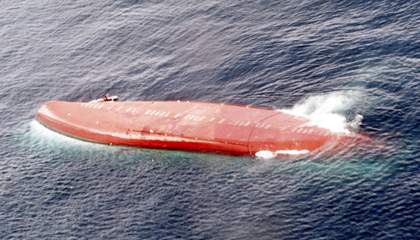
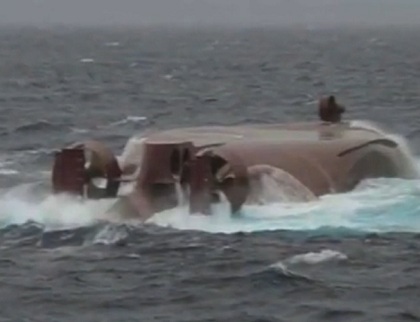
 the hull was undamaged all the times (all
watertight doors were closed and the hull was
intact and, indirectly the Commission confirmed, that the
Principles of Archimedes applied at all times), and
that
the hull was undamaged all the times (all
watertight doors were closed and the hull was
intact and, indirectly the Commission confirmed, that the
Principles of Archimedes applied at all times), and
that
 the 'Estonia' floats on the
watertight
hull,
which is subdivided into 14 watertight compartments
by watertight, transverse bulkheads fitted with
(too many) watertight doors. The hull, 7.56 meters
deep, is shown in green in the figure right where
the double bottom of the hull is shown blue. The
main engine room compartment in the hull is purple.
The top of the
hull
is the watertight car deck
no. 2
(red
in the figure),
which is >2,15 meters above the
waterline,
the 'Estonia' floats on the
watertight
hull,
which is subdivided into 14 watertight compartments
by watertight, transverse bulkheads fitted with
(too many) watertight doors. The hull, 7.56 meters
deep, is shown in green in the figure right where
the double bottom of the hull is shown blue. The
main engine room compartment in the hull is purple.
The top of the
hull
is the watertight car deck
no. 2
(red
in the figure),
which is >2,15 meters above the
waterline,