|
|
|
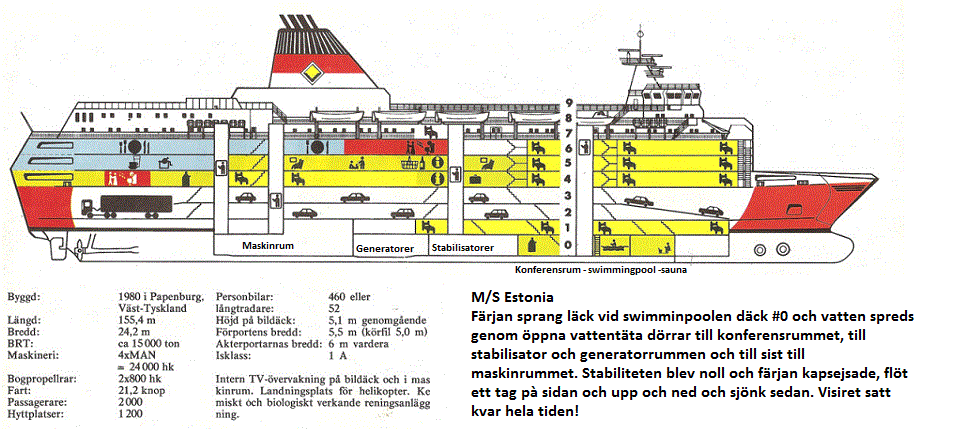
The sinking of M/S Estonia 1994 was a very serious casualty, i.e. total loss of the ship and loss of plenty life. Such casualties shall be properly investigated as per agreed procedures, i.e. IMO resolutions A.637(16) and A.849 (20). Res. A.637(16) was replaced in November 1997 by Res. A.849 (20) which in principle says exactly the same thing in a Code of marine accident investigations. Sweden, Finland and Estonia have adopted the resolutions as national laws but do not follow them. When there is an incident at sea, it must be verified that, apart from the structure itself and the crew aboard, the vessel's operational equipment incl. life saving appliances, fire fighting, bilge pumps, watertight doors/divisions in hull and weather tight doors in superstructure, cargo gear, propulsion machinery, etc, were in good condition and that the officers and ratings were highly motivated, experienced, loyal and well-trained seafarers, i.e. that the ship was seaworthy and insurable. A root cause analysis, a time line and full investigation shall then look at all aspects of the situation, including the vessel's routing, loading, equipment and fitness for purpose in extreme weather, security and safety ashore and aboard to ensure no such loss occurs again. Survivors from the ship and owners technical staff must be interviewed. In the M/S Estonia case 1994 no such verifications, time line, analysis interviews were ever done. Same day it was just announced that the ship was in perfect condition and that the visor fell off due to wave impacts, which nobody noticed. It was the beginning of the biggest fraud in maritime history. A conspiracy! It is still run by a lady! Mrs Ann-Louise Eksborg, former director general of the Swedish Accident Investigation Agency (and other government agencies) that 1997 wrote the final investigation report herself! She is now formally retired but still active in the criminal cover-up. Let's face it - everything, 100% that the Estonian, Finnish and Swedish governments and their Joint Accident Investigation Commission, JAIC, experts have stated about the incident since 1994 is false except that the ship sank. The rest they just invented. They falsified everything to hide the TRUTH! The ship sank due to sabotage/hull leakages by terrorists with the visor attached! But the Estonian, Finnish and Swedish governments and their agents said that the visor was knocked off by one or more big wave impacts and lost and ... that the ship then sank due to losing the visor, even if ships do not even float on visors, as suggested by the lying Estonian, Finnish and Swedish governments and their criminal and corrupt experts. Many people including survivors and relatives of missing people have great difficulties to accept that the Estonian, Finnish and Swedish governments and their agents lie like that and I can understand that. I myself believed that atomic bombs exploded 1945 and that Americans landed on the Moon 1969. Today I understand that I was fooled by ten US presidents and their fake news. News 2019/21 was that a Norwegian journalist has found structural damages, cracks in the hull of the ferry that it was expected to float on! Officially the hull is intact! Question now is if the Estonian, Finnish and Swedish governments and their agents shall investigate it. They have started by looking at the hull ... but it is now covered by mud and cannot be filmed!! Personally I have concluded that the ship was sunk by sabotage using explosives, i.e. hull leakages from inside/out at deck #0 caused by bombs. The shipowner transported stolen ex Sovjet military equipment using the ferry and other Estonian extremists wanted a share of the profit ... and they didn't agree. The tragedy is a 100% Estonian affair that could have been avoided by paying a small ransom to the terrorists! An answer was expected 2021/2/3 or never ... . Probably never! Estonia has a problem with its history after 1917 and 1991 that is better forgotten. It is fairly easy to inspect the hull of a wreck at 70 meters depth. Underwater surveys of floating, upright ships (UWILDs to avoid dry docking) and offshore installations are routine since many years. I have done many. The only difference is the depth and that the wreck may be upside down at an angle at the bottom of the sea. In this case the complete hull is easily accessible! There is no current and visibility is good. The wreck has in fact already been filmed several times and damages found at deck#0 level starboard side at sauna forward and at the engine room aft, i.e. two locations! Sabotage! These films/damages have been censored by the JAIC at the 1994 divings! In either case the divers inspect all the sections of the hull structure for external damage by grounding, ice damage, collisions, cracks, etc. In the Estonia case the objective is to find hull damages due to explosives (inside/out) or collision from outside/in. The deck house does not need inspection. The hull sections must be marked for easy identification by buoys and lines that will also be used by the diver moving up/down. Video and photos are important in underwater inspections using a portable underwater camera with lights or an ROV. The recording and communication equipment is on the dive boat with the dive leader directing the divers, ROVs and the inspection. Cleaning and close-ups are made when details need to be visible. Damages are described, measured and reported. But what happened? 9 July 2021 Swedish and Estonian government "experts" started to investigate! A little later they found the ramp (!) of the superstructure open. 22 July 2021 new pictures were taken! More pictures were taken 2022! But not published! And that was all! No questions about sabotage and structural damages starboard side deck #0 to the hull sinking the ship 1994! 5 February 2021 New investigation of the Estonia sinking "Prime Minister Kaja Kallas (Reform) expressed doubts as to whether it is possible to find out exactly what happened through investigation. ... I always recommend also talking with the surviving Estonian engine crew members and the body guards of the Estonia President that survived! Some later comments in Swedish Old news from NZ https://www.odt.co.nz/lifestyle/magazine/drowning-lies 27 December 2020 - New report about the Estonia's visor Earlier ... 11 October 2020. Why M/S Estonia sank 26 years ago is hotly discussed in Estonia proper today. Did the ship carry nuclear material for weapons of mass destruction!? Or military equipment? Or was it sunk due to a collision with a submarine!! I don't believe in rumors! Why? Nuclear weapons are just propaganda and submarines do not collide. I still believe in simple sabotage. The ship was slow speeding at 14 knots at less than half power. The ship could do >20 knots at full power! The weather was not bad. No wave impacts at the bow could occur in those circumstances! Then two bombs on deck #0 exploded aboard at 00.40 hrs and the ship sank like a stone in less than an hour! Forward water was seen on deck #1 above the sauna and aft water was seen in the engine rooms on deck #0 The Estonian, Finnish and Swedish governments (!) same day decided to hide the true cause and to invent a false one - the visor had been knocked off by one enormous wave impact! Why? Media cannot report it, so read my articles about it. A joint international accident commission, JAIC, falsified EVERYTHING about the incident 1994/7! Testimonies, scientific reports, certificates, etc. EVERYTHING was falsified to suit the story of the lost visor! The visor was removed from the wreck at the bottom of the sea. I was fooled 1994 but not 2023. The final investigation report was written by Ms Ann-Louise Eksborg and just signed by the co-conspirators. 10 October 2020 - Leakage in starboard side People wonder how much water will leak into a damaged hull. It is pure physics. The static pressure p (Pa) of water below surface depends on the depth h (m), density d (kg/m3) and gravity (m/s²). Thus p = g*d*h. If there is an opening a (m²) below water (into a ship) water will pass through it at a certain velocity v (m/s). The static energy (due to pressure) becomes velocity v and kinetic energy. Actually v²=2*g*h. Thus, if the leakage is 4 m below water with an area 1 m² and gravity g = 10 m/s², you will find that v = 8 m/s. Thus, through a 1 m² leakage 4 m below water >8 m3/s pass! Or >480 tons/minute. Such a leakage of M/S Estonia has never been investigated! It was observed by survivors from deck #1 fwd seeing water splashing out from the air pipes of the tank below and by crew members on deck #0 aft.
|
||||||||||
What really caused the sinking of M/S
Estonia 1994 29 years ago? It seems underwater hull
leakage and flooding of the hull starting at
around 00.40 hrs caused free water on deck #0
(tank top) that caused loss of stability and heeling around
01.02 hrs and sinking 01.35 hrs on the stern,
but what caused the hull damage/leakage?
Forget the visor that never fell off. Sabotage,
explosion or a collision with,
e.g., a submarine? Only a new, correct investigation can
answer that important question. Some passengers noticed a
strange explosion and water on deck #1 fwd long
before the loss of stability. Engine crew started bilge
pumps to empty deck #0 (tank top of the engine room)
aft to save the ship. The watertight doors were open
everywhere. What about the Estonian crew on the
bridge and in the engine room? All crew on the bridge died.
But all crew in the engine room (!) survived. They started
bilge pumps because the engine room aft was filling up!! Is
this due to the bow visor falling off fwd? Of course
not. 30
June 2020 two
Swedes were arrested for crimes against the Swedish Estonia
law by prosecutor Helene Gestrin at Riksenheten mot
internationell och organiserad brottslighet in Sweden. They
are suspected of illegal underwater work at the M/S Estonia
wreck. Helene Gestrin is
available for comments on telefon +46 10-562 58 06 and at
helene.gestrin@aklagare.se
. According Finnish media -
HBL
- a German ship visited the location of the M/S
Estonia wreck end September 2019. It was
suggested that the wreck was surveyed. It rests at
80 meters depth and is thus easy to dive to and to
film. Maybe the inspection will produce new
information about the cause of the sinking.
The Estonian
authorities say they
will not investigate any such new information, even
if, by law, they have to! They say that the
superstructure bow visor fell off,
ripped open a superstructure bow ramp
and that the superstructure (deck #2
above waterline) was then flooded sinking the ship.
The hull below deck #2 was intact. No
sabotage! So why does the Estonian
authorities
participate in a cover up? It is
criminal! The ship had after departure contacted
its head office at Tallinn that in turn contacted the
Estonian Ministry of the Interior (Mr. Heiki Arike)
that in turn contacted the Estonian Security Police (Mr.
Mart Laan) that used an airplane that started from
Tallinn in the evening to observe the ship from the air. The
airplane was seen by survivors on the ship
after the capsize and before
the sinking. The lifeboats had been made ready for
launching and no. 1 lifeboat was launched and seen by
survivors in the water. Many of the M/S Estonia crew knew
what was going on, which explains why the complete engine
crew survived. Many other crew members were kidnapped
afterwards. The engine crew had time to dress warm and
collect personal belongings incl. mobile phones and to enter
life rafts on the ship's side before sinking.
The leakages were caused by explosions aboard. Somebody
wanted to stop the ship unless getting paid! Mr Arike died 2018 at the age of
63 and cannot comment. The Estonia was sailing from Tallinn to Stockholm
when it was sunk in bad weather in the Baltic Sea off
Finland in September 1994, killing 852 of the 989
passengers and crew on board. An international probe concluded in 1997 that the
disaster was caused by a little problem with the
bow-door/visor locking system. The bow visor just dropped
off, nobody observed it and the ship sank like a
stone. Survivors and relatives were swiftly compensated
for material damages from the now-bankrupt Estonian ship
owner Estline. But more than 1 000 survivors and relatives of the
deceased battled for two decades for a court in Nanterre
outside Paris to hear the case against the French company
which certified the vessel and the German firm which
built it. The 1 116 plaintiffs are seeking more than 40
million euros ($45 million) in damages from French
certification agency Bureau Veritas
and German shipbuilder Meyer
Werft. The trial finally opened in April and one of the
lawyers for the plaintiffs, Francois Lombrez, said the
Estonia had been inspected 53 times by Bureau
Veritas. "This ship was not fit" to sail but
"no-one did their job", he alleged
on the last day of the trial. However the lawyers of Bureau Veritas denied in the
trial that the agency had committed any fault. Meyer
Werft has said the construction of the ship was in line
with regulations but it had not been maintained. Swedish authorities have always opposed the ship
being refloated for further investigation, prompting
unsubstantiated conspiracy theories and claims of a
cover-up. Some experts, politicians and relatives in Estonia
and Sweden have claimed that the sinking could have been
caused by an explosion from a secret
cargo of military equipment. An admission by Sweden that Russian military
equipment had been transported on board the ferry on at
least two occasions in 1994 gave some credence to the
theory. But Estonian investigators have dismissed this
explanation and authorities in Tallinn and Stockholm have
always rejected calls to reopen the case. The shipwreck of the Estonia is regarded as the
deadliest peacetime maritime disaster in European
waters. I was not asked to tell the court
anything. My information was just handed in for the court to
review. It is on the Internet since 1998. Nobody
gives a damn about
it. The official, proximate causes of the
incident were incompetent crew/Master, heavy weather and bad
design of the bow visor. Of course there can only be
one proximate cause of anything but in Sweden rules
are different. Neither the weather nor the design was bad.
And the crew/Master? I have met the Master's mother and wife
and both told me he was a good seaman. He and most of his
crew died. In my opinion the proximate cause of sinking was
hull leakage below waterline. Due to ...
sabotage! So it is good that the survivors and
relatives of victims will finally have their day in court at
Nanterre. In Sweden or Estonia it is not possible at all.
The responsible parties for the incident are of course the
Estonian/Swedish shipowners, the Swedish and Estonian
governments and their maritime authorities, the hull and
P&I underwriters that all conspired, together, to cover
up a crime by inventing the story of the lost bow visor.
Enjoy my website - links left - especially those about the
falsified model tests done 2005/8 to explain the sinking.
Re-do the model tests 2019 you will find that the
ship cannot sink as suggested. And here!
Or here!
I really hope the French court will open this box of rotten
shit! I have tried to find out what happened on 15 April at
Nanterre. Sorry, no result! Why - the roof of Notre-Dame de
Paris cathedral was suddenly on fire and my communications
were cut. 16 April 2019 was the 5th
anniversery of the MV
Sewol ferry incident in South
Korea. The Korean flag ferry carried 423 persons of
which 304 died. The cause of the incident is still
not established. The 19 years old, Japan built ferry (for
coastal trade), just suddenly sank ... when changing course
... and starting to heel. Of course plenty survivors and
relatives of victims demand a proper investigation but ...
safety at sea is not important in Korea. Like in Sweden,
Finland and Estonia! 12 April 2019 the French legal
court, Tribunale de Grande Instance, at Nanterre, was
finally hearing the case against the French classification
society Bureau Veritas and the German shipyard
Meyer Werft/Papenburg, to establish who is
responsible for the sinking 20 September 1994 of
ropax ferry M/S Estonia, built and classed by the
defendants 1980. That the ferry was not seaworthy
1994 and incorrectly built before that is easy to
show. The shipbuilder Meyer has shown it in its
own investigation of the
incident. It just built the ship as per contract with the
ship owner - for coastal trade between
Finland/Sweden. Just study my web site.
28 September 2018 24 years ago
M/S Estonia was sunk in the Baltic (added 22
September 2018) killing almost 1 000
people aboard.
But the complete
engine crew survived! Except
chief engineer Leiger and 4th engineer Targama
that were later declared
missing! It seems
surviving
passengers noticed that the
ship lost stability already 01.02 hrs ET and escaped
to open decks, where the ship soon had 90° list. It was
temporarily floating on the side. So what happened before
that? Watch keeping 3rd engineer Treu
probably noticed a big bang followed by sea water in the
engine rooms (decks #0 and 1) before 00.45 hrs ET -
the ship's hull was leaking - and
alerted motor men Sillaste and Kadak to start
bilge pumps. They soon realized it was not possible, they
alerted the bridge (!) and then all three went to their
cabins on decks #7 and 8, put on warm clothing, alerted the
remaining engine crew and all escaped - before the
ship lost stability 01.02 hrs - to open decks,
where they later were seen by some passengers. The ship then
sank around 01.34 hrs ET, when all persons on open
decks fell into the water apart from few persons inside some
rafts on the side. The complete engine
crew was then rescued by helicopters. Ashore the engine crew
was ordered not to talk to media about the hull leakage and
water in the engine room. 24 hrs later Treu,
Sillaste and Kadak told media a fantastic
story about water leaking in on the main/car deck #2 high
above waterline at a closed bow ramp around 01.15
hrs ET with Treu staying down in the engine
control room 10 minutes, etc. Swedish prime minister
Bildt had a little earlier told media about a bow
visor (!) falling off causing the incident. The sea
water in the engine rooms 30+ minutes earlier was
forgotten! The biggest hoax in recent maritime history then
started to hide the simple fact that
the ship was leaking (due to sabotage or bad
maintenance). 16 February 2017 twenty persons
downloaded https://heiwaco.tripod.com/epunkt116.htm
, i.e. chapter 1.16 of my book Disaster Investigation
about the Swedish official dive survey of M/S
Estonia. It is a very interesting chapter. The
hull of the wreck wreck was never properly checked by
ROV
1994! Using such equipment it is very easy to find the
structural damages of the hull in the starboard side that
sank the ship. Of course ROVs were used 1994 but any
structural damages recorded were easily edited away by the
Swedish/Finnish accident investigators as part of their
criminal cover-up. 28 September 2016 22 years ago
M/S Estonia sank in the Baltic. The Swedish
association SEA
has sent a letter
to the Estonian prime minister Taavi Rõivas to study
new facts about the incident. As usual SEA does not
mention any information of Heiwa Co. The letter was
also handed over to the Estonia embassy at Stockholm 14
October, 2016. Three months later there is no reply!
M/S
ESTONIA
- Svenska statens
haveri förklarar mycket om
Estoniaolyckan 1994 och varför och hur svenska staten
beslöt att mörklägga hela historien.
Anledningen är att i Sverige skyddar samhället och
media inte medborgarna utan makthavarna och makthavarna kan
hitta på vad som helst för att skydda sig
själva. M/S Estoniafärjan var aldrig
sjövärdigt, pga inkompetens och korruption hos
svenska Sjöfartsinspektionen. Media and not very bright readers of my
web pages are warned. My web pages about false, invented atomic
bombs 1945 that never exploded anywhere,
human
space trips 1969 that never took place
except at Hollywood, M/S Estonia
ferry incident 1994 that a corrupt Swedish
prime minister blamed on heavy weather and
911 tower
top down terrorist collapses 2001
that some clowns at Washington DC blamed on Arabs,
are popular but never quoted by Main Stream Media.
It and you probably suffer from cognitive
dissonance and cannot handle my
information without getting mentally disturbed with
serious consequences. My proven and established facts
are simple, correct, good news and no conspiracy
theories. A-bombs do not work. They were Fake
News!. Humans cannot travel to the Moon.
M/S Estonia didn't lose her bow visor
(as explained below). Skyscrapers do not collapse
from top down due to Arabs landing in them. All
information to the contrary is pseudoscience,
propaganda lies or fantasies promoted by
media and today taught at
universities. And if you do not agree with
the official lies, you will not be allowed at the
university boat race* and other silly events, etc.
Your position in society is at risk. If you suffer from cognitive
dissonance, you no doubt find my info
here disturbing and you get upset, angry, anxious
or worried. What to believe and write? Old lies or
truth? Media incl. newspaper chief editors are
kindly requested to get psychological assistance to
get rid of their cognitive
dissonance. Why not cure
yourself? And publish the result as a scoop. *Safety at sea is my
business Bow
visors high above water do not fall off ferries
without being noticed. The waves hitting against
the bow visor in severe weather is normally just
pushed aside by the flare of the visor. If the
waves are big and the angle small and there are
impacts, they produce high noise, sudden pressures
and deformations that vibrate the structure that
are heard and felt - and you slow down. Therefore
it was impossible that the bow visor just fell off
the M/S Estonia September 1994! However,
criminal politicians and corrupt government civil
servants invented the opposite Fake News - that the
bow visor just fell off the ship and, assisted by
media, they created the illusion that it was and is
the Truth ... while it is a silly Lie. It works
because in many countries you cannot query the
stupidities of the governments. You are threatened
into Silence. All
persons, Swedish, Finnish, Estonian and others,
male and female, associated with this bow
visor hoax since 1994 are in my opinion
criminals guilty of complicity in
fraud. Fraud is deliberate deception to
secure unfair or unlawful gain and
complicity is the participation in a
completed criminal act of an accomplice, a
partner in the crime, who aids or encourages
other perpetrators of that crime, and who
shares with them an intent to act to complete the
crime. To
confuse people with fake information about bow
visors is a crime. It also reduces safety at
sea. August
1945 media published
information to the effect that two small cities in Japan had
been destroyed by atomic bombs killing 100 000's of
Japanese. The result was that Japan could surrender and that
WW2 could be ended without any loss of face. But no
atomic bombs exploded anywhere. April
1961 media published
information to the effect that a Soviet cosmonaut had
orbited Earth in outer space and that the Soviet Union had
won the space race against the USA. But no cosmonauts were
ever in space. September 1994 media published
information to the effect that an Estonian ferry, M/S
Estonia, had sunk in the Baltic killing
~1.000
persons due to the bow visor having fallen off. But
no bow visor fell off anywhere. September
2001 media published
information to the effect that some Arabs had crashed
airplanes into the World Trade Centre at New York City
destroying it and killing 1000's of persons. The result was
that USA could start and lose a war against terror killing
people anywhere that still goes on 2018. Artificial intelligence (AI) is a
new discipline developed by humans to ensure that human fake
information can be established as historic facts without
further discussions and taught as such at schools and
universities. My website is an attempt to show that
Artificial intelligence (AI) is nonsense. At least 10
Estonian crew members
survived ...
but never returned home! German journalist Jutta
Rabe and her divers found a
big hole in the superstructure behind the bow visor.
The origin of this hole was the Swedish Navy using
explosives to remove the visor from the ship ... a week
after the sinking! It was a pity Jutta's divers
didn't find the hole in the side further aft and lower down
in the hull that sank the ship.
According to Mr. Bertil
Calamnius in his book Vad
hände med MS ESTONIA? (ISBN 978-91-87391-53-8)
- What happened to MS Estonia? - issued 2014 the
owners of the ship knew about the
sabotage (p.63).A court
outside Paris ruled Friday on whether Bureau
Veritas, a French certification agency and a
German shipyard should pay compensation to survivors and
relatives of the victims in the 1994
sinking of the Estonia, the deadliest accident involving
a European ship since the Titanic. The ruling was that
neither Bureau Veritas nor the shipyard was to blame. Not
even the ship owner was to blame.
Natural intelligence displayed
by humans is very easy to manipulate by fake
information of all sorts. Fake information always
starts as fake news published by media. At my website
here I present several examples of fake
information:
So what do you think about the
following;
The weather was not too bad 28 September 1994 in the Baltic
|
https://www.youtube.com/watch?v=qhowN4_Z_1c&NR=1
M/S Sewol salvage March 2017
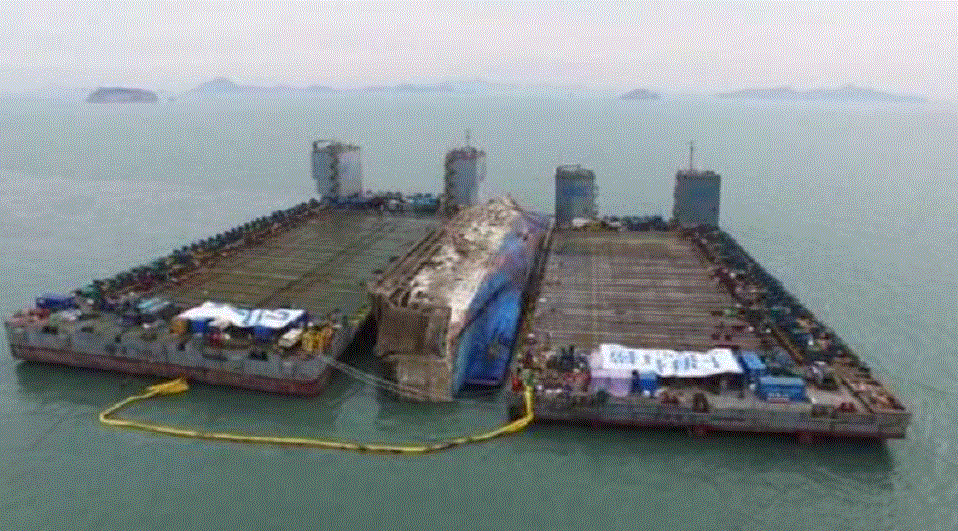
The Korean ferry M/S Sewol was salvaged March 2017 at 45 m depth using two barges. She was 10 m shorter and 2 m less wide than M/S Estonia. Tunnels were dug below the wreck and steel wires were introduced there and then connected to the barges. How did the Estonia heel at the accident 1994?
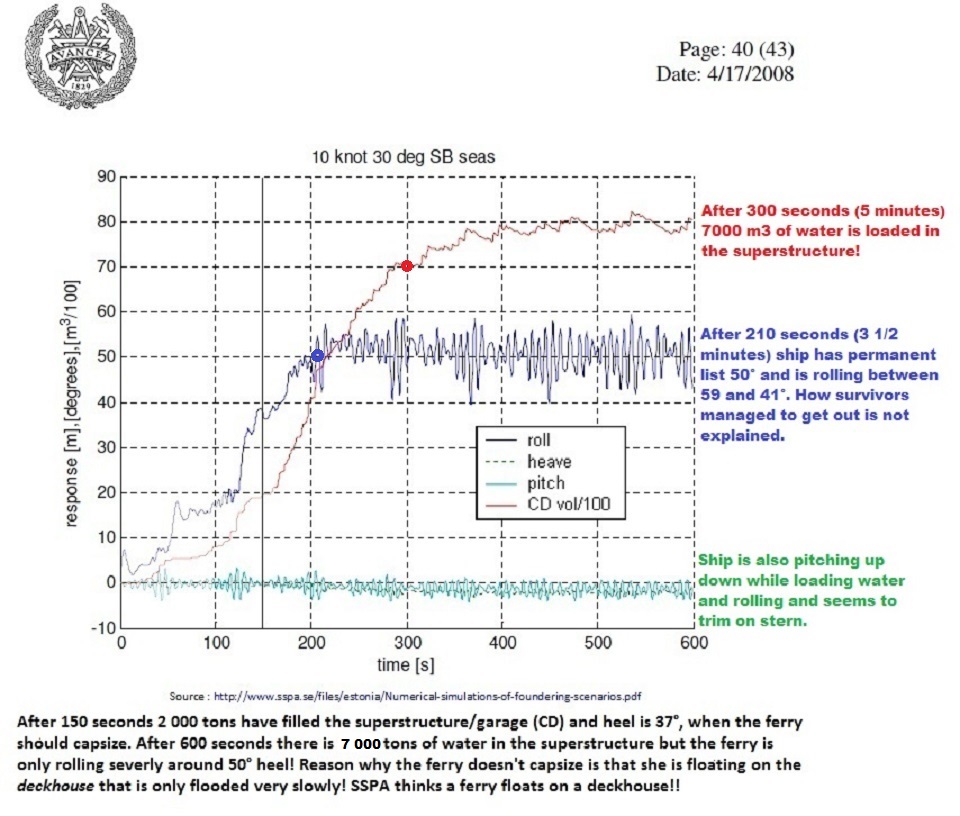 2005/8 Swedish tax payers paid SEK million for research to explain the M/S Estonia sinking 1994 but the result was not put on the Internet. You have to read about it here.
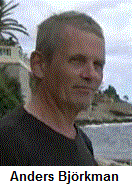
The Swedish State Commission of Fantasies, SCF, 21 years On 28 September 2016, it will be 22 years since the M/S Estonia sank in the Baltic Sea 1994 and the Prime Minister Carl Bildt ordered SCF to show that the visor had fallen off and caused the accident. Bildt knew that the M/S Estonia transported military contraband and that certain parties did not like it. The SCF Director General Olof Forssberg was eager to help Bildt and SCF shipbuilding technical expert, my old friend, navy commander Börje Stenström invented the following fantasies: The visor was wrongly constructed since 1980, when the ferry was built, it was full hurricane during the night of the accident, the ferry was travelling at too high speed due to an incompetent commander and huge waves struck off the visor 01.15 hrs without a single person aboard noticing it, the visor then pulled open the ramp, so that hundreds of tons of water could silently flood into the superstructure, when the ferry's bow dipped under water every ten seconds, the ferry heeled more than 30° after a few minutes and turned 180° south and east, when the engines stopped, Estonia then capsized but floated upside down and drifted eastward at high speed, but suddenly sank completely at 1.53 hrs a mile east of where the visor had fallen off at 01.15 hrs, several hundred people managed to get out to the open decks during 10 minutes, but only 137 survived, because they did not understand that they must swim and crawl up into the life rafts thrown into the water, the ferry was fully seaworthy on departure despite there were 22 open, watertight doors in the hull, which was not allowed, etc, etc, The German shipyard that built the ferry for protected coastal Finland/Sweden trade suggested that the ferry was perhaps not well maintained after the first owner went bankrupt about 1989, people who suggested that the ferry might have sank due to leakage below the waterline, which should be investigated, were declared to be idiots by SCF (media happily transmitted that message) and were blamed in the media to be unintelligent, unscientific and unreasonable conspiracy theorists, whose sole purpose was to topple the government, the visor was found after a while almost one mile west of the wreck, it was said, and it was salvaged by the Swedish Navy, which however could not tell where it took place, after almost three years of accident investigation Börje Stenström died suddenly of cancer, it was sadly said, and Director General Olof Forssberg took the opportunity to announce that he forgot to register a letter, what a serious error!, so he was unable to complete the fantasy investigations and a new female fat DG had to do it, who then published a final report in December 1997 that no one was basically happy with, for example, the sinking was not explained, i.e. how and why the ferry sank after floating upside down, etc., etc., which led to numerous parliamentary debates with Mona Sahlin until the government decided in 2005 that it, i.e. the sinking process, would scientifically be clarified by independent but very well-paid experts from Sweden, Scotland, Germany and Holland, which was completed in 2008, the explanation was that the M/S Estonia floated upside down due to the trapped air in the hull but the air was compressed, etc., for 30 minutes, which had never happened sooner or later, so the ferry sank. The experts declared this while licking the Bildt ass. As if it was something? No. Most Swedes just do as they are told from above. Easiest way! You can read more about all those strange fantasies in the links at the bottom of this web page. There I am not satirical! Anders Björkman - September 2015
The M/S Estonia 1994 sinking killing >850 persons was still not explained September 2014! So far only pseudo scientific info has been presented (5 December 2014 and up-dated later) More than 20 years have passed since M/S Estonia sank due to hull leakage below waterline 28 September 1994 probably due to sabotage. The ship carried military cargo protected by Swedish police and military aboard. The ship was not seaworthy at departure due to lack of correct lifesaving equipment and watertight hull subdivision. A false cause of incident was invented; a weak bow visor that dropped off. The cover-up of the incident is a success 2015. You have to admit that the Swedish cover-up of the crime of evil people works fine. On 20 September 2014 various memorial events took place to honour the dead. Mainstream media reported these events. Media also repeated the old, official explanations/lies what happened 20 years ago. The visor fell off and water was loaded in the superstructure. However it was not explained then how the ship sank, i.e. lost its buoyancy produced by the hull. And they didn't report what could have had happened - my proposal #1 or proposal #2 (formulated already 2001!) Media thought 2014 that the incident was fully explained 1997 and was completely resolved and that any publicity about other theories is an insult to governments and authorities. I just want to be helpful. It is not popular. Media forget that the sinking was supposedly scientifically explained 2008 at high costs by five scientific institutions: SSPA & Chalmers University of Gothenburg, Sweden, Safety at Sea, Ltd and University of Strathclyde, Glasgow, Scotland and MARIN, Delft, Netherlands. Media forgot 2014 to mention that a very strange sinking was presented 2008 using pseudoscientific methods. Which means that the sinking is still not explained 2015! All links to the scientific reports by SSPA & Chalmers University of Gothenburg, Sweden, and Safety at Sea, Ltd , Scotland, paid for by Swedish taxpayers, stopped working many years ago and do not work anymore (September 2014). You should wonder why. Luckily the SSPA Final report is available. The objective of the scientific project was as per Swedish government clear instructions 2005 to scientifically explain the sinking, i.e. loss of buoyancy of the ferry based on the alleged factual findings of the JAIC investigation 1994-1997, i.e. first i) the visor fell off at 01.15 hrs and pulled open the ramp protecting the superstructure and ii) water was loaded in the superstructure 2.5 meter above waterline in severe weather, so that iii) the ferry heeled/capsized/floated/drifted upside down for a certain time and iv) after having turned 180° upside down and drifted more than a mile at high speed the vessel v) sank/lost buoyancy/disappeared around 01.50 hrs. No buoyancy was lost until after the capsize, so the objective of the whole project was to establish why the floating, capsized ship with intact hull lost buoyancy and sank. 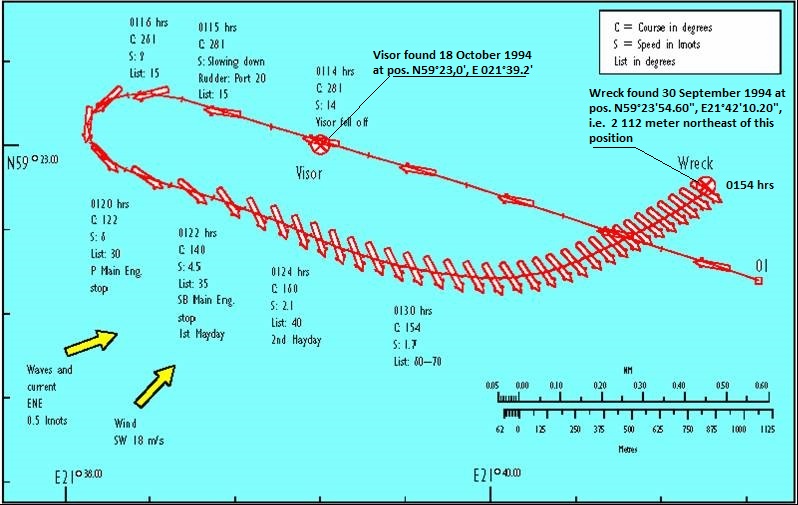 JAIC, the official accident investigation commission had 1994-1997 forgotten to explain the sinking of the ferry, i.e. how water loaded in the superstructure caused sinking i.e. loss of buoyancy of the hull while drifting. The scientists reported their findings 2008. Swedish SSPA studies of records and scientific model tests showed that >2 000 tons/min water was loaded into the superstructure starting at 01.02 hrs (not 01.14 hrs as per JAIC picture above) and that the ferry was heeling >40° after two minutes at 01.04 hrs (and not only 15°) and then stopped heeling. These events were evidently not according to the JAIC 1994-1997 findings, where sudden heeling started at 01.15 hrs but stopped at <15°, so that, say 400+ persons aboard could evacuate to open decks during 10 minutes. All 130+ survivors reported that the ship never remained at heel >40° after the first heeling/severe rolling but up righted and was not heeling so much so they could escape. You wonder why the scientists decided otherwise. The ferry was floating on the deck house! The Swedish scientists, generously paid to be politically correct and to maintain social order in their country, whose government used M/S Estonia to carry and smuggle military equipment, suggested 2008 that the vessel, still floating on the intact hull with heel >40°, then, after turning port 180°, didn't immediately capsize and float upside down. Reason was the buoyancy of an intact deck house above the superstructure! JAIC suggested 1994-1997 that the deck house (green in picture below) was flooded immediately, when it was submerged, as all deck house windows were broken at once. The Swedish scientists, to be politically correct, to lie and to maintain social order in their country, suggested 2008 that only a few windows were broken and that the ferry floated on the windows not broken, i.e. no water entered the deck house (red in picture below): 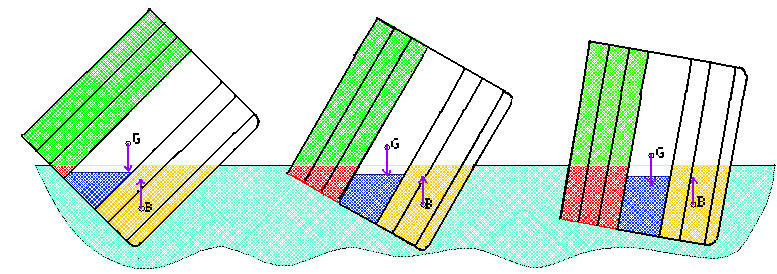 The Swedish scientists at SSPA/Chalmers thus suggested 2008, without any evidence, that the almost intact deck house (built of 4 mm steel plates with 100's of windows) prevented capsize, i.e. turning and floating upside down, for 20 minutes. Like this:
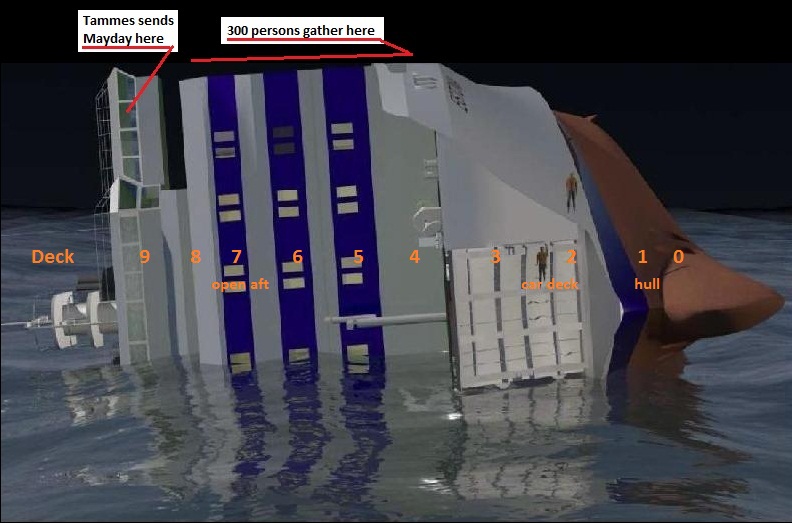
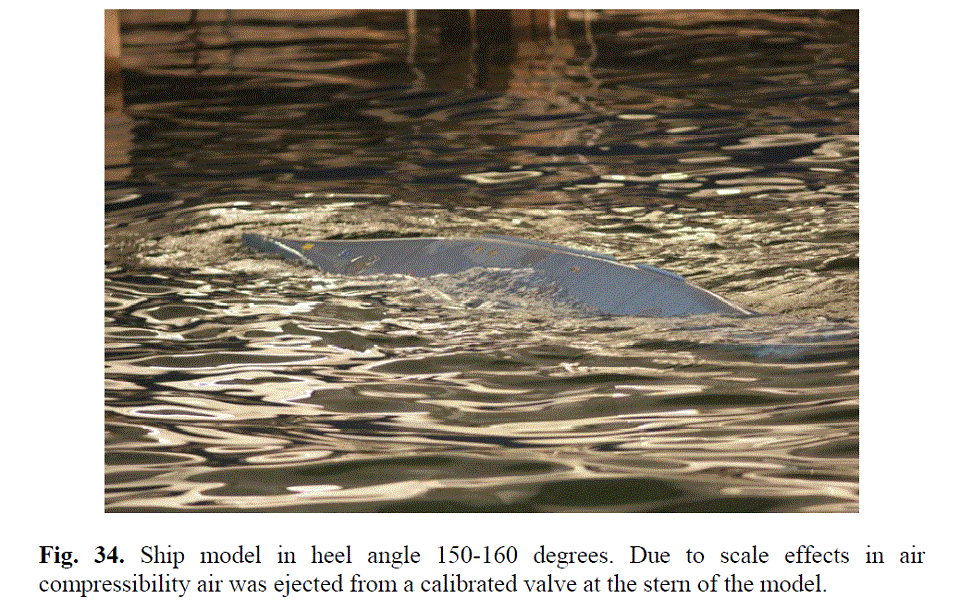
No ship can float like
this! According Strathclyde
University it can in faked, criminal animations! Antti Arak
and Ain-Alar Juhanson are the two persons on the bow of M/S
Estonia. They
say (actually
lie!) that they walked on the horizontal side of the ship to
the bow and climbed down on a closed ramp, the ship was
rolling in full storm, when the list was 90° at around
01.30 hrs ... and that the visor was missing! This magic event was confirmed by model tests of the Dutch MARIN company; it took twenty minutes (!) to fill up the deck house if only a few windows were broken, according Dutch scientists. But there was no evidence that only a few thin window panes broke. The scientists just invented it. Nobody bothered to explain how the 137 survivors managed to get out of the ship at >40° heel. However, when the deck house was finally full of water at 01.30 hrs, the ship, still floating on its intact hull, capsized and floated upside down according Archimedes and Swedish model tests and Scottish calculations. How the then upside down floating ship later sank is not explained.
All persons - probably >250 - on open decks or on the side of the ferry jumped into the cold water and swam to rafts that had been dropped into the sea - an illegal procedure. Most drowned. Some survivors were sitting on the bottom of the upside down floating ship until they were swept away. And then the floating ferry drifted upside down a mile at 2.2 knots speed and suddenly sank at 01.50 hrs stern first according JAIC. How the buoyancy was lost! The Swedish and Scottish scientists explained 2008 the reason for sinking being that buoyancy (compressed air inside the capsized, intact hull floating upside down) starting at 01.30 hrs disappeared (!) during 20 minutes; buoyancy air inside the hull disappeared by compression of the air starting at the stern. Archimedes principle didn't work! Chalmers University has decided to verify this mystery 2014! It could not happen in model scale and model tests or in reality, so in scientific model tests the air escaped through two valves in the bottom of the model. The Scottish scientists (actually an Austrian underpaid student) made full scale computer animations of the loading of water into the superstructure, the heeling to 40°, the floating on the deck house, the capsize upside down, the drifting and sinking that confirmed or copied the Swedish/Dutch model tests; vessel heeled >40° in two minutes, it took then 20 minutes to flood the deck house, then capsize upside down followed and another 20 minutes was required to slowly sink stern first due to buoyancy being lost due to air slowly (!) being compressed in the intact hull starting aft. By manipulating the software and the input a fantastic animation was produced Hollywood style. Imagine that air is slowly compressed by water, when a ship floats upside down! It is really magic. And it started at the stern! It was the first and only time in history such sinking of a ship with intact hull happened. Nobody managed to explain 2008 how a capsized, sinking vessel could drift at 2.2 knots upside down. If you asked that question, you were immediately attacked and asked to shut up and not to disturb the social order protecting corrupt, lying government officials and well paid scientists. There is evidently no evidence anywhere that the alleged scientific findings 2008 of the Swedish, Dutch and Scottish scientists are correct but nobody, except Heiwa Co, seems to care 2014. The findings were just politically correct (i.e. lies or fraud to maintain social order) generously paid for by the Swedish government and its Ministry of Defence and that's what counts in Sweden 1994-2014. When Heiwa Co published evidence (see below links) and suggested scientific fraud by Strathclyde and Chalmers universities, the Scots threatened to sue Heiwa Co. They never did it in the end, because they would have lost. But it seems they got away with the fraud assisted by media and authorities. Question is only for how long. Hopefully they will be put in jail 2016.
Why you slow down in severe weather M/S Estonia was 28 September 1994 allegedly sailing at much too great speed in very severe weather in the Baltic ... and nobody noticed it aboard in bars, restaurants, casino and in the wheelhouse. Few were seasick - the ship just rolled and pitched normally. The visor at the front of the superstructure was suddenly ripped off by big wave impacts ... and nobody heard anything. The ramp protecting the opening into the superstructure was also ripped open by big wave forces ... nobody heard anything. And 200 tons of water was loaded 10 times into the superstructure ... and nobody heard or saw anything even if the light was on in the superstructure ... . Prime minister Carl Bildt made up this fairy tale the same day ... and there we are today 2014. To be politically correct you MUST believe it! If not ...
The prorector of Chalmers Tekniska Högskola, CTH, Mats Viberg and others have appointed Karin Andersson as new prefect of the CTH department of Shipping and marine technology until 2014-12-31 and Mats has asked Karin to check about the alleged scientific fakery done there 2006-2009 by professor Olle Rutgersson and dr. Claes Källström, SSPA Marin AB (a fully owned company of CTH). The result of the review of the alleged fakery by Karin Anderssin will be published here. It is a simple question: Can an upside down floating ship after capsize, which floats on trapped air inside the intact hull and other bouyant material, sink during 18 minutes as described by Chalmer's and Strathclyde's universities 2008. The answer came 2014. Yes it can! The principle of Archimedes does not apply in Sweden! More in Swedish here.
The RMS Titanic 1912 sinking explained 2013 No iceberg. Just the usual MV Estonia style collusion! Happens at sea all the time. The MV Estonia sinking is still not explained 2013!
Progressive global collapse mitigation of any structure December 2012 I was invited to an August 2013 conference at Evanston, USA, to discuss structures (not Estonia) and present a paper. A week prior the opening the invitation was withdrawn! It feels like Estonia. When they do not like the music, they shoot the pianist. M/S Estonia - Unglücksfahrt stand unter Beobachtung (Café 23 mit Jan Gaspard) (March 2013) Jutta Rabe ëxplains in German how M/S Estonia was leaking, how Swedish Ministry of Defence called, etc, etc.
The German report update is interesting to read March 2013: (3) The visor did not tumble forward over the bulbous bow while the vessel was still on full ahead making some 14 kn, but remained attached to the vessel until she had capsized and heeled to about 130°/140°. What does it really mean? Until she had capsized? How can a ship capsize - and float upside down - if the visor remains attached? How could any water enter the superstructure when the bow opening was closed? Anybody that can explain how a capsized ship, which floats upside down for four minutes, then sinks during 18 minutes should have no problems with the Heiwa Challenge.
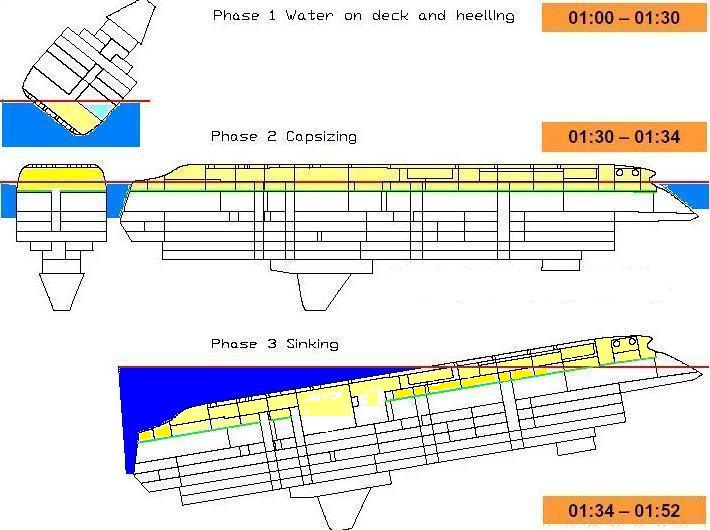 "When windows on the accommodation decks (i.e. in the deck house decks 4 - 9) were broken by wave forces, subsequent .... sinking was inevitable". M/S Estonia sinking 1994 is still not explained 2014 Many persons suggest it is a lost cause to explain the M/S Estonia's mysterious sinking 1994 but I do not believe in lost causes! Scientific fraud at Strathclyde and Chalmers Universities 2008 to cover-up the truth about the sinking of the M/S Estonia 1994. Foreword 1999 explains everything about the Estonia accident cover-up The "bow visor" lie (June 1, 2001) "It should be remembered that Carl Bildt was the father of the "bow visor" lie, which was used to explain the sinking of Estonia on September 28, 1994. The Swedish-owned passenger ferry, which sank with an estimated 1,000 lives lost including 502 Swedes, was being used in an ongoing operation to smuggle stolen Soviet military technology - with the approval of then prime minister Bildt and the head of the Swedish military. Sweden was evidently being used as a transit point for the contraband, which was being forwarded on to Israel from Arlanda airport - without being inspected by Swedish customs on entry or exit from Sweden."
M/S 'Costa Concordia', January 13, 2012
M/S 'Al Salam Boccaccio 98', February 3, 2006 Why is it, that whenever a serious incident occurs at sea with many killed, that the maritime authorities invent a completely unrealistic cause?
The 1998 NTF M/S Estonia conference
About the M/S Estonia Accident
Popular page - bilge pumps! Why start them?
Lifeboat Alarm Learn about lifeboat alarms! The ultimate Manipulation - how SSPA faked the Model Tests; the Model floats on the Deckhouse!! (explains it all)
Scientific fraud is permitted at Strathclyde University Subject matter has been raised and investigated. Professor Jim McDonald, FREng FRSE FIET FInstP, Principal and Vice Chancellor of Strathclyde University have been investigating for several months! It seems fraud is permitted. The Naval Architect, journal of the Royal Institution of Naval Architects in London writes on pp 28-42 in the September 2010 issue about the Estonia accident and quotes the info of Heiwa Co that has been censored by the authorities since 1994 - the defective watertight doors. New Estonia Investigation demanded (15 March 2009) Swedish MPs Jan Erik Ågren (-), Per Bolund (mp), Kent Härstedt (s) and Aleksander Gabelic (s) demand 091002 a new investigation of the Estonia sinking 1994! The reasons are results from latest work carried out at the request of Vinnova (The Swedish Governmental Agency for Innovation Systems) by various research institutions. Some persons participating in the studies suggest that past investigations of the cause of the accident are not sufficient for complete clarity. The Joint Accident Investigation Commission, JAIC, working 1994-1997 never studied or explained the causes for the sudden sinking. The Vinnova research was presented during 2008 at a demonstration of model tests at Chalmers University 3 April and at a symposium at Stockholm 23 May. At the model tests it was clearly shown that the vessel capsized and floated upside down, which, according JAIC, didn’t happen 1994. Furthermore it is now shown that three persons in the engine room must have evacuated latest 01.06-01.07 hrs and not after 01.23 hrs or later as suggested by JAIC. The examples just show two circumstances that the JAIC investigation is full of important errors. Another serious fault is that questionings of survivors were done unprofessionally more to confirm one event than to find out all circumstances. The JAIC was not independent. It consisted of hand picked representatives of Sweden, Estonia and Finland. Several expert reports, results of divings the days after the accident and other information suggest that the description of JAIC in its report – that the visor dropped off – does not satisfactorily explain the speedy sinking of the M/S Estonia 1994. The uncertainty about cause and sinking must be removed and a responsible party identified. These factors taken together are good reasons to appoint one from Sweden, Finland and Estonia independent and international investigation about the sinking of the ship, the four MPs say. The suggestion will be dealt with by the Parliament in 2010. On 3rd March 2010 Swedish Parliament decided to do nothing - without discussion or voting! Safety at Sea Ltd, 280 St Vincent Street, Glasgow, G2 5RL, UK has on 17 November 2009 asked Heiwa Co to remove the following web pages/articles from this web site within 15 days: The Safety at Sea Ltd report May 2008 Serious Errors in the SSPA Reports Full-scale Computer Simulations Vinnova and Chalmers University deny Faults with Estonia Study Recidivism of SSPA regarding the M/S Estonia The ultimate Manipulation - how SSPA faked the Model Tests (to hide the true cause of accident!) Video with the SSPA Model Test Preamble 2005 to the English Edition of Katastrofutredning Safety at Sea Ltd suggests that Heiwa Co questions the intellectual and professional independence and the technical competency of Safety at Sea Ltd and/or its staff. It is further suggested that criticism by Heiwa Co is not scientific and that the objective is to annoy and damage the reputation of Safety at Sea Ltd and/or its staff. The Safety at Sea Ltd report May 2008 is evidently a review, where the JAIC scenario is modified but it is still maintained that >4 000 tons of water was loaded in the M/S Estonia superstructure within a few minutes causing a list of >47°, etc. There is nothing there to annoy or damage anybodies reputation. Evidently you cannot load >4 000 tons of water at open seas into a cargo space full of cars and trucks, while nobody hears it and when the light in the hold is still on! It is further suggested by Safety at Sea Ltd that the condition with 47° list is stable; the ferry is floating on the deckhouse for 20-30 minutes! This is also wrong! The submerged deckhouse does not provide any buoyancy, all side windows are smashed at once and the ferry should capsize at once and then float upside down. It is finally suggested by Safety at Sea Ltd that, when the ferry floats upside down after capsize and bouyancy is provided by air inside the hull and displaced bouyant materials (as seen in model tests and verified by calculations), it will slowly sink! Buoyancy is slowly lost during 15 minutes! The Safety at Sea Ltd explanations for this are also wrong. 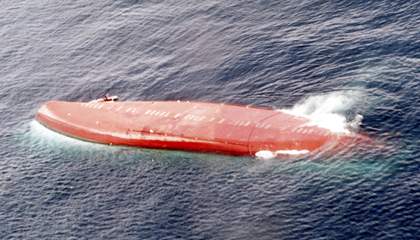
Ferry floating after capsize - it cannot sink! Suggesting anything else, e.g. air leaking out, is fraud! The following links are news items prior to and after Heiwa Co:s review. These references pose similar unanswered questions. It is then also concluded that model tests and computer simulations are falsified by SSPA (model tests) and Safety at Sea Ltd (computer simulations) to achieve the requested results. Heiwa Co conclusions are evidently supported by facts and calculations as provided in the links. The last link is the Preamble to a book originally written 2002 that summarizes the whole thing long before Safety at Sea Ltd got involved. Heiwa Co:s recommendation to Safety at Sea Ltd in order to save its intellectual and professional independence and its technical competency is that it publicly withdraws its reports and computer simulations of the Estonia accident with the explanation that they contain serious errors. Let's do that within 15 days! TV-program about M/S Estonia - Friday 16 October 2009 French TV-company FR3/Thalassa sent a 30 minutes reportage about the latest investigations of the M/S Estonia disaster with info of Heiwa Co! Link to program . How does a capsized Ship like M/S Estonia sink? (31 July 2009) The Films by M/S Finnmerchant of the Rescue M/S Finnmerchant arrived at 03.25 hrs at the site of accident on 28 September 1994 and when dawn arrived they filmed rafts and helicopters. As you can see, the weather was not too bad. No 10 metres waves as JAIC reported, etc. 147 Estonians demand a new Investigation! The Government refuses! (27 July 2009) How did the Estonia heel? (18 July 2009) Books 'Disaster Investigation' and 'Lies and Truths about the M/S Estonia Accident' now available in pdf Format! (13 June 2009) The MV Estonia sinking is still not explained! Chalmers University supports scientific Cheating and breaks Swedish Laws (28 May 2009) Very easy to examine the Estonia Hull (4 April 2009) Many experts have recently suggested that the underwater hull of MS Estonia must be re-examined. It is very easy! The whole underwater hull is accessible on the sea floor - both the flat hull bottom and the hull sides up to the waterline and to the main deck fender. All parts of the underwater hull are above the mud line. All areas can be marked up by divers and then filmed by ROV. Report of the Committee of Experts formed for the investigation of circumstances related to the transport of equipment for military use on the passenger ferry Estonia in September 1994 (2 March 2009) On 16 February 2009 Margus Kurm, Chairman of the Committee, Leading Public Prosecutor, handed in subject report to the Estonian government. It was the result of the Committee studying the latest research studies done by the SSPA consortium and the HSVA/TUHH consortium 2006-2008. Research Study on the Sinking Sequence and Evacuation of the MV Estonia - Final Report Competition for Naval Architects (20 December 2008) Technical Summary of the Investigation on the Sinking Sequence of MV Estonia Unbelievable new Information (29 November 2008) |
|
Mariella rescued 40 Persons! (29 November 2008) Anders Björkman, Heiwa Co, lectures
at Pärnu, Tartu and Tallinn 'Ten good Reasons why the M/S Estonia
Accident Investigation (1994-1997) must be
reopened 2008!' A lot of new
evidence has been produced 2008. The new evidence
will be presented and it is suggested it is best
handled by a Formal Investigation reopened as per
international law by the Estonian government.
Lecture will be in English and
Estonian. Sunday 23 November, 12-2 pm, Pärnu -
Pensionäride päevakeskus, Tammsaare 11 -
invited by ELA Monday 24 November, 5-7 pm, Tartu - Theatre
Vanemuine (ERGO saal) - invited by ELA Tuesday 25 November, 6.30-8.30 pm, Lüganuse
Rahvamajas - invited by Nõmmeradio Wednesday 26 November, 11 am-1 pm, Tallinn -
Tallinna Volikogu istungite saal, Vana-Viru 12 -
invited by Evelyn Sepp, MP Listen to Nõmmeradio or watch this space
for further details! Lecture can be found here!
At some instant two survivors managed to climb down the closed ramp, using its stiffening arrangement and abandon the ship. Angle of heel 93°. (Source - Vinnova/SSPA/Safety at Sea/Glasgow, May 2008) Serious Errors in the SSPA Reports (20 October 2008) Vinnova and Chalmers University deny Faults with Estonia Study (15 October 2008) The Vinnova Estonia Study 2005 - Amazing Findings 2008
Recidivism of SSPA regarding the M/S Estonia The ultimate Manipulation - how SSPA faked the Model Tests (to hide the true cause of accident!) Weapons Smuggling on Estonia (2 September 2008) Announcement by SSPA/Chalmers/Strathclyde/MARIN 7th April 2008 (actually published on their web site15 April 2008) "It is hereby announced that the project has entered into its final stages of synthesis of the available evidence. All final reports, relevant data and the video from physical model experiment on the most likely sinking sequence conducted on the 3rd April 2008 at SSPA’s laboratory in Gothenburg will be made available in early May 2008. A final international workshop will be held in Stockholm on 23rd of May 2008 to facilitate public discussion and exchange of opinions on the outcome from this investigation." So then we will know (1) how fast the Estonia model heeled to 37° due to water noisily loaded on the superstructure car deck and then (2) how she floated on the (model) deck house for 20-25 minutes (full scale) and (3) how at least 18 000 m3 air trapped in the (model) hull leaked out during another 20-25 minutes (full scale), when vessel (model) floated upside down until sinking, and (4) how she moved/drifted between the position of alleged visor loss and the final position of the impossible sinking for about 50 minutes (full scale)! Does a ferry float on a deck house? Video with the SSPA Model Test (the link is no longer available on the Internet)
But then finally the complete deck house is flooded ... and the model heels upside down ... slowly. The floating condition shown in the picture below (next section) is not shown after 26.58 minutes of the video! Instead underwater pictures are shown. The Estonia floats upside down. And then the stern sinks. Very strange. How does the air trapped in the stern escape? Heiwa Co will analyse the SSPA video further, when all details of the model, incl. its deck house, are available. SSPA Model Tests 3 April 2008 now done (DN 20080404) SSPA Model Tests 3 April 2008 - Media invited Did MV Estonia turn 180° port at 01.02 hrs? New findings to explain the MV Estonia sinking have been reported by Der Spiegel 01/08! According to German scientists Valanto and Krüger, HSVA and T-U Hamburg-Harburg working for Vinnova, the MV Estonia made a 180° port turn south/east already at 01.02 hrs (sic) on the morning of 28 September 1994!! According to official information by the JAIC the turn took place 01.17 hrs ... as witnessed by MV Mariella. The 180° turn took place a few minutes before the Mayday at 01.22 hrs. According to the latest German findings MV Estonia had 50° list at 01.20 hrs and was drifting at that time. It will be interesting to see how the scientists invent new events to explain the sinking. The German report to explain the sinking will be pusblished in May 2008. The Swedish/Scottish/Dutch consortium led by SSPA working on the same project has commented upon the new findings in Swedish daily Dagens Nyheter. They are not so certain that the Germans are right! SSPA are doing there own final model tests of the sinking to be completed this spring. Heiwa Co has already analyzed the SSPA 2007 model tests. See below! Heiwa Co will publish an analysis of all these findings when available. Here! A new Report about the MV Estonia Sinking (part of the Vinnova study 2006-2008) has been published 2007 by the Institute of Ship Design and Ship Safety at TU-Hamburg-Harburg On 1 st April 2006 an ANNOUNCEMENT was made: "It is hereby announced that to aid the proceeding of this study, the SSPA Consortium invites any substantive information to be provided in written form for consideration in explaining the circumstances of the loss of the MV Estonia. If deemed beneficial, and is agreeable, further dialog will be initiated with the contributing parties. The information provided to this consortium will be made available publicly through this site, or other media, after due scrutiny. The information can be sent electronically or in other form to the address given in the Contact Us section." Heiwa Co has since made a number of contributions to the SSPA Consortium and none has been made available publicly and no dialog has been initiated today (21 January 2008). The SSPA Consortium final report explaining the sinking will be ready by March 2008 and later reviewed at a Seminary of unknown date and location. In the meantime interested parties should continue visit this page for review of the developments. SSPA produces a Power Point Presentation with Questions about MV Estonia Sinking (31 August 2007) In a recent PPP the SSPA consortium statets that : "No consistent explanation of the chain of events leading to all these processes (various observations of the sinking) has been provided to date". However, Heiwa Co has already 2006 provided the explanations required! SSPA Sweden AB produces another manipulated 'Estonia' Model Test Report (Report no. 4006 4100-2)! (uppdated 25 August 2007)
Survivors' Testimonies prove the JAIC wrong (Updated 20 July 2007) Chief prosecutor Margus Kurm believes the lying Crewmembers - On 11 May 2007 Estonian chief prosecutor Margus Kurm reported that he belives the three crewmembers that escaped from the engine room of the Estonia long after the listing ocurred and thus that he does not believe the 134 other survivors! His findings can be read here. Scientific Report proves the JAIC Accident Scenario wrong - In a report by SSPA Marine AB dated 27 March 2007 the tests indicated that initial flooding in the order of 2000-2500 tons/min could be expected with a fully open ramp. Actually the only test close to the actual conditions of the Estonia (14.5 knots) was done at 11.36 knots, when the initial inflow was 1108.9 tons/min. Tests at higher speeds could not be done as then the model was overfilled with water! By simple extrapolation it is clear that the initial inflow at 14.5 knots would be >1800 tons/min. As this water will trim the vessel on the bow the conclusion is that the initial inflow will increase to 2000-2500 tons/min! By simple calculations done 1999 Heiwa Co has got exactly the same result. With such big inflows the vessel would capsize and float upside down after one minute! The JAIC suggests (figure 12.16 in the Final report) that the initial inflow at 15 knots would have been only 315 tons/min increasing to 580 tons/min when there was 1000 tons of water loaded. It is thus evident that JAIC miscalculated the inflow by a factor 6, which invalidates (again) the complete JAIC report. But the writers of the SSPA report shall still validate the JAIC scenario! As this is impossible, the SSPA staff indicates that maybe the vessel sank due to leakage below waterline. Media does not react. Submarine Collision - North Baltic Sea - 28 September 1994 - 00.55 hrs The
'Estonia' Sinking - The Biggest Scam In Maritime
History
Diving is permitted at the Wreck - It must be clear to anybody that diving is permitted at the wreck as long as it is done under the authority of, e.g. the Estonian government or Parliament and that the purpose of the diving is either to 'protect the wreck' or to 'protect the marine environment'. The wreck has spent a long time on the bottom of the sea and it would be very prudent to carry out a detailed examination of the wreck now to establish if any further action is required to protect it or the marine environment. At the same time any suspect areas of the wreck can be examined of damages not reported by the JAIC or caused by unreported human activity. Heiwa Co does not believe that the accident 1994 was caused by bad visor locks 1978! Every essential finding by the Commission is false! Testimonies have been changed, facts have been manipulated, people have been threatened to shut up.
To assist survivors and relatives who after the accident still pursue the Truth 2006, Heiwa Co has compiled some Findings that will easily convince anybody that all essential, official facts of the accident are false. If you want to study the official lies you only have to visit the Swedish government web site Estoniasamlingen and compare (in Swedish only). Twenty facts listed below also prove that the complete official investigation 1994-1997 is 100% falsified. Not one essential information is correct. It is a legal scandal according to a statement by the MP Björn von der Esch in the Swedish Parliament 30 May 2002 (and not reported in the media). The alleged loss of the visor having caused the accident is a well orchestrated myth and the Swedish media does not dare to inform the public about it. 20 Facts prove the Commission wrong - It is sad to conclude that every essential official information about the 'Estonia' accident 28 September 1994 announced between 1994 and 1997 is false. The following are, e.g. twenty proven facts, which are not mentioned in the official Final Report issued December 1997, but are described in the book Disaster Investigation and summarized for Estonian readers at a separate web page:
Recovery of dead Bodies 1994 - The dead bodies could and should have been recovered immediately after the accident. The French-Norwegian company Stolt-Comex offered its services at very low cost and had equipment and staff in place. The offer was refused. The only logical reason seems to have been to prevent outsiders from investigating the wreck in early October 1994 and to find the true cause of the accident. Probably the visor was then first attached to wreck itself, then detached underwater around 4-6 October, so it fell to the bottom below the wreck, and as the visor was not finally removed/salvaged until mid-November, no salvage of bodies could take place in early October. Later - all proposals for further investigation of the wreck to confirm new findings are refused with reference to the dead bodies - they shall rest in peace. So the refusal to salvage the bodies had two reasons - to prevent an early inspection of the wreck and to prevent any later inspections of the wreck. The official sequence of events during and after the accident is not possible.
The official Explanation - slow Sinking due to Water on the Car Deck in the Superstructure - not possible! Heiwa Co quickly concluded 1994 that the official sequence of events was unlikely - unbelievable - and that the visor must have fallen off after the first sudden listing. The independent Investigation by Heiwa Co
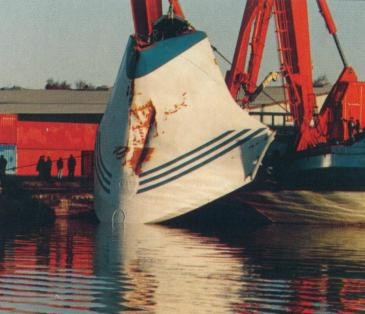
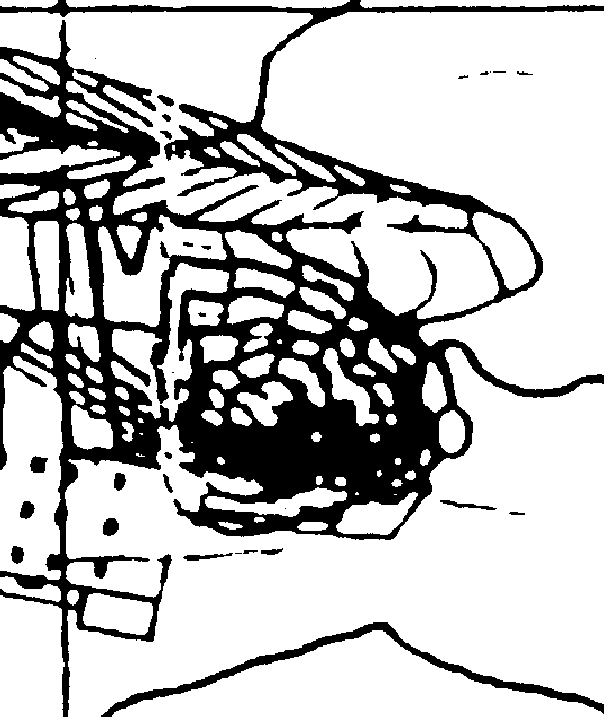
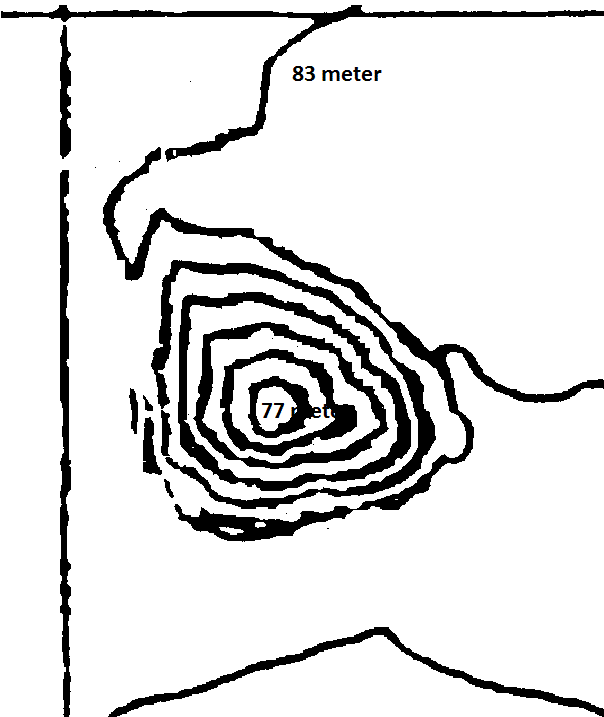
Staff Changes at the National Maritime Administration It is quite strange to note the following staff changes in the Swedish National Maritime Administration 2001 since the 'Estonia' accident 1994: 1. Mr. Jan-Olof Selén is Director General 2001. In 1994 he was legal counsel at the Ministry of Transportation to minister Ines Uusmann who decided not to or prevented the salvage of dead bodies. He is not a seafarer. The seven top members of the Swedish NMA have all contributed to the misleading 'Estonia' accident investigation. The official position of the Swedish NMA is that the Final Report is complete and correct and that this web page does not include any new information. Other new information is the below picture of the 'Estonia' wreck published in Sweden spring 2000. The left picture is a 'sonar picture' of the wreck officially made 1996 - two years after the accident - but probably made already 30 September, 1994 - the day the wreck was found. Actually the left picture is a hydrographical chart of the wreck area with a picture of the wreck sketched on top. By removing the 'wreck' you get the center picture showing a pyramide shaped object about 13x13 m on the bottom about 6-7 metres high - shaped like the visor (left picture) with the bottom up. The pictures suggest that the visor was in fact found at the bow of the ship, i.e. it could not have fallen off under way, before the sudden list occurred far away from the sinking position. There are more pictures of the visor on the bottom of the sea.
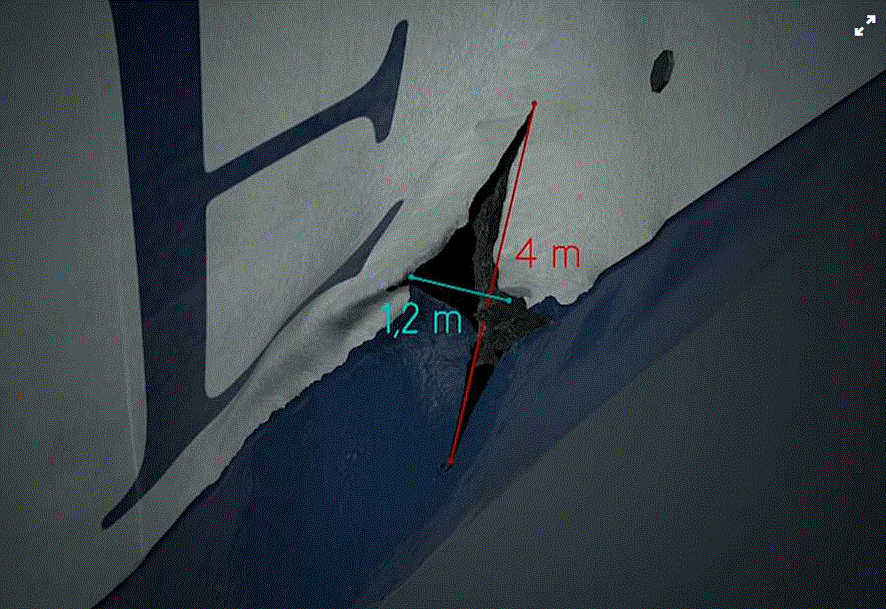
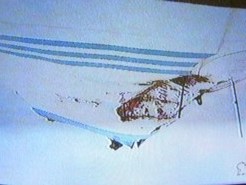
Disaster Investigation (2001 in English) Katastrofutredning (2000 - in Swedish) Nya Fakta om Estonia (1999 - in Swedish) - Price Euro 15:- incl. postage. Order the book ! Some outstanding Questions about the M/S Estonia - Paper presented the 27 October 1999 at the 'Debate on the Estonia' of the "DESIGN FOR SAFETY" CONFERENCE of the Ship Stability Research Centre, University of Strathclyde, Glasgow, Scotland. Lies and Truths about the M/S Estonia Accident (1998 - in English) - Price Euro 15:- incl.postage. Not learning from Marine Accidents - some Lessons which have not been learnt - Paper censored by the Royal Institution of Naval Architects - it should have been read at the Learning from Marine Incidents II conference the 14 March, 2002, in London. 28 september 1994 - Estoniabluffen - visiret föll aldrig av Estonia (2002 - in Swedish) Lessons learnt by the M/S Estonia Accident Ship owners and ship safety experts have a lot to learn from the 'Estonia' accident. The deficiencies 1993 in design and arrangements were due to the fact that the 'Estonia' was never designed to sail on the open sea. She was designed 1979 for protected coastal trading and the SOLAS requirements were never fully used or complied with in spite of certification to the contrary. Thus she was permitted by the Finnish and Swedish maritime administrations 1980 to have too many (open) watertight doors - total 22!, restricted number of life rafts under davits, no possibility to evacuate all 2000 passengers aboard by life saving means under davits, a swimming pool on the the double bottom, etc. Unfortunately, when the trade changed in 1993, the new Swedish/Estonian owners never bothered to up-grade the ship. The owners and the maritime administrations were one and the same. In retrospect it would have cost very little to have made the 'Estonia' safe and seaworthy as per the SOLAS in 1993. The hull steel work performed in 1994 to install the fin stabilizers should have been better supervised and documented. Now the stabilizers were installed in a compartment that could only be accessed via watertight doors! Then the Estonia would never have sunk in 35 minutes as she did in 1994. The visor and bow ramp were defective prior to the accident and could not be locked. The ramp was secured by ropes and the visor was held in place by its own weight and its hydraulics. The JAIC just concluded without any evidence that they were in perfect condition and locked at the time of accident. There are strange stories about an explosive device found at the bow Note about one explosive Device found at the Bow and a big unreported Hole in the starboard Front Bulkhead Read about the Six Phases of the Sinking - Ramp always leaking Since 1999 many parties have requested the Swedish government to re-open the investigation as per IMO Resolution A.849(20) and to review the new proven facts and then inform other interested countries. Every time the Swedish government has refused with the weak argument - no new facts have been presented. In April 2001 the Swedish government in a press release referring to this web page stated that it did not contain any information to the effect that the official cause and sequence of accident were wrong! It is very sad - the writer of this web page started out trying to help and to improve safety at sea. Now he is being treated like an idiot by the Swedish and Finnish establishments. Read the report of The German 'Expert group' Read the reports of The Independent Fact Group And what do you see on the picture right? It is
a big hole found in the superstructure of the
'Estonia'. The hole is in an area, which the
Commission states is 100% undamaged. The hole is
certainly the result of an explosion from inside
the superstructure as (i) the edges are bent
outboard, (ii) material is missing from the centre
inside of the hole and (iii) analysis of test
pieces of the ruptured edges show that the material
has been subject to high temperatures = explosion.
See the
damage hole in the superstructure
. The hole was blown open by the Swedish Navy when
the visor was removed from the wreck at the bottom
of the sea after the accident. How it was done under water is described
here
. Why a falsified Report and Explanation? Many persons ask why the authorities presented a 100% falsified explanation and report about the accident. The simple answer is that the Swedish government didn't want the public to know what really happened, so it decided to make up a totally false story - the lost visor. By parading 'experts' stating that ferries sink due to lost visors and by falsifying testimonies from some crew members the conspirators managed to create a fairly credible story among the ignorant public. Evidently, the visor was attached to the wreck, so the visor had to be removed by explosives in order to be salvaged, etc., etc., which had to be kept secret. And the technical explanations were never good enough - evidently a ferry does not sink due to a lost visor - the ferry would have capsized and floated upside down with water in the superstructure. So why was a falsified explanation ordered by the Swedish government? To protect the incompetents Swedish National Maritime Authority (Sjöfartsverket)? Or a more sinister cause - to protect, e.g. military interests using the 'Estonia' ferry to carry secret ordinance from the former Soviet Union to Sweden? Will we ever know? It is quite easy actually - ask the Swedish government to provide the missing information. The whole matter is presently handled by the Swedish military authorities. 28 September 2006 - 12 Years Of Lying About The MV Estonia Sinking 1994 This is not a "conspiracy theory" website. The definition of a theory is: "An assumption based on limited information or knowledge; a conjecture (guesswork)." No theories are presented here, only conclusive evidence and, well, some hypothesis. After the MV Estonia sinking 1994, the Swedish Government and its lackey the Joint Accident Investigation Commission took it upon itself to be the official determiners of the Truth, in this case a story about a stupid visor. But, it is evidence, and not the Government, that determines what the Truth is. The Government's official story about MV Estonia is not the divine Truth; do not fall into the trap of thinking that any counter-evidence against their story is just a mere theory. Accepting The MV Estonia Truth Do not get defensive when presented with MV Estonia counter-evidence even late. Who are you trying to defend? You are not being accused of lying about MV Estonia; the Government is. No longer let society, the media, social democrats, moderates, or the Government do your thinking for you. You will not be charged with a "thought crime" for believing that the Government did lie about the MV Estonia sinking. You are free to believe whatever you want to. According to the logic of the Swedish public, a story is not real unless it is reported by the mass media. Following this logic, the Government couldn't possibly have lied about the MV Estonia sinking unless some major newspaper or TV news station said so. Fact: The media has the exact same evidence that this website has. Fact: The media has had this evidence for many years. Fact: The media has had many years to say that the Government lied about the MV Estonia. Thus, the media will not suddenly come out tomorrow and say that the Government lied about the MV Estonia. It is not important to know why the Swedish media will not report that the Government lied about the MV Estonia. All you need to know is that after many years they have not done so and therefore will not do so. As for Heiwa Co, it is just an organization of people concerned with safety at sea who are here to show you the Truth. So, either all of the evidence on this website means nothing and does not warrant any kind of investigation, OR, the Swedish media knows the truth about the MV Estonia and is withholding it from the public. This is the MV Estonia fulcrum. You must pick one of the two; you have no other choice. Come On, Rebut The Counter-Evidence! If the MV Estonia counter-evidence is indeed so kooky and crazy, then how come the Swedish media can't just rebut it? What, are they so dignified and classy that they are "not even going to justify it with a response"? There should be no problem with the Estonia counter-evidence being plastered all over the TV news. Skeptics love to attack the messenger and love to attack the plausibility of the conspiracy i.e. "The Government lying about the MV Estonia is totally implausible and beyond absurd.", but never talk about the actual evidence. They feel it is not necessary to acknowledge the evidence, when in fact the evidence is the only thing they should be concerned about. Your Opinion About The Swedish Government Means Nothing Attempting to debunk the MV Estonia counter-evidence is one thing, but simply saying, "I don't think that the Government is capable of doing such a thing," means absolutely nothing and is not evidence. Stick to evaluating the evidence, rather than pushing blind allegiance. Making Your Decision, Taking A Stand Once you have viewed all of the evidence on this website, make your new decision about the MV Estonia sinking immediately. Do not be someone who refuses to act alone, waiting to see what others will do first. What you need to realize is that you are in fact that "other person." And, you need not be in accord with "the collective". Think for yourself, rather than falling to peer pressure and engaging in groupthink. But remember, "thinking for yourself" involves the fact that you do not need your beliefs to be validated by other people's beliefs. If the majority is uninformed, then their opinion means absolutely nothing. Just because something is widely thought to be the Truth does not automatically make it the Truth. You should be able to go up to your family and friends, and proudly tell them that you know the Truth about MV Estonia 1994. And don't worry if they call you "crazy," because it is not that you are crazy, it is that they are uninformed. "All truth passes through three stages. First, it is ridiculed. Second, it is violently opposed. Third, it is accepted as being self-evident." The Real Kooks The person who goes about an investigation in a logical, objective manner and pays attention to evidence is not a kook. The real kook is one who thinks that governmental treason is impossible and ignores evidence that is right in front of their face. Skeptics will use delusional rationalizations to explain away all of the MV Estonia evidence. For them, it does not matter what evidence is presented, because their ultimate goal is to hold onto their existing worldview at any cost rather than to be open-minded and seek the Truth. It is a worldview that is practical, sensible, popular, sane, and rational....but not true. The MV Estonia Truth Is Not Some Kind Of "Mysterious Secret" The MV Estonia counter-evidence is obvious. The fact that the Truth finally after 12 years is coming out is refreshing. MV Estonia is not up for debate. It has already been proven, far beyond a reasonable doubt, that the Government and JAIC lied about the MV Estonia sinking - that was the easy part. The hard part is getting the Truth out to the Swedish and Estonian public, because to them the thought of their Governments lying about the MV Estonia sinking is taboo. It is not as though the MV Estonia counter-evidence is weak, it is blind allegiance, herd mentality and ignorance, that is stalling the Truth. The evidence is here, but because the people have been tricked into believing the Joint Accident Investigation Commission 1994-1997 and don't want to feel they have been duped for the last 12 years, they stop asking questions. For the skeptics, being correct is more important than being corrected. Skeptics are not "defending the Truth," they are just defending their fragile egos. A real defender of the Truth would take all pieces of evidence into account; and then, they would evaluate that evidence OBJECTIVELY. September 2006
No reason for a new investigation 23 April 2001 Contact anders.bjorkman@wanadoo.fr
"A fundamental objective of the Swedish system is that the citizens should have faith in central government activities and be able to examine them critically. The decentralisation of central government activities has been carried out with the aim of making the agencies more efficient and of moving the decision-making process closer to the individual citizen. Under the law, all agencies serve the citizens and provide them, on request, with information about their activities. The management controls in the agencies must safeguard this right. Government organisation in Sweden differs from that in most other countries. Sweden's central government administration is characterised by very small ministries. Less than 1 per cent of the 300 000 central government employees work for the ministries. The agencies working within the different fields of competence of the ministries have a high degree of independence from the ministries. The central government agencies are responsible for making their own decisions in cases that involve the application of the law and the exercise of public authority. It is common for an agency employee to have tasks or interests beyond his or her job at the agency. Decentralisation and/or delegation of responsibility and powers create greater risks of conflicts of interest and similar situations. One such situation arises when civil servants, in the course of their duties, are improperly affected by their spare-time occupations. This is particularly true for universities and technical institutes, where many employees have second occupations. For example, university employees may own companies that have business relations with their own university. Such situations, which in themselves are questionable, can mean that employees, on behalf of their university departments, favour their own companies in a bidding process. The public's faith in civil servants can be shaken by problems of conflict of interest if agency management is unable to apply the Administrative Act's rules on conflict of interest in the agency's internal control system. Conflicts of interest and part-time occupations still pose a serious problem, especially in universities. Jan Hagvall - Audit director at the Swedish National Audit Office, responsible for the audit of all government agencies within the area of responsibility of the Ministry of Finance. |