|
|
|
 Ship Management
Audits and Inspections
Ship Management
Audits and Inspections
Heiwa Co agency does audits of ships under management by specialized companies to verify that the contractual agreements are fulfilled. A ship management audit is a very cost effective means to improve safety and, at the same time, reduce running cost. Heiwa Co agency inspects ships at the request of buyers, banks and charteres to verify the actual condition, the equipment, and the systems and that the certification are in order. The audit may be limited to the condition of the ship and/or how the crew looks after it according to procedures in force. Heiwa Co agency can act as project
consultant with newbuildings, conversions and
repairs working closely with the client's staff.
Heiwa Co agency develops and/or reviews the
specification of the work and can assist with
initial design and design development and plan
approval. Heiwa Co agency may assist with
the negotiations with the shipyard and can
participate in the supervision of the works. Some
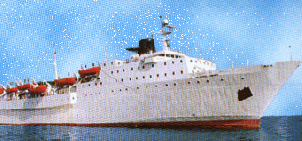
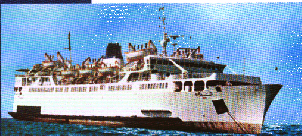
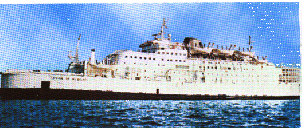
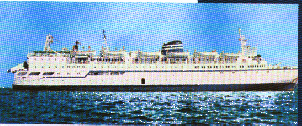
roro-ships converted to roro-pax ships and some
roro-paxships upgraded by Heiwa Co agents
are shown right. Heiwa Co has particular experience of
major conversions and repairs executed by a number
of subcontractors and can take on the
responsibility that the complete work is in
compliance with the expectations and rules and
regulations (class and IMO). Conversions may affect
the safety of the whole ship and Heiwa Co
ensures that all aspects are considered. Heiwa Co has particular experience from
Scandinavia, Japan, Middle East, Ukraine and the
Mediterranean area. Heiwa Co has limited in-house capability
of computerized stability calculations, drawing
(ACAD) and structural analysis using FEM
particularly for oil tanker design. Heiwa Co
considers that tanker design shall not only
consider strength (stresses and buckling) and
fatigue but also elastic deformations, which may
break down the protective coating, and locations of
welding seams and butts. Most ships can be made safer and more economical
by a fresh approach using first principles and FSA.
The difficulty is the many variables involved of a
floating, intact ship, not to mention a damaged
ship, which means that ship safety development work
never ends. It is a circle - ships can always
become better and safer. Heiwa Co tries to
learn as much as possible from past accidents,
which explains its independent investigations of
the M/S Estonia,
M/T Erika,
M/T Prestige
and M/S Costa
Concordia incidents. The findings, which do not always concur with
the official ones, are nevertheless used to improve
the safety of a number of ships. Heiwa Co takes pride in trying to achieve
the safest and most economical solution of ship
design and operation. Heiwa Co used Formal
Safety Assessment (FSA), before it was adopted by
the IMO, as a guiding principle of its work and one
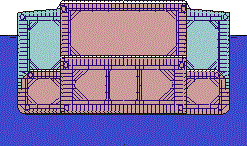
result is the Coulombi
Egg tanker, which provides
environmental protection exceeding that of
Double Hull using much simpler and safer
arrangements and which is now fully approved by the
IMO since 1997. Collision damage above waterline only for other ships than tankers does not create a big successive risk, as the ship continues to float on the undamaged underwater body, and it was maybe one reason why the IMO had not studied this matter (damage above water line only) in any detail previously. Many IMO rules are thus based on erroneous damage assumptions. To develop the particular Coulombi Egg structure took a long time using FEM, etc. Also intact and damage stability checks of all load condition permutations took a good effort. Heiwa Co considers that Double Hull for very large crude oil tankers was a step backwards, as the concept had not been tested when the rules were established. Double Hull works for small tankers - product carriers - but the risks associated with big ships - crude oil carriers - need still to be resolved. Heiwa Co will compute the tanker environmental index E for shipyards designing and building Coulombi Egg oil tankers. Heiwa Co has designed, got Class approval, and manufactured and fitted a large number of life boat davits to extremely competetive costs.
Heiwa Co does particular investigations for underwriters, law firms and individuals to verify damage claims and suggested proximate causes of incidents. These investigations are always based on first principles, applicable safety (SOLAS) rules and available, public information to confirm the relationship between cause and damage. One example is the M/S Estonia incident investigation 1994 that Heiwa Co has clarified later. And still up-dates 2021 !! Another is the M/S Costa Concordia incident 14 January, 2012, where the innocent Master is accused of killing people.
Heiwa Co is frequently asked about giving general training and courses for staff. Before any decision to this effect the client should define its needs and requirements based on past experience and incidents.
|