Welcome to a chapter of the e-book Disaster Investigation.
'The situation that you from a safety point of view are not permitted to assume and to calculate with the buoyancy of a deck house, does not exclude that such a buoyancy actually exists. It exists and therefore the sequence of events as described by the Commission is very likely'.
Johan Franson and Jan-Olof Selén, Swedish NMA, 15 December 2000
'Even if the investigation later has been subject to quite a lot of criticism, I dare state that with regard to the circumstances under which the investigation was done, the result has been shown to be very valid'.
Mikael Huss to the Swedish NMA, 26 November 2000
'The detailed time sequence of the course of events has still not been clarified, but considerable amounts of water flowed into the car deck (the superstructure) between 01.15 and 01.30 hrs (Estonian time). The ship sank due to the space being filled with water and it disappeared from radar screens at 01.48 hrs. The clock on the radio station on the bridge stopped at 23.35 UTC (01.35 hrs Estonian time)'
Commission press release 15 December 1994 (13) - para. 6
'We must proceed to do a major study of the actual sinking. How did the Estonia sink and why did she sink so fast? That experience may provide still more knowledge to improve safety at sea both in today's and tomorrow's shipping. Latest 1 February next year it shall be informed to the Government office what or which research institute or consortium that has been given this task'.
Mona Sahlin, Minister, Swedish Parliament, 17 March 2005
1.9 The alleged Sinking (plenty of lies produced by Investigators)
Members of the Royal Institution of Naval Architects and all students and researchers of marine accidents are particularly welcome to study this page about the alleged sinking of the 'Estonia' and to verify the observations and conclusions. Please also check 2.17 and 3.12 for more stability data, Appendix 4 for water inflow data and 4.4, why everybody lied the way they lied.
The strange Visor Position
The visor was 'officially' found the following day (18 October) one mile West of the wreck. The only evidence of the location of the visor, i.e. its position, is the position of a red buoy (sic) allegedly established early December 1994 by a Swedish Coastal Artillery, KA, vessel, i.e. two months after the visor was found!
The positions of the ship 'Tursas' that located the visor 18 October 1994 and the ship 'Nordica' that salvaged the visor mid-November 1994 have never been announced and it is not known when the red buoy was put at the position and by whom. It is very strange that 'Tursas' could not inform its own and the visor position 18 October 1994 and that the visor position was not confirmed by the salvage vessel 'Nordica' mid-November 1994 or that a red buoy was anchored at the visor before and after salvage.
It is unclear why the Swedish Coastal Artillery sent a vessel early December 1994 to the red buoy in order to establish its position = the visor position - after the visor was salvaged. But the position of the visor in the Final report (5) is that of a red buoy established early December 1994. How can anybody believe that the position of red buoy taken December 1994 should be the same as the lost visor position more than two months earlier? Why was the red buoy still there? Or was it ever there?
There is today a lot of information to the effect that the visor was attached to the superstructure of the vessel, when it sank, thus the visor could hardly have fallen off 'under way' (at 01.15 hrs) 33 minutes before the sinking (at 01.48 hrs) as stated by the Commission on 17 October 1994 and it could hardly have been found one mile West of the wreck on 18 October.
In December 1994 the Commission suggested that the final 'sinking' of 'Estonia' was later - 01.54 hrs.
The 'Estonia' had had a Westerly course from Tallinn to Stockholm, so a rational person would expect the visor to be found East of the wreck, if it had been lost under way, so that waves then could hit against the ramp and open it 1.4-3,4, when the ship moved Westward, etc, and that ship then had capsized (and sunk?) West of the visor.
But the visor was allegedly found one mile West of the (false or real position (?) of the) wreck and it should have raised several questions in the Commission. How did it end up there? The ferry could have heeled first (due to leakage of the hull!), turned around, lost the visor later (it may not have been properly locked) and then drifted to the wreck position. Alternatively the ship had turned before (the crew was aware that something was wrong) and was on its way back to Tallinn, when the accident otherwise took place as stated by the Commission 1.14 except for the 180° turn after the heeling. But these questions are not discussed in the Final Report.
A third alternative, the most likely, is that all information that Commission had published between 28 September and 17 October 1994 about the visor was disinformation and that the visor was attached to the ship, when it sank (between 01.32 and 01.36 hrs).
The actual circumstances where the visor was found need be further investigated.
To support the alleged loss of the visor before the accident - the listing at 01.15 hrs - the Commission simply arranged that the visor be removed from the bow of the wreck below water by divers from the Swedish Navy using explosives a couple of days after the accident. This strange, alternative possibility will be discussed later in this book.
Evident Falsifications
The writer now thinks it is time to introduce the detailed sequence of events of the accident produced by the Commission after the visor was lost as described in the Final Report (5) of December 1997 and the dramatic 35-37 minutes that then followed between, allegedly 01.15 and 01.50/52 hrs, which the Swedish NMA considers 'very likely'. We will not consider the 10-20 minutes of noise, etc. prior to the alleged loss of the visor. The alleged failures causing visor loss and ramp opening are described in detail in 3.7 and following chapters.
The Commission thus alleges that the visor fell off 'under way' at 01.15 hrs, when the vessel was doing 14-15 knots. This strange event should have taken place 1 560 meters West of the final resting - wreck - position. The casualty was due to a design fault of the visor locks, which were too weak and could not withstand the wave loads. The visor pulled the inner ramp fully open, when it fell off. The forward end of the superstructure was thus fully open. Water then allegedly entered on the car deck of the superstructure through the big opening forward >2 meters above the waterline, when the bow pitched down into the waves. There are no witnesses to this event. The crew in the engine control room only saw a closed ramp on the monitor.
The weight of the water loaded on the car deck then allegedly caused the ship first to immediately heel (but not capsize) at 01.15 hrs. As more water came in, the angle of heel increased. Then the ferry turned 180° and proceeded back on an easterly course.
An unproven Turn 2 400 meters West of the Wreck
According the Final report (5) chapter 12.5, page 161:
"It has been discovered both from the sonar investigations of fragments on the seabed and from manoeuvring simulations that the ESTONIA made a port turn at an early stage of the accident."
The turn allegedly took place (see below), between 01.16 and 01.20 hrs, when the list was only 15-30°, 2 400 meters west (sic) of the sinking/wreck position at 01.52 hrs, i.e. 32 minutes before the 'Estonia' sank.
Facts are that no sonar investigations were done 2 400 meters west of the wreck, no fragments have ever been investigated on the seabed 2 400 meters west of the wreck (or anywhere - all information about fragments on the seabed is false, as nothing falls off a ship when list is 15-30°) and no manoeuvring simulations have ever shown that the 'Estonia' should have done a port turn.
All statements about a turn during the sinking are not proven. All statements that the 'Estonia' then drifts 2 400 meters at 2,2 knots speed are not proven. All statements that the 'Estonia' superstructure high above the waterline is loaded with water are not proven. As everything else that the Commission invented about the sinking.
The Commission was simply lying about everything! Making up lies to suit their inventions.
To further study the strange port turn between 01.16 and 01.20 hrs and the amazingly high speed when drifting while flooding, the stable conditions - no capsize - has the Swedish government on 17 March 2005, i.e. 10 years and five months after the sinking, announced a SEK 8 million research study:
(The Swedish government has 17 March 2005 decided that the Swedish agency VINNOVA, as responsible for the Vinnova, so called Safety at sea program, shall order a research project concerning a study of the sinking of the M/S Estonia on 28 September 1994 between 01.15 hrs (the visor falls of when the Estonia is on a westerly course) and about 01.52 hrs (the Estonia sinks 1 560 meters east of the visor) and how the port turn took place, how the ship was flooded while drifting at high speed..
The principal objective of the study is to develop knowledge that may contribute to better safety at sea for ships in Swedish waters. The government has allowed SEK 8 million for this purpose.
Responsible for the government study is Claes Unge (VINNOVA), tel +46-8-473 31 77 and Gunnel Färm (chairperson of the program board of the safety at sea program), tel +46-73-600 38 45.
Responsible for the present VINNOVA safety at sea program is Per Ekberg, Sjöfartsinspektionen.
More information in Swedish about the government study is at regeringens pressmeddelande of the 17 March 2005.
The study was finished in May 2008 with plenty of falsified scientific (sic) reports produced showing a floating, capsized model slowly sinking due to air being released through secret valves in the model bottom.)
The Sinking continues
At around 01.30 hrs the angle of heel was allegedly >70° but the ship was stable. Between 01.30 and 01.50 hrs the listing ferry drifted Eastward at >2,2 knots constant speed and suddenly she sank (sic) at about 01.50-01.52 hrs.
The writer is absolutely certain that this scenario is impossible and that it is an intentional falsification like every other essential information in the Final report. It is thus very good that the Swedish government 10 years later orders a new study.
The official 1994 scenario, e.g. assumes that the principle of Archimedes does not apply. The reader should therefore know the following - it is basic naval architecture and ship stability theory:
Basic Particulars and Assumptions - Hull - Bilge Pumps - Superstructure - Scuppers - Deck House
|
|
Fig. 1.9.1 - Various parts of the 'Estonia' |
 on top of the superstructure
was the deckhouse (decks 4-8). The deckhouse
was >8 meters above the intact waterline and neither
watertight nor weather tight, as it was fitted with windows
and doors and other openings. The deckhouse is evidently
indicated in white (with blue stripes) in figure 1.9.1
right.
on top of the superstructure
was the deckhouse (decks 4-8). The deckhouse
was >8 meters above the intact waterline and neither
watertight nor weather tight, as it was fitted with windows
and doors and other openings. The deckhouse is evidently
indicated in white (with blue stripes) in figure 1.9.1
right.
The False Sequence of Events
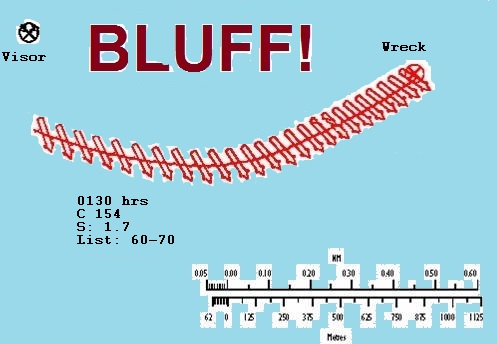
The sequence of events after the visor was lost as per the Commission is shown in figure 13.2 of the Final Report (5) and reproduced below. Each arrow represents the position and heading of the 'Estonia' at one-minute intervals, e.g. four minutes after the visor fell off the 'Estonia' was heading South and another 33 minutes later she allegedly sank.
The plot is in fact a falsification. It shows the movements of a completely undamaged ship, which makes a 180° turn and then drifts due to (exaggerated) wind and (exaggerated) currents - it never sinks, e.g. at the Wreck position - but continues to drift after that, but those arrows after 01.54 hrs have been edited away (sic) from the plot.
Then various arbitrary - but cleverly misleading - pieces of information (no evidence exists) have been added on the plot - times, courses, speeds, angles of list and events. The falsifications are described below:
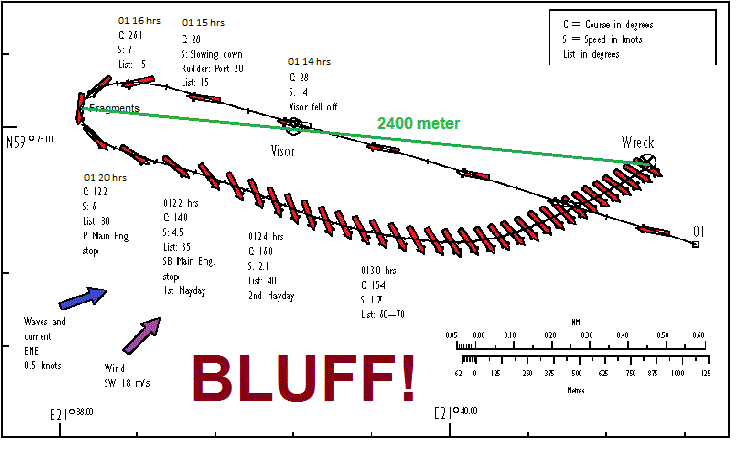
Figure 1.9.2 - Sequence of events as per the Commission (fig. 13.2 in (5))
The Ferry starts to heel at 01.15 hrs
In the Final Report (5) page 22 the Commission confirms that the visor fell off at 01.15 hrs (on 28 September), when the ship was under way to Söderarm (course 281°) with unchanged speed, about 14/15 knots, exactly as announced on 17 October 1994 1.12-1. Then the ramp was pulled fully open but see 1.10, water started to enter the superstructure > 2 meters above waterline, when it pitched below the waves, and the ship started to heel - 15 degrees after one minute, 30 degrees after six minutes (when evacuation from inboard to open decks was impossible) and 40 degrees after 10 minutes. The reason for the heeling was that the water collected in the side of the superstructure and produced a heeling moment.
Calculations of the writer shows that 2 000 tons of water should have entered the superstructure in less than 2 minutes. These calculations are easy to confirm with, e.g. model tests. This enormous lose weight should have heeled the vessel >40° and then the ship should have capsized and floated upside down at 01.15 hrs. Therefore the first allegation of the Commission cannot be true.
|
|
The Ferry turns at 01.16 hrs The ship started after two minutes to turn (159°) port according to the Commission, first towards, later away from the waves between 01.16-01.19 hrs on the plot, as in the above plot the visor falls off at 01.14 hrs. The evidence for this event - fragments and simulations - is false. After the visor had fallen off at 01.14/5 hrs, the 'Estonia' thus continued at 14 knots for two minutes straight forward half a mile with the 4,3 meters high waves on the port bow - she was still 'under way' towards Söderarm - but with the bow ramp in the superstructure pulled fully open - the visor had been lost and the list was 15 degrees. The vessel was then pitching up/down with amplitude of 4-5 meters and a period of 6-8 seconds, so the open bow with the ramp down in the superstructure was about 25% of the time several meters below water, when water flowed in due to pitching and forward motion. The Commission does not consider that this water in the superstructure would have stopped the pitching and trimmed the bow permanently below the water - the 'Estonia' should have gone under as a submarine after one minute - actually capsized and turned upside down - before any turn could take place! |
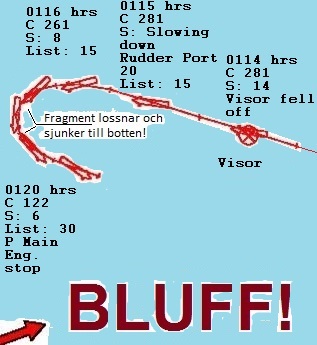
The strange Event at 01.20 hrs - why does the Ferry not upright?
At 01.20 hrs the ship has turned 159° and his heading back at 6 knots with the waves on the stern (sic). The list is 30° to starboard into waves and wind due to 1 500 tons of water inside the superstructure and the ramp is wide open. No more water can enter the superstructure car deck at this instance. The bow opening is not facing the waves any longer! You would thus expect that all water inside the superstructure flows out from the superstructure at this time, when the vessel pitches and trims on the bow! And that the vessel up-rights and gets 100% stable again.
It is a little later that the Mayday message is sent ... to the effect that there is a problem. The Mayday conversation stops around 01.30 hrs. According to the official plot of the accident it was impossible for water to enter the superstructure after 01.20 hrs due to the fact that the opening was facing away from the ways and the ship was moving with the waves. But the Commission decided - without any evidence - that more water flows into the superstructure. Very strange.
The Engines stops at 01.24 hrs
After having turned 159° and proceeded under engine power on contra course for a few minutes, the Commission suggests, that the engines stopped (there is no evidence) and that the ship then drifted about 2 000 meters sideway from about 01.24 hrs (the list was 40 degrees) to the position of the wreck, where the ship suddenly sank/disappeared (sic) 28 minutes later at 01.52 hrs with >135 degrees list. The Commission had however stated in Swedish daily DN 941019 that
'Nothing in the statements of the crew indicates that the Master managed to turn the ship and return towards Tallinn, before she sank'.
But in order to connect the position of the visor, which was not known 17 October 1994, with the position of the wreck a 180° turn and >2 000 meter of drifting were necessary. Evidently it was not the Master that turned the ship - the Commission later tells us that it was the officers on the bridge that initiated the turn - engines running - by turning the rudder fully to port when the ship was listing to starboard.
The mystery here is why the water inside the superstructure never flowed out with the bow ramp opening away from the waves!
Fragments on the Seabed
In order to prove the port turn the Final Report (5) chapter 12.5 states that 'fragments' found during a sonar search of the seabed helped the Commission to determine, that a port turn had in fact taken place 1.14.
When were these 'fragments' found and what were they?
The Commission stated that the Finnish vessel 'Tursas' found and filmed 'fragments' on 5 October, but then the 'Tursas' never searched (a) half a mile West of the visor (sic! - it was not yet officially found) or (b) half a mile South of the visor. No films of the 'fragments' exist!
Notice the logical summersault - small 'fragments' indicating the turn of the ship were found and filmed long before the big visor was (officially) found - but these fragments were not found, where the turn allegedly took place. What type of 'fragments' was found and how and where? It must be big 'fragments', as sonar can only see fairly large objects at 80 meters depth, and it must be assumed that the 'fragments' were buried in deep clay and mud.
Unfortunately the Final Report (5) does not say what the 'fragments' were, their positions, how they were found and how and why they fell off the 'Estonia' before, during and after the turn. According a press release of 6 October from the Estonia Foreign office quoting the Commission the 'Tursas' found the fragments - 'smaller objects' - East and South of the wreck37 (it is not known if it was from the false or correct wreck position), i.e. at least 3 000 meters from the location of the alleged turn!
Objects fall off when the List is <30 Degrees at 01.18 hrs
But it is very strange that small 'fragments' were allegedly found and filmed, before the very big visor was found! And these 'fragments' would prove the port turn, after the visor was lost, i.e. the fragments had fallen off the ship after the visor fell off when the angle of list was <30 degrees.
What fragments could have fallen off a few minutes after the visor, when the angle of list was not very big? The fragments are an obvious lie of chapter 12.5 of the Final report (5). After the report was published Commission member Tuomo Karppinen announced (at Glasgow, October 1999) that the 'fragments' were found 200-300 meters straight West of the true wreck position - see figure in 2.26. But according to fig. 1.9.2 above the 'Estonia' never passed that area - before, during or after the accident and according to the Estonian press release nobody searched that area at the time. And the fragments should prove the turn at 01.16-01.19 hrs >2 000 meters further to the West! The statement in chapter 12.5 in (5) cannot be correct. No 'fragments' ever confirmed the port turn.
The writer is rather concerned about these fragments falling off the 'Estonia' after the visor had allegedly fallen off. Why cannot the Commission clarify this matter? The fragments must have been found 3 000 meters West of the wreck if they proved a turn. And how could they fall off so early? And why do 'fragments' fall off a ship ... but why does not the water in the superstructure flow out?
Did the ship actually turn?
Did the heel to starboard initiate a turn to port? No - model tests showed clearly that the 'Estonia' with starboard list would not turn to port. The Commission then tried another angle. They say in the Final Report that a simulation of manoeuvres (sic) should have indicated that a bow wind would make the ferry turn into the wind - but not turn 180°. No reports of such simulations or model tests are included in the Final report and its supplements.
As the Commission could not prove the port turn with 'fragments' and model tests and simulation, it says instead in chapter 13.3 of the Final Report (5) that it considers it clear (sic), that it was the officers on the bridge that initiated a reduction in speed and a turn to port. The crew on the bridge should have been alerted by (a) the noise, when the ferry collided with the visor before the list occurred and (b) the sudden list (sic) at 01.15 hrs. But there is no evidence that the two or three persons on the bridge actually initiated a slow down or a turn or if there were any persons on the bridge in the first place.
Note here the logic of the Commission - the ship is said to have collided with the visor, which is not proven - it could have been attached to the ship, when it sank. And then there should have been a sudden list - but according to e.g. 3/E Treu there was no sudden list - the ramp was still closed and there was only a slow increase in list 1.3. And due to this alleged collision the officers on the bridge are assumed to have initiated a 180° turn to port. Why not starboard away from the waves? Logic?
The repeat statement of the Commission on page 223 of the Final Report (5) that the watch-keeping officers reduced speed and initiated the port turn is not proven. To make a sharp turn to port you need to turn the rudders maximum angle to port - it takes about 30 seconds, i.e. the alleged turn was initiated 90 seconds after the loss of the visor. But the rudders were found 1.16 turned to maximum starboard angle 35°. After the turn to port - which took a couple of minutes - the bridge apparently turned the rudders full starboard again, which takes another 60 seconds. How, why? After the turn ending at 01.19 hrs the crew must have put the rudders amidships - the ship continued straight - and later they turned the rudders full starboard?
Eyewitnesses to the Sinking - no Turn, no Drifting, the 'Estonia' immobile
However - there are eyewitnesses to the sinking of the 'Estonia' and they never mention a turn. On 24 October 1994 the Finnish police interviewed second officer Ingemar Eklund of the 'Mariella', who had seen the 'Estonia' at 01.30 hrs and that the ship disappeared already at 01.36 hrs (act A93c). The testimony of Mr Eklund was discussed at a Commission meeting 26-27 January 1995. His watch had started at 22.00 hrs and he had all the time seen the 'Estonia' since then. He told the Finnish police:
"At 22.00 hrs I saw the 'Estonia' at an angle in front of us, about 30°, on the port side. ... Her course at 22.00 hrs was almost Westerly and she sailed steady there beside us. ... I saw the 'Estonia' all the time on the radar. ... At 01.30 hrs the Master Törnroos called the bridge and asked about the weather. I replied something about the pitching and at the same time, during the telephone call, I heard on Channel 16 how the 'Estonia' said once Mayday. I think her next words were about blackout and heavy listing. I told the Master to come to the bridge, which he did. I replied to the 'Estonia' at once but they did not respond back. When the Master arrived on the bridge I was still trying to contact the Estonia but she didn't reply. Meanwhile I recorded her position from the radar. From hearing the Mayday-call and until the radar echo of the 'Estonia' disappeared I think it was only about six minutes. The times can be seen from the log book I kept during the night. As soon as the Master arrived on the bridge we changed course towards the 'Estonia'. ... We also saw the'Estonia' optically, I had looked at her several times earlier during the night with binoculars and recognized her silhouette. ... During the voyage towards the position of the 'Estonia', her lights disappeared and she also disappeared from the radar. Just before she disappeared from the radar, I thought she turned to port ...this happened very quickly ... because the vector disappeared, I assumed that the 'Estonia' sank. ... We were using all three radars. ...During the voyage to the position of the 'Estonia' I manoeuvered the ship ... I also kept the log book. ... In the log book I wrote the exact times taken from the GPS Navigator".
The missing Logbook
A copy of the 'Mariella'/Eklund logbook does not exist in the Commission's archive, so we do not know what position of the 'Estonia' was recorded. The logbook has disappeared. Note that Mr Eklund thinks that the Mayday was at 01.30 hrs and that the 'Estonia' sank already at 01.36 hrs and that the positions of the 'Estonia's were recorded at 01.30 hrs and 01.36 hrs and that she appeared to turn just before disappearing at 01.36 hrs. Eklund is quite clear - he did not see the 'Estonia' drifting >1 300 meter sideways until say 01.52 hrs. Eklund was at the time of the Mayday talking on the phone to the Master of the 'Mariella', Jan-Tore Thörnroos (who was in his cabin), when the Mayday was heard, and he has told the Commission in November 1994 that the 'Estonia' was not moving, when she was under observation between 01.30 and 01.36 hrs, i.e. the position of the 'Estonia' didn't change. It is quite obvious that a ship without engine power and listing on the side does not turn or drift very fast or long, in spite of all later suggestions to the contrary.
Note that Eklund gave his testimony after the Commission had announced its cause of events and the finding of the visor. Therefore the Commission had to modify it to suit.
How the Commission falsified Eklund's Testimony
It is interesting to note how the Commission presents (falsifies) Eklund's testimony in the Final report (5) chapter 7.5.3 (page 104):
"The officer of the watch (Eklund) was talking on the telephone with the master (Thörnroos) about reducing speed when the first (sic) Mayday call was received. On learning of the call the master went quickly to the bridge. ... at 01.32 hrs ... we turned towards the site of the accident. When she was four nautical miles away, the radar image of the ESTONIA disappeared at about 0150-0155 hrs (sic)."
Evidently the Commission decided to censor the observations of the eyewitnesses on the 'Mariella' - they did not see a turn at 01.16-01.20 hrs. Later the Commission totally falsified the testimonies of Eklund/Thörnroos to the effect that they had seen the 'Estonia' sinking at 01.50-01.55 hrs as shown above! Media has also published other statements of Thörnroos about the 'Estonia's movements prior to the Mayday (but then Thörnroos was in his cabin and could not have noticed anything).
In the Jörle/Hellberg book 'Katastrofkurs (20), chapter 15 (page 120) the call Thörnroos/Eklund is described as follows:
"The ship (Mariella) made 10 knots (sic), when the master Jan-Tore Thörnroos called the watch keeping mate Ingemar Eklund to order a further (sic) reduction in speed. "I thought it was too much slamming at the bow" he (Thörnroos) has told. During the call Eklund heard the first (sic) Mayday from the 'Estonia'."
Jörle/Hellberg makes a big deal about the 'Mariella' making only 10 knots (not proven of course - it was 14.6 knots according to a plot in the Final report (5)) - and that the 'Estonia' was going faster. In reality the 'Mariella' kept about the same speed as the 'Estonia'. And Eklund never testified about reducing the speed (they might in fact have increased the speed to reach the 'Estonia').
In the Jörle/Hellberg book 'Katastrofkurs (20), chapter 34 (pp 246) the position noted in the log book by Eklund is described as follows:
"When the last Estonian word is heard from 3rd mate Andres Tammes on the 'Estonia, the time is 01.30,06 and the Estonian ship is visible on the radar screen (of the 'Mariella') but does not make any forward speed (sic). ... Ingemar Eklund notes the position given by the radar and gets N 59.22 and E 21.39 (sic). ... Life rafts and lights were clearly visible when the 'Mariella' arrived in the area.
The 'Mariella' is now heading towards the 'Estonia' but loses ... sight of the lights at 01.34-01.35 hrs. But still there is a radar echo (sic). A quarter of an hour later, at 01.50,27 the 'Mariella' tells the 'Silja Europe', that they have a radar echo five miles South. ... Jan-Tore Thörnroos and other officers on the bridge of the 'Mariella' say that this echo disappears about five minutes later, thus 01.55 hrs. ...
This time, 01.55 hrs, shall be compared with the official time 01.48 hrs ... then the echo disappeared on the radar screen of the Utö fortress."
Note that Eklund told the Finnish police that the radar echo disappeared, when the lights went out. The positions and the times are nonsense and the logbook of the 'Mariella' has, as stated, disappeared. And the recordings/plot of the radar screen at Utö has disappeared 1.13.
In the Jörle/Hellberg book 'Katastrofkurs (20), chapter 35 (pp 255) the port turn seen by Eklund (and his colleagues - sic) is described as follows:
"It means that the turn reasonably was made between 01.15 and 01.20 hrs and that the engines stopped thereafter.
If we compare with the time when the officers (sic) on the 'Mariella' see that the 'Estonia' is turning - a short moment before (sic) the first 'Mayday'-call at 01.22 hrs ... we see that the times align correctly."
Observe the strange reporting above about the turn - Eklund was alone on the bridge on the 'Mariella' when he hears the end of the Mayday at 01.30 hrs (or the beginning at 01.22). The master of the 'Mariella' comes up to the bridge and course is changed at 01.32 hrs towards the 'Estonia'. Later more officers come to the bridge of the 'Mariella'. And Jörle/Hellberg then reports gladly that all these officers observed the 'Estonia' turning before the first 'Mayday'-call took place at 01.22 hrs. But then Eklund was still alone on the bridge and had not seen anything - he was on the phone to the master.
In the Jörle/Hellberg book 'Katastrofkurs (20), chapter 2 (pp 19) all above is also described - but no port turn is mentioned. But Jörle/Hellberg are sure about the port turn - in chapter 23 (page 183) they say:
"Eklund had nevertheless been given a little pre-warning (about the Mayday). He (Eklund) tells us that the 'Estonia' about one half or one minute before the 'Mayday' tried (sic) to turn. It is a manoeuvre which is clearly seen on a big professional radar screen. Every echo has a vector - an arrow of different length indicating speed and course of the ship. If a ship turns, the arrow changes quickly direction. So the echo of the 'Estonia' looked like that just before ... the Mayday call."
Aha - Eklund told Jörle/Hellberg about the 'Estonia' port turn and that it took place just before the Mayday call at 01.22 hrs. But then Eklund was talking to the master on the phone about other things. And later Eklund told the Finnish police that the 'turn' - or what looked like a 'turn' - took place when the 'Estonia' sank - at 01.36 hrs. Then vectors and arrows disappeared.
If the speed is zero there is no vector arrow - and you cannot see if the ship is turning. Why would a ship at zero speed turn?
But officially according to the Commission the 'Estonia' was drifting > 1 300 meters at 2.2 knots until after 01.50 hrs - and there were echoes (and vectors?) on the radar screen. More about Jörle/Hellberg in 1.44. They are clever disinformers and they have cleverly falsified Eklund's statements - one (Hellberg) is a star reporter of the biggest Swedish daily Dagens Nyheter, the other (Jörle) is today information chief at the Nuclear Power Inspection Board.
A normal person reading Eklund's testimony gets the impression that Eklund was chatting with the Master Thörnroos on the phone and thus did not hear the initial Mayday on the VHF. But during the call Eklund heard the Mayday conversation Estonia/Silja Europe. According to the Final report (5) Eklund or Thörnroos then contacted Silja Europe already 01.25 hrs on VHF and at 01.28.31 the Mariella didn't see the 'Estonia'. This was 8 minutes after the alleged turn.
Let's assume the port Turn took place!
|
|
But let's assume that the port turn took place after the alleged loss of the visor and the sudden listing (which either took place at 01.02! (see below) or after 01.15 hrs) and that the speed then was 10-14 knots and long before the Mayday was sent. How much water would enter through the open bow ramp into the superstructure during the suggested manoeuvre? The writer's conclusion is simple - 1 800 - 3 600 tons would have entered during the first minute, when the speed was still >14 knots - the 'Estonia' would have capsized immediately and floated upside down on the hull and there would never have been time for a turn and, even less time for >32 minutes of floating and drifting >3 000 meters. For detailed calculations see below (and Appendix 4). And no survivor would have time to escape! Dr Michael Huss, FRINA - Inventor of the false Plot The project to reconstruct the last 35-40 minutes of the fatal voyage and to answer the question, how the 'Estonia' could lose the visor 1 560 meters West of the wreck and later heel, turn and sink (sic - without capsizing!), was given to the stability expert of the Commission - tekn. dr. and docent Mikael Huss, FRINA, etc, 1994 of the Royal Institute of Technology, Stockholm. |
The reader should know the following about basic naval architecture:
|
Basic Particulars and Assumptions - Buoyancy - Intact Stability - Damage Assumptions - Damage Stability - Water in the Superstructure - Capsize - Sinking
|
The first Attempt of dr Huss to simulate the Accident
In his first report (12) written in 1994 Huss, FRINA, stated that it took only 6 minutes to fill up the car deck space in the superstructure with 2 100 tons of water 1.15 - inflow 480-240 tons/min through a wide open ramp - and that the ship then capsized, i.e. floated upside down on the undamaged watertight hull.
This calculation was not too bad - but this was not what the Commission wanted to hear!! And it was not what the survivors had experienced!
Huss had been employed as 'expert' to the Commission in November 1994 to demonstrate how the 'Estonia' sank slowly during 38 minutes with water on the car deck 1.5 without capsizing. He had apparently not been properly briefed, what he should do and report.
Huss knew, or should have known, what of course would have happened during the first few minutes: If the ramp in the superstructure was wide open (pulled open) at 01.14-01.15 hrs, if the speed was 7,46 m/s (14.5 knots), if the waves were 4.3 meters high with a period of 8-9 seconds, and if the relative motion amplitude (up/down vis-à-vis the water surface) was ±5 meters at the bow ramp, the opening forward, 2,0 m above the waterline/bow wave, should be under water about 1.5 seconds every 5,5 seconds, when the ship headed and pitched straight into the waves on the port bow (wave direction 160-180°). The opening was 5,4 meters wide and about 3 meters, on average, below water at each downward motion. Then 180 m3 of water flows into the forward opening of the superstructure every time the bow dips into a wave (1,5 seconds every 5,5 seconds), as the area (5,4x3,0 m2) x speed (7,46 m/s) x time (1,5 seconds) = 180 m3/dip into the wave. In one minute about 1 963 m3 (60/5.5 = 10.9 waves of 180 m3 = 1 963 m3) flows in; Appendix 4 for detailed calculations. If the direction of the waves were on the bow side, the inflow was slightly reduced, but according to the Commission sequence the 'Estonia' headed straight into the waves at 01.16-01.17 hrs, when the speed was about nine knots (inflow about 1 200 tons/minute). If you consider that the ramp acts as a plough forcing more water into the superstructure of the ship, the inflows may be doubled. The above assumes that the ship actually pitches up again, when the first wave with 180 tons have entered the superstructure.180 tons would trim the ship >one meter on the bow and may have stopped the relative motion altogether - the ship might not have pitched up again; but would have gone down like a submarine. But let's assume that the ship pitches up and then pitches down again and scoops up another wave and that the superstructure is gradually filled up with more and more water with each wave encountered every six second. The above is very easy to verify with, e.g. model tests.
With 1 963 tons of water (11 waves) on the car deck in the superstructure at 01.16 hrs, the 'Estonia' should have capsized, stopped and floated upside down on the hull in the stormy weather 2.16. It should have taken a few minutes to fill the deck house. Nobody would have survived! 'Estonia' should have floated upside down latest at 01.19 hrs.
Testimonies of Survivors censored
There were other big problems for the Commission. The surviving passengers testified about something completely different.
Surviving passengers stated 2.1 that the 'Estonia' listed suddenly already at about 01.02-01.05 hrs >30 degrees, and then became stable at about 15 degrees list, while rolling a lot - it was possible to evacuate during several minutes, when the decks were almost horizontal.
For unknown reasons the Commission has falsified/delayed (a) the time of the listing 10-15 minutes 4.4 and (b) never reported the big list >30 degrees and (c) that stability was re-established at a smaller angle of heel - say 15 degrees.
How could the angle of heel be reduced, if water continuously flowed into the superstructure?
The survivors then stated that the ship slowly sank, while the list increased. The ship was on the side at 01.30 hrs, when many survivors jumped into the water and their watches were broken and stopped. The survivors testimonies tally with the observations of the 'Mariella' - see above.
It is very likely that the ship sank at 01.32-01.36 hrs. And therefore the 'Estonia' could not have turned at 01.16 hrs and drifted between 01.24-01.52 hrs.
All this Huss knew or should have known in 1994.34 The Commission certainly knew it (later) and it was the main reason, why the Commission 1994 had great difficulties to explain the alleged (unproven) sequence of events - sudden listing at 01.15 hrs, 'fragments' falling off, and final sinking without capsize at about 01.54 hrs after >3 000 meters drifting.
The Bow Ramp partially open
The Commission had first stated 4 October 1994 that the bow ramp of the superstructure was only partially open (permitting an inflow of only 60-120 tons of water per minute 1.15) and all three survivors in the Engine Control Room had testified to this effect 1.48. Later the Commission discovered that it - a partially open ramp as testified by the ECR staff, would not have caused sudden listing/capsize - so it decided 15 December 1994 that the ramp had been pulled fully open even if the crew maintained it was closed - and then it probably discovered that it would have caused immediate capsize.
Huss was thus probably ordered to reduce the inflows into the superstructure to fit the alleged - read false - sequence of events? The delay of the time of the heeling from 01.02 to 01.15 hrs was probably an attempt to align a testimony of a watchman (Linde) with the testimonies of the ECR staff - even if the many survivors testified that the listing started at 01.02 hrs and that there was a fair or short time to evacuate.
In his first attempt (12) Huss thus managed to reduce the inflow to 2 100 tons in 6 minutes - see table 1.9.1 below - when the ship had only turned 150° port, while the speed was quickly reduced during four minutes, which also reduced the water inflow - but then the ship would have capsized 1.15 at 01.20 hrs, when the first scenario ends with the ship floating upside down. Huss cautiously writes (12)
"After this event (i.e. 2 100 tons had flowed into the superstructure) water starts to enter the upper decks (i.e. the deck house; decks 4-9). The ship is then lost (i.e. capsizes and floats upside down). The time depends on how quickly the upper decks fill up".
When the 'Herald of Free Enterprise' capsized due to water inside its superstructure (the bow door was fully open), the upper decks in the deck house filled up in less than a minute. Then the HFE had capsized and the voyage was ended. We know why the HFE capsized, but we do not know what happened to the 'Estonia'.
Basic Physics - Water inside a Superstructure heels a Ship
Water inside a superstructure above water line heels and trims the ship. The relationship between the free water in the superstructure and the resulting angle of list or heel in below table 1.9.1 is generally correct, even if Huss does not consider the trim caused by the very large amounts of water, which evidently collects at one end of the superstructure, when it fills up, and trims the ship on the bow. Huss assumes that the water in the superstructure does not modify the trim, which pushes the bow down below the water.
Estonian Time Time after Loss
of Visor (min) Water in the
Superstructure (tons) List
(degrees) Water Inflow
(tons/min) Velocity of Heel
(degree/min) Wave Direction*
(°) Speed
(knots) Turn to port
(°) 01.14.00 0.0 0 0 500 14 120 14 0 01.15.00 1.0 500 14 400 7 140 10 20 01.16.00 2.0 900 21 400 4 170 6 50 01.17.00 3.0 1
300 27 300 5 210 3 90 01.18.00 4.0 1
600 32 200 3 240 1 120 01.19.00 5.0 1
800 35 300 4 260 0 140 01.20.00 6.0 2
100 39/180! - 180 270 0 150
(* 180° = bow straight into the waves)
(h. m.s)
Constant Water Inflow - sudden Stop after four Minutes - 150 Degrees Turn in six Minutes
|
As you can see, Huss thought 1994 that the inflow into the superstructure through the wide open ramp was quite constant 500-200 tons/min regardless of speed and wave direction and that the speed was zero knots after four, five minutes, i.e. the ship stopped almost immediately. The distance made after losing the visor was about half a mile - the ship would then have capsized more than two miles from the actual wreck position (sic) and more than three miles from the false wreck position 1.3. With 2 100 tons of water loaded inside the superstructure the list was 39 degrees (the Huss calculations are only 90% correct as he forgets that water starts to flow out when speed is >3 knots and turn to port is >90° away from the waves) and an inside view (from the bow - no cars/trucks) of the inside of the superstructure at zero (sic) trim is figure 1.9.3 right. No water has flowed out but you would expect most water to flow out when the ship trims on the bow and its open ramp. |
Fig. 1.9.3 Water in the superstructure |
|
Compare figure 2.16.1D. The water reaches the underside of deck 4 above! The trim is assumed to be zero. An outside view of the 'Estonia' shortly after that time (01.20 hrs) is figure 1.9.4 right. Evidently nobody can walk on the sloping decks at this time. It is at this time or later that three crew members on deck 1 decide to start evacuation 1.48. The first Huss report seems to have been based on the information about a sudden list, say 14 degrees and then a slowly increasing list, and not based on real inflows. Huss didn't seem to be aware of the fact that the visor was allegedly found 1 560 meters due West of the wreck (that position was not official until December 1994, when the false wreck position was 'corrected'. When Huss started his work, he must have been confused by plenty of disinformation of the Commission). |
Fig. 1.9.4 'The 'Estonia' listing 45° |
|
But with 2 100 tons of water loaded in the superstructure Huss knew - "The ship is then lost"! She quickly tips on the side - 90 degrees list - see figure 1.9.5 right. The Commission (Forssberg/Stenström) apparently could not accept the results. The speed could not be zero after only four minutes, because the ferry could then not reach the 'position of the wreck' >3 000 meters East and sink at 01.52 hrs; Huss first attempt ended >3 000 meters West of the wreck position at 01.20 hrs! No - after four minutes the 'Estonia' had only turned 120° according to the alleged (false) sequence of events of the Commission/Huss and was only listing <30 degrees. But Huss knew that the ship was lost, i.e. would have floated upside down as indicated in figure 1.9.6. |
Fig. 1.9.5 'The 'Estonia' capsizing |
|
|
Fig. 1.9.6 'The
'Estonia' floating |
It is interesting to note how nonchalantly the 'experts' consider 2 000 tons of free water in a superstructure - as if it was a small weight being used in an inclining experiment in harbour. 2 000 tons of extra free water was more or less 60% the total deadweight of the ship of which 80% was already used. And the weight was lose! It was a monster! But on paper it was just an imaginary weight listing the ship - not trimming it!! - according to Huss. And this monster weight never caused any capsize like Herald of Free Enterprise 1987! Later the Commission suggested that the 'Estonia' floated on the deck house! The windows in the deck house were never smashed. The ferry floated on the deck house!
The second Attempt of Huss/Rosengren to simulate the Accident - the first false Plot
Dr Huss was apparently soon thereafter told by the Commission to 'improve' - read 'falsify' - on the simulation - he must then have been given more details (the real story?) - and Hans Rosenberg, member of the Commission, came to assistance and suggested that they should use the navigation simulator at the Kalmar Marine Academy. Now the serious falsifications started. The whole cover-up of the 'Estonia' accident was in the hands of dr Huss and his co-conspirator, Captain Rosengren.
The Final Report (5) clearly states that the plot of the 'Estonia's last 40 minutes - figure 13.2 in (5) reproduced in this chapter - has been done on the navigation (sic) simulator of the Marine Academy at Kalmar, Sweden. The navigation simulator was made by Norcontrol A/S, Horten, Norway. This type of simulator can be programmed with the particulars of a ship and then predict the results of various navigation (rudder, engine) manoeuvres with a certain correction for wind and current. Naturally the ship's hull must be undamaged and upright. Another condition is that you know when the different manoeuvres take place - reduction in speed, rudder turned, etc.
The simulator cannot be used to predict a manoeuvre with big heel, as the characteristics of the ship then change and are not known. Likewise you cannot simulate the movements of a sinking ship, as then the total displacement, including water trapped inside the deck house, increases >200-300%, i.e. the mass of the ship is modified (increased) - and the characteristics of the ship are changing and not known - the ship evidently moves much slower or stops, particularly if there is no engine power. Therefore the plot of Huss/Rosengren is wrong within a few minutes.
Evidently a navigation simulator cannot calculate stability - intact or damage of a ship. These data including the increase in mass had to be input separately - and it is here the falsifications of the plot are crystal clear.
Evidently it was not possible for Huss to accept that the water inflow was1 963 m3/min at speed 14,5 knots (7.45 m/s) in head seas as suggested by, e.g. the writer and easily verified by moddel tests, as then the 'Estonia' would have capsized immediately. Huss started to produce other calculations - maximum 250-400 m3/min according to apparently/certainly falsified calculations and mathematical models (see figures. 4.2, 3 and 4 in supplement 522 in (5)) to cause an initial list and much, much less inflow later (to prevent capsizing).
To avoid a critical review of the results of the second attempt Forssberg classified all the reports of Huss as secret during the investigation. This is typical - a false report is classified secret to prevent it being disclosed as forgery!
Then they (the Commission, Huss, Rosengren?) decided to reduce the speed - from 14 to 9 knots under two minutes before the turn - but the speed could not be zero - the ship must turn 180° and sail or drift almost two more miles for 38 minutes, before it sank at the wreck position 1 560 meters East of the visor. It is during this time 'fragments' fall off the vessel.
Dr Huss and Rosengren thus tried with the help of the simulator and other 'scientific' (sic) methods to reconstruct the last 40 minutes of the 'Estonia'. Their results are shown in figure 4.12 in supplement no. 522 of (5) by Huss - Simulation of the Capsize. This report is not dated and has no reference number, etc. This report is a pure falsification.
Small Water Inflow during 28 Minutes - no sudden listing
Assuming that the turn actually took place, dr Huss predicted that it now took 6-19-28 minutes to fill the superstructure with 1 000-1 500-2 000 tons of water (inflow 166.7-38.5-55.6 tons/min), when the angle of heel increased to 22-29-37 degrees (heel velocity 3.67-0.54-0.89 degrees/min), i.e. there was no sudden listing, and that it then took the 'Estonia' 19 minutes to stop, and, after having drifted another 9 minutes, the ship capsized (which did not happen): after the 'capsize' Huss/Rosengren allows the ship to drift sideway (upside down?) another 9-10 minutes at >2 knots to suddenly sink at the wreck position.
How and why the hull is flooded in this scenario, so the ship could sink, is not described. It could evidently not be described - a ship cannot drift >2 000 meter with >2,2 knots and simultaneously sink.
Figure 4.12 in supplement no. 522 is identical to figure 13.2 (or 1.9.1 above), when it comes to the courses, speeds, positions and times - all arrows at one-minute intervals are identical (the simulated ship is of course assumed to be undamaged). However - the alleged amounts of water on the car deck in the superstructure and the corresponding angles of heel differ completely. The differences are shown in table 1.9.2 below. But let's first review the background of the Huss second and final report - supplement no. 522 of (5).
Modified and falsified Data
|
|
Two minutes and 24 seconds after the loss of the visor, i.e. during the turn, the 'Estonia' steamed according to Huss/the Commission against the waves with about 9 knots, when about 1 200 tons/min should have flowed into the superstructure according to the writer's calculations. Huss reduced the inflow to 83.3 tons/min! The speed was then zero 19 minutes after the loss of the visor! Until then only total 1 500 tons water had entered (during 10 minutes!) into the superstructure according Huss, when the angle of heel was only about 29 degrees (according to correct intact stability calculations) at 01.33 hrs. This condition is a safe and stable condition - albeit with a list and much reduced stability range. However - the problem with this calculation was that the ship, according to both the Commission and survivors, was on its side at 01.30 hrs (see below) with an angle of list (say 90 degrees) much, much greater than 29 degrees of Huss and sank soon afterwards. Why the water in the superstructure (1 500 tons) didn't flow out, when the speed was zero and when the bow was directed away from the waves, Huss does not explain. The condition with 1 500 tons of water in the superstructure is stable and safe. |
Huss does not calculate the trim caused by 1 500 tons of lose weight or any weight. You would have expected, when the listing ship at zero speed was pitching with the opening away from the waves, that the water simply would have flowed out, when the ship trimmed on the bow! The open bow ramp should have acted like a big scupper!
Instead Huss states that another 500 tons (!) flowed into the superstructure during another 9 more minutes - the 'Estonia' is alleged to have drifted sideway then with the opening of the superstructure away from the waves and no water could have entered then - it should have flowed out when the ship trimmed on the bow - the vessel was still floating safely on the unsinkable hull albeit with a list but the speed was zero - and all water should simply have flowed out - and the ship would have uprighted! Alternatively the 1 500 tons would have flowed to the stern and trimmed the ship so that the bow was high above the water and no water could have flowed in. Anyway you look at - after the 180° turn the ship should have been safe. But Huss completely ignores that water in the superstructure trims the ship (and that the water should flow out due to bow trim).
Furthermore, when the 'Estonia' with an alleged total of 2 000 tons of water on the car deck in the superstructure and with a list of 37 degrees (the righting arm GZ was zero), she would have capsized (half a mile from the position of the wreck!) at 01.42 hrs - table 4.3 in supplement 522, which is also shown in table 1.9.2 below.
Estonian
Time Time
after Loss of Visor (min) Water
in the Super-structure as per Huss
(tons) Inflow
as per Huss (tons/ minute) List
as per Huss (degrees) Wave
Direction (°) List
as per Final Report (degrees) Velocity
of Heel (degrees per min) based on
(5) Diff.
in List between Huss and Final
Report Speed
acc. Huss (knots) Speed
acc. Final report (knots) 01.14.00 0.0 0 400.0 0 135 0 15.0 0 14.5 14.0 01.14.30 0.5 200 400.0 6 135 - 15.0 - 14.5 ~ 01.15.00 1.0 (340) 285.7 (10) ~ 15 15.0 (+5) ~ ~ 01.15.12 1.2 400 250.0 11 150 15 0 +4 13.0 ~ 01.16.00 2.0 (571) 250.0 (15) ~ 15 0 ±0 ~ 9.0 01.16.24 2.4 700 83.3 17 *180 - 5.0 - 8.5 ~ 01.20.00 6.0 1
000 38.5 22 ~ 30 5.0 +8 5.5 6.0 01.22.00 8.0 (1
077) 38.5 (23) ~ 35 2.5 (+12) ~ 4.5 01.24.00 10.0 (1
154) 38.5 (24) ~ 40 2.5 (+15) ~ 2.1 01.27.00 13.0 (1
269) 38.5 (26) ~ (50) (3.3) (+24) ~ ~ 01.30.00 16.0 (1
385) 38.5 (27) ~ 60-70 3.3-5.0 (+33/43) ~ 1.7 01.33.00 19.0 1
500 55.6 29 255 80 6.7 +51 0.0 2.2 01.40.00 26.0 (1
888) 55.6 (35) 255 110 2.5 (+75) 0.0 2.2 01.42.00 28.0 2
000 55.6 37/180! 255 115 4.0 +78/-65 0.0 2.2 01.43.00 29.0 2
056 - 180!! ~ (119) 4.0 (-61) 0.0 2.2 01.51.00 37.0 - - 180!! ~ (150+) 4.0 (-30) - 2.2
(figures in brackets are estimated by the writer –
*180° = head waves)
(h. m. s)
Turn starts
Turn finished
Water inflow stops
Alarm aboard
a"During the port turn water continued
to enter the car deck and the list increased to 20-30
degrees where the vessel for some minutes stabilised as the
water inflow decreased". (Chapter 13.2.6 of (5))
b"By about 0120 hrs all four main
engines had stopped ... The main generators stopped about
five minutes later.
After the main engines stopped, the 'Estonia' drifted with a
list of about 40 degrees and the starboard side towards the
waves". (Chapter 13.2.6 of (5))
c"... and the vessel
started to sink. At a list of about 80 degrees
the bridge was partly flooded. This happened shortly after
0130 hrs as indicated by the clock in the chartroom ... The
emergency generator stopped at the same time ..."
(Chapter 13.2.6 of (5))
As you can see Huss calculated that the inflow into the superstructure was only 38.5 tons/min 6 to 19 minutes (between 01.20 and 01.30 hrs) after the loss of the visor, which then increased to 55.6 tons/ min 19 to 28 minutes after the accident (between 01.30 and 01.42 hrs) and the original Kalmar plot is allegedly based on these figures - that the ship floated high up on the hull, when it was <2 000 tons of water on the car deck - 28 minutes after the accident (in reality the plotted ship was undamaged).
Of course the inflows and the times are nonsense, but the Commission was still not very happy with the simulation. Further falsifications were required. The list with vessel floating stably was reported by the key witnesses (Linde, Treu, Sillaste and Kadak 1.48) and by passengers to have been 70-90 degrees at about 01.30 hrs. And 'Mariella' saw that she sank at 01.36 hrs. The sinking time the Commission just changed to about 01.50-01.52 hrs to permit the ship to drift to the wreck position in the plot.
How the Falsification was done
It is certain that Huss/Rosengren falsified the plot above (figure 1.9.2 reproduced here again) as follows:-
Fig. 1.9.2 - Fig. 13.2 of (5) - The falsified plot of the sequence of events
The simulated ship was assumed to be intact (upright) the whole time 01.14 - 01.52 hrs and the only (navigation) parameters were engine power, rudder action and weather/current. Then Huss/Rosengren managed to produce a plot, where the undamaged vessel managed to turn 180° degrees with reduced engine power and speed between 01.16 - 01.20 hrs - "Good God, the first part of the manipulation was achieved "- and then they arranged that the intact ship with stopped engines was drifting by manipulating the wind/sea current parameters (very strong current!), so that the ship arrived at the wreck position at 01.52 hrs, when they stopped the plot - "Success, thank you God" - Huss/Rosengren had managed to get a plot, where the simulated - intact - ship moved between a visor position at 01.14 hrs and a wreck position at 01.52 hrs with a 180° turn. That false plot could then be used as base for further falsifications.
Evidently the undamaged, simulated ship continued to drift with >2,2 knots to Northeast after 01.52 hrs, but that could not be shown, so it was edited away. It is evident from the plot above that the simulated ship must have continued to drift after 01.52 hrs. But could the Commission edit the video films of the wreck, then Huss/Rosengren could edit the Kalmar plot! Finally Huss/Rosengren just added the false angles of list to the plot at various times (prior to capsize) and stated that the relevant angles of list were the result of the (small <2 000 tons) amounts of water on the car deck in the superstructure. It looked good, but it was not good enough. The angles of list were much too small at the alleged times!!
Very easy to re-make the Falsifications
It is fact very easy to re-make the above falsified plot, but then the ship is completely undamaged the whole time and the current/wind parameters have to be adjusted to suit - and evidently the ship continues to drift after 01.52 hrs at >2,2 knots (Thank you to the students at the Kalmar Marine Academy re-making the false plot).
The Commission modifies/falsifies further the Huss/Rosengren Plot and Data. The second and final false Plot
So the Commission took the figure 4.12 in supplement no. 522 of (5), produced by Huss/Rosengren, and shamelessly changed all angles of list/times to 'suit' (e.g. the manipulated testimonies of the crew 1.48) - which is the figure 13.2 above in the Final report (5) - with no considerations to the physical relationship between angle of list and amount of water on the car deck in the superstructure. Otherwise figures 4.12 in supplement no. 522 and 13.2 in the Final report are identical!
The Commission cannot produce any documentation that figure 13.2 of the Final Report is true. All members of the Commission agreed that the falsified plot suited their dark purposes.
That dr Huss, FRINA, and Captain Rosengren at this occasion didn't resign from the Commission is a mystery. Then they had a golden opportunity to leave the Commission with some honours. But dr Huss never resigned, and surprisingly, he still defends (see below) the above manipulated figure 13.2, which is only a manipulated version of his own plot/figure 4.12 in his report; supplement no. 522. Why - 2.7?
Probably because figure 4.12 is based on falsified inflow figures through an open ramp into the superstructure. Interesting enough dr Huss shows in his second report - chapter 4.4 in suppl. no. 522 - a comparison between Finnish water inflow calculations through an open ramp. The Finns thinks that the water inflows should be twice as big (sic), i.e. the ship should have capsized in half the time.
Inflow 666 Tons/Min during three Minutes 01.24-01.27 hrs - Trim Effects ignored
|
|
The Commission decided that the angle of list increased to 40 degrees in 10 minutes (inflow 200 tons/min, velocity of heel 4,0 degrees/min at 01.24 hrs) with 2 000 tons on the car deck, and to 50 degrees after 13 minutes (01.27 hrs) with 4 000 tons of water on the car deck (inflow 666 tons/min, velocity of heel 3,33 degrees/min during three minutes), and to 110 degrees (sic) at 01.40 hrs (velocity of heel 4,61 degrees/min), as a result of alleged increasing amounts of water on the car deck in the superstructure and in the deck house, which is summarized in table 1.9.3 below. There is no evidence at all for the Commissions figures. The Commission had no idea that the ship would capsize with >2 000 tons inside the superstructure. It is crystal clear that the Commission used the falsified plot of the Huss/Rosengren second attempt but changed the angles of list to further falsify it in the Final report (5)! The Commission evidently ignores that their increased amounts of water should also trim the ship. But as Huss evidently chose to ignore the trimming effects of the water, the Commission decided to do the same thing. |
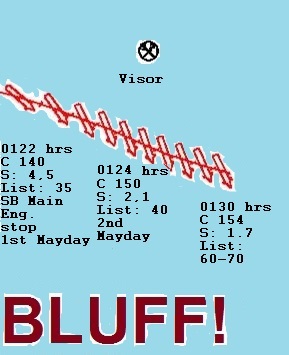
Estonian Time Time after Loss
of Visor (min) Water in the
Superstructure Water in the
Superstructure Angle of List as
per Huss (degrees) Angle of List as
per the Final report (degrees) Diff. in Amount
Water in the Ship: Final report/Huss
(tons) Diff. in Angle of List: Final
report/Huss (degrees) Inflow into
super-structure as per Huss (t/min) Inflow into
supers-tructure Final report (t/min) 01.14.00 0 0 0/0 0 0 0 0 400.0 200.0 01.24.00 10.0 1
154 2
000/? 22 40 >+846 18 38.5 200.0 01.27.00 13.0 1
269 4
000/? 26 50 >+2
731 24 38.5 666.6 01.33.00 19.0 1
500 6 000/14
000 29 80 +18
500 51 55.6 333.3 01.42.00 28.0 2
000 8 000/22
000 37 115 +28
000 78 55.6 220.0
a"During the port turn water continued to
enter the car deck and the list increased to 20-30
degrees where the vessel for some minutes
stabilised as the water inflow decreased". (Chapter
13.2.6 of (5))
(h. m. s.)
as per Huss (tons)
/in the Deck House as per the Final report
(tons)
b"By about 0120 hrs all four main
engines had stopped ... The main generators stopped about
five minutes later.
After the main engines stopped, the 'Estonia' drifted with a
list of about 40 degrees and the
starboard side towards the waves". (Chapter 13.2.6 of
(5))
c"... and the vessel
started to sink. At a list of about
80 degrees the bridge was partly
flooded. This happened shortly after 0130 hrs as indicated
by the clock in the chartroom ... The emergency generator
stopped at the same time ..." (Chapter 13.2.6 of
(5))
Note the difference in water in the ship between the estimates of Huss/Rosengren and the Commission 19-28 minutes after the loss of the visor - 18 500-28 000 tons at 01.33-01.42 hrs! Notice the difference in the angle of list between the estimates of Huss/Rosengren and the Commission 28 minutes after the loss of the visor - 78 degrees at 01.42 hrs! Notice the difference in inflow amounts.
Huss estimates that the inflow into the superstructure was 55.6 tons/min after 19 minutes - at 01.33 hrs - and the Kalmar plot is based on it, while the Commission says that then the deck house filled up with about 7 000 tons/min and the superstructure with 333.3 tons/min. But no water flowed into the hull!
Why the Plot is false
The reason why Huss/Rosengren stop calculating the
inflow, when 2 000 tons have entered the
superstructure, is that they knew that then the ship
would capsize (and they cannot explain, why it didn't
happen). The Commission has no knowledge at all about
stability - it assumes that you can add water, as you like,
that the ship is stable (later the Commission invented the
story that the ship floated on the deck house), doesn't trim
and that the ship continues to float (and drift at unchanged
speed). The angle of list was 75 grader according
to the Commission at about 01.32 hrs (28 degrees
according to Huss) - 15 minutes after
the loss of the visor. Then the Commission reports
in chapter 13.6 of the Final Report (5) page 183
that "18 000 tons of water had flowed in divided
between the car deck and decks 4 and 5
(sic) in about 15
minutes" which is of course a completely
unstable condition - see figure 1.9.7 right - where
the centre of gravity G is located >8 meters
outside the centre of buoyancy B (decks 6 and 7 are
also flooded). Huss/Rosengren evidently knew that,
so they never included any water (14 000 tons!) in
the deck house in their plot. According to the
Commission (figure 13.2 i (5)) and as shown in
table 1.9.3 above only 4 000 tons had flowed into
the superstructure in 13 minutes. It means
that in two minutes the deck house filled
with 14 000 tons - inflow 7 000 tons/min or 117
tons/sek! The Final Report says that the inflow was
20 tons/sek. The higher figure indicates of
course that the ship was going to capsize - the
heeling moment turning the ship upside down
is about 100 000 ton-meter - but in spite of
the increased weight and the heeling moment at
01.32 hrs the Commission states that the
ship continued to sail/drift Eastwards with a speed
>2 knots35 for another 20
minutes.
Where the 18 000 tons of water were actually located
inside the ship is not known: assuming the average length of
superstructure/deckhouse to be 120 meters the flooded cross
area is 150 m². Say that the superstructure (decks 2
and 3) is 6 meters high and decks 4 and 5 are together 5.6
meters high the flooded width is >13 meters, i.e. more
than B/2 3.12. To
sink the ship you needed only about 3 000 tons of water in
the hull - but the hull was never flooded before 01.30 hrs
according the Commission.
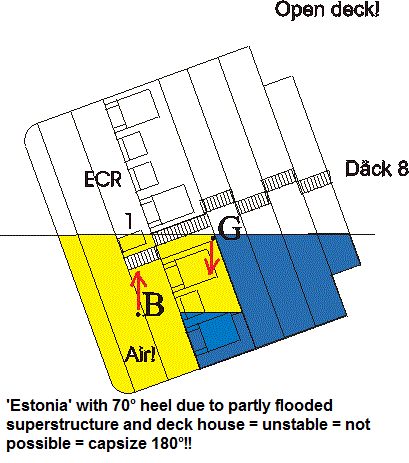
The 'Estonia' floats on the Deck House 01.24 hrs
The Swedish NMA - director general Jan-Olof Selén and the director of safety at sea Johan Franson - have commented upon the above in a letter dated 2000-12-15 reference 0799-0036172 to the Swedish ministry of Economy (and Transport) - minister Ms Mona Sahlin:
''The (Swedish) NMA will underline that, when calculating damage stability, you are not permitted to allow for the buoyancy in a deck house (superstructure), unless it is watertight. On ferries the deck house (superstructure) is not watertight, because there are doors, which are easy to open and windows that cannot resist water pressure. The situation that you from safety point of view are not permitted to assume and to calculate with the buoyancy of a deck house (superstructure), does not exclude that such a buoyancy actually exists. It exists and therefore the sequence of events as described by the Commission is very likely'.
The Commission clearly shows that the deck house (decks 4-7) is not watertight and thus is flooded with 7 000 tons/min in two minutes, nineteen minutes after the loss of the visor but twenty minutes before the ship sank, but that this sudden inflow or flooding of the deck house then stopped - how is not explained - so that the ship floated for another twenty minutes on a watertight part of the deck house, and the Swedish NMA (Franson/Selén) also thinks that there is an unaccounted buoyancy force in the deck house, which prevented the 'Estonia' to capsize. This is normal Swedish practice - you state one thing to prove one thing and another thing to prove another thing, even if the two statements are contradictory 3.12. Selén is the Director General and head of the Swedish NMA, Franson is Director of Ship Safety and Inspections. That deck houses do not provide any buoyancy when submerged at capsizes is shown in the Herald of Free Enterprise accident 1987.
The reader should know the following:-
|
Basic Particulars and Assumptions - Deck House - Intact Stability - Water in the Deck House
|
However, neither the Commission nor dr. Huss, nor Franson/Selén of the Swedish NMA, explains how the hull was flooded and why the ship actually sank!
The 'Estonia' drifts 1 300 Meters in lieu of sinks 01.30-01.52 hrs
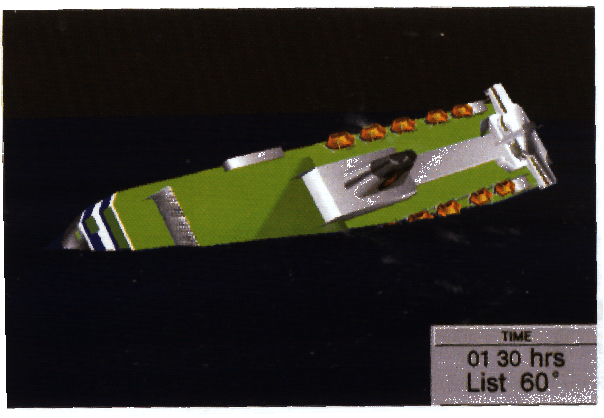
The movements of the ship never stopped according to the Commission and Huss/Rosengren. The 'sinking' ship continued to move/drift East or North East with a speed >2,2 knots sideway, in spite of the fact that it filled up with 28 000 tons of water and should have stopped. At 01.30 hrs the 'Estonia' had reached the following position as per a 'simulation' (another falsification!) in the Final Report (5) - see figure 1.9.8 below. Evidently there is no evidence that the ferry ever was in this position, but the picture is illustrative.
|
You can see the lifeboats: nos. 1, 3, 5, 7 och 9 starboard, where no. 9 is completely below water and no. 7 is in the waterline, while nos. 2, 4, 6, 8 och 10 port remain on the upper side. You see also two white 'squares' fore and aft of the lifeboats and they are the sloping ramps for the life raft containers that can be thrown overboard. Starboard aft rafts are below water (no white square seen) and should at this time have been ripped off the ramp, opened up and drifted away. Alternatively they were so hard secured to the ramp that they never release. We do not know how many of the 60+ rafts that were actually released. The number of rafts found have never been published. There are reports from survivors in 20 different rafts A-U in chapter 6.3.12 of the Final report (5). |
|
|
|
The ship is evidently sinking and should have capsized but dr Huss & Co. states that it moves with >2,2 knots (the current is <0.5 knots) sideway (sic) for 22 minutes 1 300 meters Northeast to suddenly sink at 01.52 hrs (see figure 1.9.1 above). However, there are no evidences that the 'Estonia' actually drifted in such a way. The writer thinks that the 'Estonia' sank at 01.32-01.36 hrs, because the clock on the bridge stopped at 01.35 hrs. Kukk's Story The assistant mate Einar Kukk was at this time - just prior to 01.30 hrs - on deck 8 - in line with the lifeboats in their stowed positions. He told the Finnish police on 29 September (12.30 hrs) that there were 70-100 persons on decks 7 and 8 then and that you could only move by creeping. |
Henrik Sillaste
Our hero Sillaste from chapter 1.3 of this book had at this time evacuated from the Engine Control Room, ECR, at about 01.24 hrs 1.48 and was now - a miracle - at 01.26 hrs, on the outside of the port, flat hull of the 'Estonia', where he was opening life raft containers (see Raft "S" - chapter 6.3.12 in (5)).
He secured these rafts - how many are not known and not to what he secured them - and when the angle was correct, he cut the ropes so the rafts slid into the water. There are no ropes attached to a drop-over-board life raft container. The containers are heavy and difficult to handle - you need two men to slide a container on a flat deck, and how these life raft containers ended up on the port side is not known. Anyway Henrik Sillaste inflated several rafts and was together with Silver Linde and Kadak in raft "S" - apparently one of the rafts launched by Sillaste. Later - Linde found another raft and moved over to it - all according to (5). Strange story.
Key witness Sillaste is such a useful person to the Commission - he is on deck 0 when the ship heels at 01.15 hrs and does not see anything strange there. Then he is in the ECR on deck 1 between 01.17 and 01.24 hrs and sees water entering into the superstructure at the partially open ramp, and the finally he is on the outside of the ship at 01.27 hrs launching life rafts and at 01.30 hrs he is safely inside a life raft floating in the water. But the ship does not sink until 01.52 hrs. What a fantastic and lucky escape.
On the figure above you can also see that no. 1 starboard lifeboat was still above water, when the list was 60 degrees with a good stern trim. There are speculations that this lifeboat was launched before or after the accident, the listing, 2.25 and 3.18. It may have been launched as late as 01.30 hrs, when it was just a few meters above the water.
You can speculate, if Rosengren/Huss were aware of the fact that the ship actually sank at 01.32-01.36 hrs, because Huss reported that the speed and stability were then zero (01.33 hrs) (sic) - the ships was only drifting? Figure 13.2 is remarkable - after 01.33 hrs the ship starts to move to Northeast and the plot records another 20 minutes (!) of movement sideway at 2,2 knots in a completely unstable and alleged sinking condition. This speed 2,2 knots is maintained unchanged (!) until the ship sank. But the speed cannot be 2,2 knots, when a ship sinks - it must be zero. But the plot is of course of a completely undamaged ship. It is quite a bad falsification.
The late Clarifications of the Headmaster of the Kalmar Marine Academy
On 21 February 2001 the headmaster of the Kalmar Marine Academy and the boss of Hans Rosengren, Mr Rolf Zeberg - wrote to the writer:
"My dear Anders Björkman,... I have full understanding with your displeasure of the 'Estonia' accident investigation. I too think it has big deficiencies and contains too many compromises - but it is probably the result when you are not appointing a neutral and really competent Commission.
I have earlier pointed out that the Kalmar Marine Academy in no way was connected to the investigation of the Commission. I do not know who got the idea to simulate the sequence of accident events on our navigation simulator, but it was probably Hans Rosengren himself that suggested it, as it had successfully been used earlier to simulate other accidents but then collisions and similar.
Anybody aware of the objective of a navigation simulator and its technology is probably also aware of the limitations, e.g. what preceds the sinking of a ship (and that the navigation simulator does not calculate stability - AB note). ...
... I hope you reach your objective, which apparently is that a new 'Estonia' investigation is decided.
Good luck
Rolf Zeberg"
Unfortunately Mr Zeberg has not voiced his scepticism officially and Captain Rosengren is still a teacher at the Academy (teaching his pupils how to falsify accident investigations with false plots?). Anyone familiar with plots of navigation simulators should quickly have spotted that the plot presented by the Commission was the plot of an undamaged ship making a turn and then drifting and never sinking.
The Falsifications were intentional
The conclusions are clear. Dr Huss, FRINA, second attempt to simulate the last 40 minutes of the 'Estonia' was a real attempt to falsify the sequence of events. It can be shown that the original plot 01.14 - 01.52 hrs is based on the simulated movements of an undamaged, floating ship that never sank at 01.52 hrs (it continued to drift), that the plot was cut or edited after 01.52 hrs and that arbitrary angles of heel have been added later. Dr Huss and Captain Rosengren must then have known that the whole investigation was being manipulated, when they made the plot - why otherwise use an undamaged ship to simulate the plot? Huss was probably ordered by Forssberg to produce the false plot already in January 1995 just after having handed in his first report, which clearly showed what would have happened with water in the superstructure. Thus the conspiracy to cover up the Truth was in full swing then.
The Commission used the plot of dr Huss and Captain Rosengren and changed heel angles and times further to 'suit' some observations aboard to make the falsifications more convincing. Then nothing fitted anymore. Evidently neither Huss/Rosengren nor the Commission could explain why the hull was flooded, so that the 'Estonia' sank. Instead they were only worried about the amounts of water in the superstructure and the resulting angle of list and that the vessel would not sink - or capsize - so that it could drift >3 000 meters before it sank at the position of the wreck at 01.52 hrs. The long description of the flooding of the deck house was added to make the scenario more convincing. This could not be done without shameful manipulations and falsifications of basic stability principles, and the times, angles of heel, etc.
Figure 13.2 in the Final
Report (5) is thus a falsification. Dr Michael Huss and Captain
Hans Rosengren of the Commission made the original
falsifications and the whole Commission made
further falsifications.
|
The falsification is evidence that the total Final Report (5) is wrong. |
|
There was no port turn. The visor was attached to the ship after the listing. |
Dr Huss has since never managed to convince anybody that his calculations and simulations were correct and he had problems to perform his job as a teacher of naval architecture and instability (!) and floating on the deckhouse at the Royal Institute of Technology, Stockholm, where he had spent all his career since graduation.
Huss' last Explanation - the Result is very valid - the Thank-you Gift
In a job application to the Swedish NMA dr Huss, FRINA, wrote on 26 November 2000:
'Even if the (Estonia) investigation later has been subject to quite a lot of criticism, I dare state that with regard to the circumstances (sic) under which the investigation was done, the result has been shown to be very valid'.
The 'circumstances under which the investigation was done' were apparently that you could lie and falsify as you - or the Commission - liked.
Dr Huss got the job at the Swedish NMA in April 2001 appointed by Mr Franson 1.16. The appointment was quite irregular, apart from the fact that dr Huss lacked the relevant qualifications for the job. It was made public on 16 April 2001 on an obscure notice board in the cellars of the Swedish NMA headquarters at Norrköping (according to standard procedures?). In a circular letter of 9 May 2001 the other eight applicants were informed that somebody else (Huss name was not mentioned) had got the job. If they wanted to appeal the decision by Franson, they had to do it before 8 (sic) May 2001. It seems the new job of Dr Huss, FRINA, was a Thank-you gift from Mr Franson for the 'Estonia' job - the falsified simulation of the last 40 minutes.
What does the Swedish NMA staff think about that? Ask them! Or apply for a job there. It seems serious naval architects are leaving the NMA and that the new boss Huss is looking for new ones (the time to apply expires 7 November 2001 - Note February 2002 - the NMA has informed that the job was cancelled all together).
Dr Huss is still FRINA. The writer was invited to present a paper at a RINA conference in March 2002 about, i.a. the above. However, RINA decided at the last moment to stop the presentation, so you have to read the paper at the above link instead. RINA is not interested in safety at sea anymore. Quite sad!
Return to the Fantasy World of the Commission
But let's return to the 17 October 1994. The Commission has just told the media and public that the visor had fallen off the 'Estonia' on her way to Stockholm and that this was a contributory cause of the accident (the proximate cause was later 'design fault' of the visor itself). The visor was not yet found. Dr Huss was not yet appointed and the Commission was still not aware about the great difficulties of Huss/Rosengren to simulate or reconstruct a false sequence of events based on the alleged proposal that the visor was lost 'under way' and that water entered into the superstructure. The falsified figure 13.2 of the Final report (5) had not yet been produced.
It is very probable that the visor was not lost 'under way' and that the statement on 17 October was false. From that date all information of the Commission had to be manipulated to suit.
On 19 April 2001 the Swedish government requested the Swedish Board of Psychological Defence (sic) to clarify to it, the Parliament and the Swedish public how (on earth!) the hull of the 'Estonia' was flooded with water and how the ship (the hull) actually sank during the end of the sequence of events shown above (say between 01.30 and 01.52 hrs) without capsizing due to alleged cause - design fault of the visor. When this is written (28 February 2002) the Board has not even started with the project. And on 26 August 2002 the Board has still not discussed the possibility that the plot is a falsification.
---
34 At a meeting with dr Huss at the Royal Institute of Technology at Stockholm in August 1997 the writer friendly asked Huss to clarify his calculations. Huss refused and accused the writer to be conspiratorial (sic) and left the room. Huss' boss, professor Olle Rutgersson, who witnessed the event, was very embarrassed. As the 'Estonia' sank slowly in 35-45 minutes according to the Commission, it as obvious that Huss had been forced to manipulate his calculations. The writer informed that the inflow should have been 1 800-3 600 tons/minute of water on the car deck Appendix 4 instead of 10-20 times less and this was apparently conspiratorial. Professor Rutgersson is one of the Swedish governments 'independent' experts who has later been asked to review e.g. the information in this book. Rutgersson has never had the guts to confirm any error in the Final report - all new observations are difficult to analyse! Professor Rutgersson does not dare to criticize the faulty calculations of one of his employees. In 2001 the government decided to close the department of Naval Architecture at the Royal Institute of Technology and to transfer the activities to the Marine Academy at Gothenburg.
35 The remarkably high speed >2 knots for 20 minutes, when the 'Estonia' half sunk drifts sideways, is necessary so that the 'Estonia' reaches the wreck position.
37 Press Release from the Ministry of Foreign Affairs Republic of Estonia IMMEDIATE RELEASE Nr. 94.10.03 06 October 1994 17:15 (GMT +2) THE BALTIC FERRY DISASTER. Reports from the Estonian Government Commission, and the International Joint Investigation Commission. The Estonian Government Commission met today at 11:00 am and discussed the current state of the investigation. More video footage of the wreck was studied ... The International Joint Investigation Commission into the 'Estonia' ferry disaster issued a press release which reported on the search for the bow visor of the 'Estonia'. The report is quoted below
"... The Finnish coast guard vessel
'Tursas' and the Estonian coast guard vessel 'EVA-200' have
searched for the bow visor of the m/s Estonia throughout the
night. Early on the morning of the 6th of October, however
the search had to be interrupted due to strong winds. The
search was begun in the immediate vicinity of the wreck.
The search has so far
concentrated primarily immediately to the east and
the south of the wreck Smaller objects found on the
sea bed would appear to confirm this presumed
route.
which, according to the available information, would match
the route taken by the m/s Estonia.
The search has thus been interrupted, and will be continued
as soon as the winds allow. The board of Investigation
requests that the representatives of the media do not
contact the 'Tursas' directly for information, as the sonar
scans and the analysis of the data requires the
uninterrupted attention of the crew".
The search was never continued. On the 8-9 October the 'Tursas' was anchored at the wreck and filmed it. Then the 'Tursas' was in port until 17 October. Then the 'Tursas' found the visor - without any search - on 18 October. Then there were no more searches for 'fragments'.