|
![]() |
|
Many persons today, 2013, are curious how much fuel (energy) you need to fly to the Moon ... and back using 1960's or today's space ship technology and how much it cost and arrive at this popular web page visited by 1 000's of people. If you ask Google or any search engine, it will direct you to a couple of nonsensical sites and web pages apparently supported by NASA. Why is that? The answer is simple. It is not possible to fly to the Moon and back (inspite of Wikipedia/NASA shills suggesting otherwise) because you need plenty of fuel/energy to do it using the best rocket engines available by the military very secret industry, but you cannot carry all the fuel with you, because you get too heavy. The cost is also prohibitive. And any human will probably be fried to death in space due to cosmic radiation. Those are the reasons why USA/NASA faked it in the 1960's to impress friends and foes. So "NASA is not going to the Moon with a human as a primary project probably in my lifetime, NASA chief Charles Bolden said" April 5, 2013 is simple propaganda. You cannot go there at all. Anybody planning a Moon trip should study below article. You cannot even just get to the Moon and land (forgetting about the return) because you need too much fuel just to brake when landing on the Moon and you cannot get this fuel with you off the Earth apart from other safety risks like being fried alive or bombarded by cosmic particles during the trip. Surprised? Sorry, you are a victim of the NASA fraud that started around 1961 backed up by media (newspapers, radio, TV, Hollywood) and US flying saucers and UFO observers, etc. NASA evidently knew they needed 10 times more fuel/energy or 10 times more efficient rocket engines to go to the Moon and as they and US military experts could not produce it ... they faked it (to impress the USSR experts that were laughing all the time). Same with the Shuttle or all transports from the ISS! Same with the Mars Science Laboratory! All of it. Imagine the amount of money NASA has stolen from US tax payers since 1961. Listen to what experts summarize: "A significant factor contributing to the difficulty (of space travel) is the energy which must be supplied to obtain a reasonable travel time. A lower bound for the required energy is the kinetic energy K = ½ mv² where m is the final mass. If deceleration on arrival is desired and cannot be achieved by any means other than the engines of the ship, then the required energy at least doubles, because the energy needed to halt the ship equals the energy needed to accelerate it to travel speed." Etc, etc.
I and my agency Heiwa Co are mainly interested in peaceful, maritime transportation safety and fuel consumed at sea and, therefore, also in space travel. Difference is not big! How to travel in space safely? You need fuel to reach your destination. And let's face it - Apollo 11 finally ended up in water subject to maritime rules and regulations - my specialty. My ships operate in the wavy interface water/air on Earth that offers resistance and limits velocity all the time and make some people sea sick. Space ships operate in space that offers no resistance until you enter a planet's atmosphere. Only gravity forces of the Sun, planets and moons affect vehicles in space. The fuel used during the first manned Apollo 11 Moon visit July 1969 is of great interest, as you must bring along all fuel from start to accomplish all parts of the trip after getting launched from planet Earth by external rockets. The NASA faked it! You cannot fill up under way (unless you carry, e.g. solar panels to charge some batteries, etc)! You need fuel (energy) to brake or reduce speed and to accelerate or increase velocity in space. Rocket engine function to accelerate and brake in space is very simple. The liquid fuel burns in the rocket engine combustion chamber and becomes hot gas at great volume that is ejected at high velocity in one direction through a rocket engine nozzle, which produces a force applied to the space ship with the engine/nozzle in the other direction that changes the speed as required. You have to carry all the fuel with you from start. The NASA faked it. According NASA [1]
you need only 10 898 kg rocket fuel to slow
down a 32 676 kg space ship (Apollo 11) from
2 400 m/s to 1 500 m/s speed during 357.5
seconds to get into lunar orbit. These 10 898
kg fuel was according NASA available to
produce 88.73 GJ energy to slow down
the space ship, 1 kg of rocket fuel thus
produced 8.14 MJ brake energy, i.e. fuel
consumption to produce energy for braking was 8.14
MJ/kg fuel. It sounds much too good to be true. I do not
believe it is technically, humanly and physically
possible. I think you need much more fuel. I
explain why in my presentation below. Furthermore I
doubt the space ship pilots/cosmokrauts could carry
out the braking maneuver flying backwards. NASA and Dr. David R. Williams, are not willing to tell neither how much fuel was actually needed and carried by the Apollo 11 Service and Lunar modules to produce the kinetic energy required to get into orbit around Moon with the Lunar Module, visit the Moon and then get out of orbit around Moon direction Earth and to brake upon arrival Earth again, nor how and where to store it during the trip! Info is available in confusing reports, but if it can be trusted is not certain. 1969 model rocket engines seem to be very efficient. Too efficient! Reason is that too much fuel was required that could be carried and the pilot maneuvers were impossible to carry out ... and that everything was just a hoax 1969. That people believed. It was easy to fool people 1969. Since the 1940's the public had been told that Flying Saucers, UFOs, were regularly visiting Earth and that the USA could easily do space flying too. No rocket engineers would disagree. They are generally military where everything is secret. But ... This article explains in detail the energy, i.e. fuel, required by (1) the Apollo command/service modules to get into and out of Moon orbit from Earth and (2) the Lunar module to land on Moon and get back into orbit around Moon again. Fuel consumption is given as MJ/kg, i.e. how much effective kinetic energy 1 kg of rocket fuel produces during the various speed changes, when fuel is consumed. Another fuel consumption figure, kg/s, when the SM rocket engine was fired seems to have been constant 30-31 kg/s. The conclusion is simply that the Service and Lunar modules could not carry the required fuel and that the Saturn V rocket could never have carried the space ship and the extra fuel into space. Too heavy! The article also analyses the Apollo re-entry to Earth. No fuel at all was used to decelerate the Apollo 11 descent on Earth. Only friction and turbulence were used ... which is simply impossible. The Apollo command module should have burnt up at re-entry. Applying the same principles to the many NASA Shuttle re-entries and the recent NASA Mars Science Laboratory landing on Mars you find they are other likely hoaxes. A good way to start is using Formal Safety Assessment methods, which are standard in the marine world. So how is it possible that NASA fakes their activities? The person to ask is Terrence
W. Wilcutt, NASA's Chief of Safety and
Mission Assurance. Terrence heads the Office of
Safety and Mission Assurance (OSMA) that assures
the safety and enhances the success of all NASA
activities through the development, implementation,
and oversight of Agencywide safety, reliability,
maintainability, and quality assurance (SRM&QA)
policies and procedures. Enjoy reading the article and the links (if they work)! Comments are always welcome at anders.bjorkman@wanadoo.fr . And if you get hold of Terrence, pls tell me! If you think I am crazy, I recommend that you emigrate to planet Mars with Terrence and make a fortune there. The space ship is ready! But can you really trust the space travel agent Elon Musk selling the tickets? Elon is performing SpaceX re-entries today. But is anybody really up there in the ISS being re-entered? The ISS is 99% NASA that created the Apollo 11 hoax paid for by US tax payers. I have a feeling the show is just going on. Prove me wrong! Show that you are clever and earn € 1M! |
|
(The spaceship velocities used here are absolute to the center of Earth thus assumed fixed. The planet Earth evidently orbits around the Sun at other velocity. Space travel experts suggest that I should add the velocity of the Earth orbiting the Sun plus the velocity of the Sun orbiting the Universe to the velocities given here but as I do not know the latter I just use the velocities given by NASA relative the center of Earth ... to calculate the kinetic energies involved. Just to get a feel of the situation. It seems Moon travel is pretty easy as the Moon orbits the Earth almost circularly. If you depart from Earth orbit at exactly the right time and speed on a straight course to arrive at the Moon a few days later, you can visually see the Moon ahead of you a little to the side or up/down all the time when getting closer - Earth gravity slows you down though and Sun gravity may affect your straight course - and if you navigate correctly you will after 90% of the trip feel the Moon gravity attracting you and your space ship - velocity increases again - and your concern is then not to crash on the Moon but to get into orbit around the Moon at the right altitude/velocity. Remember that the Moon has a velocity of 1 023 m/s in orbit around Earth, which you must consider. Of course the Sun radiation will heat up your space ship to 150°C during the trip, so increase the aircon inside not to get fried or boiled inside. If you miss the Moon, there is no way back because you cannot possibly turn around in space due to lack of fuel.)
How much fuel (energy) is required to get to the Moon and back after having left Earth and what did it cost? The below presentation is compiled using info from the following sources of NASA about the Apollo 11 Moon/Earth 1969 trip:
"The NASA technical reports server will be unavailable for public access while the agency conducts a review of the site's content to ensure that it does not contain technical information that is subject to U.S. export control laws and regulations and that the appropriate reviews were performed. The site will return to service when the review is complete. We apologize for any inconvenience this may cause." The NASA info 1969 is evidently wrong, false or incomplete or under review 2013, e.g. masses of modules and fuel differ from source to source, fuel consumption for various events are unclear and the velocity to orbit the Moon, 3 000 m/s according NASA, cannot be correct and a good reason to doubt that a manned Moon/Earth space trip took place 1969, etc, etc. This presentation is mainly about i) the energy used to change velocity up or down during the trip and ii) how much fuel is used for each change and iii) if it can be carried along. The Apollo 11 1969 Moon trip went something like this:
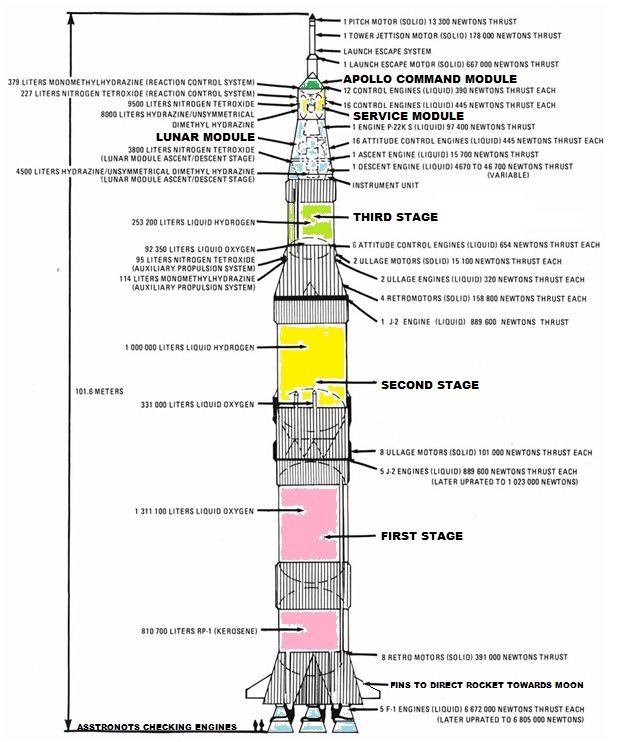
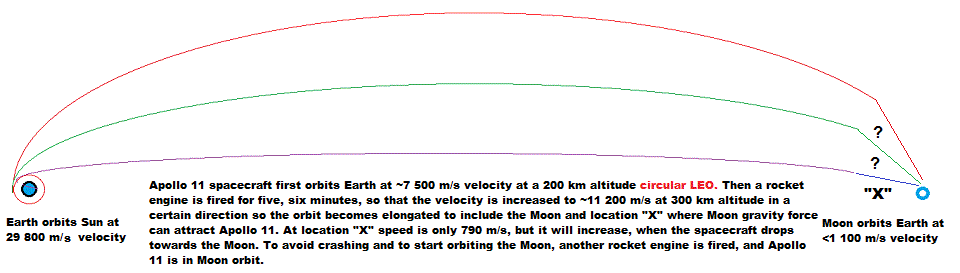
Summary table of Moon trip Table starts when the Apollo 11 Control, Service Modules, CSM, and Lunar Landing Module, LM, fitted on the full of fuel Saturn V rockets third stage are already on the way at ~7 500 m/s velocity in Earth orbit put there by the Saturn V rocket's first and second stages (Event #1). The total mass of Apollo 11 + third stage is then 135 699 or 338.692 kg. Nobody seems to know! At that speed and altitude you go around Earth in about 90 minutes! If you go slower you will soon crash on Earth. Then the third stage rocket is allegedly fired (Event #3) and the Apollo 11 modules are sent off at ~11 200 m/s velocity in direction Moon about 400 000 km away ... or where the Moon will be three days later. Plenty of fuel was used for getting off the Earth ...3 798 350 liters (or about 4 000 tons) ... but all carried in separate rocket stages.
Event # 1 - Into orbit around Earth - (Low Earth Orbit - LEO) - How much did it cost? First rocket stage with steering fins and 1 311 100 liters liquid oxygen + 810 700 liters kerosene (total mass of fuel about 2 169 tons) for 5 F-1 engines with 6.672.000 N thrust each and second rocket stage with no fins - 1.000.000 liters liquid hydrogen (mass 709 tons) + 331 000 liters liquid oxygen (mass 468 tons) for 5 J-2 engines with 889 600 N thrust each were apparently used to get the Apollo 11 (CSM+LM) and the third rocket stage into Low Earth Orbit around planet Earth at 7 500 m/s speed. The first stage burnt 2 121 800 liters fuel in 161 (or 150) seconds, 13 179 liters/second (or 12 705 liters/second or 12 885 kg/second according Wiki) fuel and brought the second and third stages + Apollo 11 to a height of 68 000 m and a speed of 2 755 m/s. Imagine burning about 2 169 tons of fuel in 161 seconds. The second stage burnt 1 331 000 liters hydrogen/oxygen fuel in about 389 seconds - 3 422 liters/second producing the required force and visible exhaust to get the third stage + Apollo 11 into Low Earth Orbit, LEO, at speed 7 500 m/s and altitude about 400 000 m. Imagine burning about 1 177 tons of fuel in 389 seconds. According Wiki the weight or mass of the fuel was only 444 tons!
Imagine if it cost NASA $ 10 000:- to put one kilogram into LEO. We dont' know if Apollo 11 had mass 339 or 136 tons but the cost should then have been of the order $ 3.39-1.36 billions. Not cheap! (Thus easier just to fake it). And the NASA hoax is just going on and on:
Events # 2 and 3 - Out of orbit - trans-lunar injection - and en route to the Moon at 40.11° on your side Two hours, 44 minutes and one-and-a-half Earth orbits
after launch the third rocket stage with 253 200 liters
liquid hydrogen + 92 350 liters liquid oxygen (total mass
284 890 kg) for 1 J-2 engines with 889 600 N thrust
reignited for a burn of 349 seconds, placing Apollo
11 (CSM+LM) and itself en route to the Moon about 384 000
000 meters away, i.e. where the Moon will be after about 75
hours.
Events # 5 and 6 - Slowing down very suddenly to get into orbit around the Moon = lunar orbit insertion maneuver At about 75 hours, 50 minutes into the flight when the space ship had total mass of 43 574 kg (or 96 062 lb) and radial speed ~2 400 m/s straight from Earth, a retrograde firing of the service module, SM, P-22KS rocket engine with 97 400 N thrust for 357.5 seconds reduced the speed to 1 500 m/s at 2.52 m/s² deceleration and placed the spacecraft into an initial, elliptical-lunar orbit at about 115 000 m altitude. Events # 5 and 6. Ref. [1-Table 8.6-2] states other speeds. The Moon has radius 1 738 000 m. The lunar-orbit has thus radius 1 853 000 m. The lunar orbit insertion changes the course 21 55° or 28.14°. There is no change in potential energy as you remain at 115 000 m altitude during lunar orbit insertion (forgetting it is a little elliptical). You apparently need a big, powerful rocket engine of the SM, as it is only used to brake or accelerate in space to get in/out of Moon orbit, where you have little time to maneuver. It thus took about 73 hours or 262 800 seconds to travel the distance R = 384 000 000 meters to the Moon = the radius R of the Moon orbit around Earth. Average velocity during that trip was ~1 460 m/s. During that time the target - the Moon - moved 262 800x1 023 = 268 844 400 meters in orbit around Earth because the velocity of the Moon is 1 023 m/s. It means that at start of Moon travel the Moon was at bearing 40.11° on the side of Apollo 11 and near 0° or straight ahead on arrival to insert into lunar orbit at 115 000 m altitude. Of course the bearing changed all the time, like the distance travelled and the local speed, during the 73 hrs passage, but if you got off to a correct start with the Moon at exactly 40.11° on your side and in the horizontal plane of Earth/moon, then no adjustments were required during the trip. It is not easy to navigate in 3-D space when the target - the Moon - is also moving, luckily at constant speed, ahead of you. Imagine starting at 11 200 m/s speed and then slow down to about 800 m/s due Earth gravity during 66 hrs and then speed up again to ~2 400 m/s during 7 hours, when Moon gravity gets hold of you. And after 262 800 seconds of variable speeds space travel a 357.5 seconds blast to produce 97 400 N thrust, burning 10 898 kg of fuel, brought you suddenly into Moon orbit. Amazing. Imagine burning almost 11 tons of fuel just to brake and a 22-28° turn for 6 minutes! And do not forget that the Moon has its own orbital velocity of 1 023 m/s around the Earth, when you were coming in from behind. The Moon thus moved 365 722 meters, while Apollo 11 travelled 697.125 meters to get into orbit. It seems quite complicated to enter into orbit of a rather fast moving moon! The Specific Fuel Consumption (g/(kN*s), SFC, seems to be 10 898 000/(97.4x357.5) = 313 but it is just a relationship between thrust and fuel burnt and not an indication of work done and energy required. Space ship mass after this brake maneuver was 32 676 kg (or 72 038 lb). The spaceship kinetic energy before braking was 43574*2400²/2 = 125.5 GJ and after braking 32676*1500²/2 = 36.76 GJ, i.e. change in kinetic energy due braking was 88.73 GJ. Self appointed space travel experts suggest that you cannot calculate the kinetic energy in space like I do, as the 'space' is moving at another velocity than the one relative Earth/Moon to be added or subtracted to the ones given but as the latter speed is not known to them, I keep it simple as indicated. It seems we agree that fuel/energy, in this case 10 898 kg, was used to change the velocity of the space craft from something - 2 400 m/s - to the one orbiting the Moon - 1 500 m/s and that the space craft in the process became 10 898 kg lighter. The amount of fuel on the CSM used for events # 5 and 6 was 10 898 kg that equals the change in space ship mass before/after braking. The 10 898 kg mass of fuel evidently disappeared in space as exhaust fumes at velocity 4 033 m/s providing the brake force energy (88.73 GJ) and has not been seen or heard of since. The exhaust has no color! If the exhaust fumes have velocity only 1 426 m/s, 8 times more fuel is required for braking. During the 357.5 seconds braking the space ship, apart from changing course 21.55° (assuming the Moon was standing still (sic), travelled about 697 125 meter (for that you need a brake force 127 151 N that the SM engine could not provide?) or maybe 910 000 meter (course change 28.14° - Moon still immobile!), with a brake force 97 400 N provided by the P-22KS rocket engine but then it took longer - 467 seconds. Basic physics is quite simple. But then the SPC is only 240.
In order to do a correct braking - reducing speed - in universe of a space ship by retrograde firing of a rocket engine close to the moving Moon, the rocket engine outlet must evidently be positioned in the direction of flight during the 700 000 to 900 000 m curved braking trajectory ... thus the space ship flips 180° with pilots looking backwards ... not seeing the Moon at all through the space ship windows. The three brave space pilots flew backwards, when suddenly braking to insert into Moon orbit. The trajectory was evidently not straight as you curved 22-28° or whatever into Moon orbit due to Moon gravity. At start of braking the 43.5 ton space ship velocity was 2 400 m/s. Then you applied the 10 ton rocket brake force (97 400 N) to your 43.5 ton space craft and braking started. At end of braking, 357.5 (or 467?) seconds later space ship velocity was 1 500 m/s and you were in an elliptic Moon orbit after having spent 10.898 kg fuel at rate 30 kg/second and turned 22-28°. You probably were at same altitude 115 000 m during the maneuver, but who knows and cares? The conversation of the asstroholes during the 6 minutes lunar orbit insertion burn between 75 hrs 50 minutes and 75 hrs 56 minutes of the flight does not reveal anything dramatic ... except that they can see the Moon while braking backwards. How was it possible? Were the three (crazy?) assholes aboard piloting the space ship manually with compass/chart pushing the brake button or pedal in the process looking out through the window like on an airplane? How did they know what was up/down/right/left and the directions of velocity and the force. How was the steering done? Assisted by 1969 made computers and instruments? It is suggested that Moon gravity actually caused Apollo 11 to turn while speed increased and that the brake burn started behind the Moon with the pilots looking aft. If the brake force was applied a little too much left or right or up or down, they could easily crash on the Moon or fly off into Universe. NASA seems 2013 unable to provide an answer. But: "The steering of the docked (sic) spacecraft was exceptionally smooth, and the control of applied velocity change was extremely accurate, as evidenced by the fact that residuals were only 0.1 ft/sec in all axes." [1-4.6] Amazingly, Apollo 11 managed to get into Moon orbit 1969 one way or another, we are told to believe, and a little later the LM undocked from the CSM and started its descent towards the Moon. The show (hoax) went on!
Events # 8-11 - Eagle undocking, descent and landing on the Moon (and how it was done) On July 20 at 100 hours, 12 minutes into the flight, the LM Eagle, mass 15 279 kg (or 33 683 lb), undocked and separated from CSM Columbia, mass about 16 623 kg (36 647 lb). Event # 8. Altitude was about 100 000 m. "Particular care was exercised in the operation of both vehicles throughout the undocking and separation sequences to insure that the lunar module guidance computer maintained an accurate knowledge of position and velocity." [1-4.9] At 101 hours, 36 minutes, when the LM was behind the Moon on its 13th orbit, the LM descent engine with 46 700 N thrust fired for 30 seconds to provide retrograde, i.e. braking thrust and to commence descent orbit insertion, changing to an orbit of 9 by 67 miles, on a trajectory that was virtually identical to that flown by Apollo 10. So the CSM/LM orbited the Moon with circumference about 11 000 kms 13 times in about 26 hours - average speed thus 1 500 m/s. Relative the Moon of course. The Moon orbits the Earth at 1 023 m/s. Descent initiation was performed with the descent engine firing for 756.3 seconds with 46 700 N thrust. After eight minutes, the LM was at "high gate" about 26.000 feet (7 925 meter) above the surface and about five miles (8 040 meter) from the landing site. Just prior to powered descent the LM crew managed the following important manual check on intertial platform (sic) drift at 1 500 m/s speed: "Just prior to powered descent, the angle between the line of sight to the sun and a selected axis of the inertial platform was compared with the onboard computer prediction of that angle and this provided a check on inertial platform drift." [1-4.10.2] Imagine that - manually checking the computer calculations! How to steer an LM with only one big rocket engine is described here! It looks as if it is impossible. The LM descent engine continued to provide constant 46 700 N braking thrust until about 102 hours, 45 minutes into the mission when the LM Eagle, arrival mass 7 327 kg (16 153 lb) landed in the Sea of Tranquility at 0 degrees, 41 minutes, 15 seconds north latitude and 23 degrees, 26 minutes east longitude. You would expect that you could vary the 5 tons thrust to slow down or stop the descent - to have a look around - and then slowly descend the last 10 meters, but there is no indication that you could do it. Imagine manually controlling a rocket engine (thrust and direction) that can provide 5 ton (46.7 kN) thrust onto a 7.4 ton (7 327 kg) space ship in a low gravity 1.6 m/s² field. This Armstrong asstrohole was fantastically clever! An American HERO! The descent engine worked until the LM Eagle had landed. There is no evidence that the Moon surface was affected beneath the descent engine nozzle a little above producing 46.7 kN thrust ejecting exhaust at 1 400 or 4 000 m/s speed creating, e.g. some disturbance. Event # 11. Maybe there was no dust on the Moon? However: "The landing gear foot pads had penetrated the surface 2 to 5 centimeters and there was no discernible throwout from the foot pads". [1-11.2.1] 7 952 kg (of 8 212 kg) fuel carried in the LM descent stage was used for the 100 000 m descent and decrease in speed from 1 500 m/s to 0 m/s. The LM kinetic energy before descent was 15279*1500²/2 = 17.19 GJ and after landing 0 GJ, i.e. change in kinetic energy due braking was 17.19 GJ. The LM potential energy before decent was 15279*100000*1.63= 2.49 GJ (and 0 on the Moon Surface). Total energy change was 19.68 GJ. As 7 952 kg fuel was used to overcome 19.68 GJ energy, 1 kg of fuel produced 2.47 MJ brake energy; fuel consumption 2.47 MJ/kg. It seems the LM rocket engine used 3.3 times more fuel than the SM.
Event # 11 - On the Moon planting the flag After landing asstronut Armstrong reported: "Houston, Tranquility Base here - the Eagle has landed." Armstrong stepped into the 150° C hot lunar surface dust at 02:56:15 UT on 21 July stating, "That's one small step for man, one giant leap for mankind". Somebody took a photo of the boot trace in the dust later. His boots didn't melt in the hot Moon dust. Aldrin followed 19 minutes later. The astronauts deployed the flag and instruments, took photographs, and collected very hot - 150° C - lunar rock and soil and dust: "Collecting the bulk sample required more time than anticipated because the modular equipment stowage assembly table was in deep shadow, and collecting samples in that areas was far less desirable than taking those in the sunlight. It was also desirable to take samples as far from the exhaust plume and propellant contamination as possible." [1-4.12.4] or ... another version: "Approximately 20 selected, but unphotographed, grab samples (about 6 kilograms ) were collected in the final minutes of the extravehicular activity. These specimens were collected out to a distance of 0 to 15 meters in the area south of the lunar module and near the east rim of the large double crater. ... During bulk sampling, rock fragments were collected primarily on the northeast rim of the large double crater southwest of the lunar module". [1-11.1.5] Strangely enough the asstronuts didn't measure the temperature of the samples. Maybe it was too hot? And you wonder what the temperature was inside the space suits? No gravity experiments were carried out, e.g. to drop a piece of rock from the LM platform down to ground, distance 3.61 meters, and film it. The drop would take exactly 2 seconds (compared with 0.86 seconds on Earth). But why drop it? Throw it upwards instead. It will really go far! It would have looked nice ... and is difficult to fake. But they allegedly left an experiment on the lunar surface to prove that they had been there, which (2004) continues to work as well as it did the day it got there, 1969. The Apollo 11 lunar laser ranging reflector consists of 100 fused silica half cubes, called corner cubes, mounted in a 46-centimeter (18-inch) square aluminum panel. Each corner cube is 3.8 centimeters (1.5 inches) in diameter. Corner cubes reflect a beam of light directly back toward its point of origin. Anyone can send a laser signal to it on the Moon and the signal will bounce back - ergo - the cosmokrauts were on the Moon. However, in 1969 they forgot to tell anybody about it. Imagine that! A whole or half silica cube with a diameter that bounces light! The astronuts traversed a total distance of about 250 meters. The visit ended at 5:11:13 UT when the brave men returned to the LM and closed the hatch. Inside the LM it was now150° C hot. If the asstronuts filled the LM with cool air and get out of their space suits for a nap are not clear ... except that they slept for 10 hours after the hard outside lunar labour. Then it was time to go back to the CSM! At later Moon visits the asstronuts took a car along so they didn't need to walk. ![]() Evidently the car also heated up to 150°C in the sunshine. It was left behind and is still there today!
Events # 12 and 13 - Departure and Lunar Module ascent stage lift-off from the Moon The LM ascent stage - mass 4 888 kg - lifted off from the Moon at 17:54:01 UT on 21 July after 21 hours, 36 minutes on the lunar surface. The rocket engine suddenly applied 14.7 kN thrust while burning about 4.5 kg fuel per second ejecting about 5 m3 exhaust at 1 400 or 4 000 m/s velocity. Imagine a 1.5 ton force suddenly being applied to a 4.9 ton mass. That is the lift-off from the Moon.
As 2 285 kg fuel was used to overcome 4-5 GJ energy, 1 kg of fuel produced 1.75- 2.2 MJ energy; fuel consumption 1.75-2.2 MJ/kg. It is quite close to the consumption 2.47 MJ/kg for the descent. But still much less efficient than the SM engine. Total fuel used by the LM for descent and ascent was 10 237 kg according [1]. The LM was jettisoned into lunar orbit at 00:01:01 UT on 22 July and remained in lunar orbit, where it should still be today as there is no friction stopping it.
Events # 14 and 15 - Speeding up to get out of orbit around the Moon to get home = trans-Earth injection Trans-Earth injection of the CSM, mass now 16 829 kg (37 100 lb) began July 21 as the P-22KS rocket engine with 97 400 N thrust fired for two-and-a-half minutes (150 seconds), when Columbia was behind the moon in its 59th hour of lunar orbit. The speed increased from 1 500 m/s to 2 400 m/s at average acceleration 6.00 m/s² (!) and placed the CSM into course straight back to Earth. Events # 14 and 15. Mass was then 12 153 kg (or 26 793 lb). 4 676 kg of fuel was burnt. The asstronots were now facing forward during the trans-Earth injection. Their conversation between 135 hrs 23 minutes and 135 hrs 27 minutes of the flight when they were subject to 6 m/s² acceleration was quite normal. The speed after trans-Earth injection was maybe 2 640 m/s. The distance travelled during the 150 seconds curved trans-Earth injection - you have to get out of orbit around the Moon at exactly the right moment and into a straight course to Earth overcoming Moon gravity force - was only 292 500 meter. It looks like you only need an average force of ~57 000 N or 6 ton to do this maneuver, so maybe the rocket engine was not on full blast? Or you put on full blast 97.4 kN during 150 seconds and reached 3 038 m/s start speed (56.1 GJ kinetic energy) getting home? The home leg was apparently faster due to greater speed ... but then the arrival speed will also be greater. The amount of fuel used on the CSM for acceleration events # 14 and 15 was 4 676 kg or 31 kg/s! Same actually when braking (events #5 and 6). The CSM kinetic energy before trans-Earth injection was 16829*1500²/2 = 18.93 GJ and after trans-Earth injection 12153*2 640²/2 = 42.35 GJ, i.e. change in kinetic energy due trans-Earth injection was 23.42 GJ. As 4 676 kg fuel was used, 1 kg of fuel produced 5.00 MJ kinetic energy. Using 97.4 kN thrust the SPC was 4676000/(97.4x150) = 320 though. Same more or less as when braking. [1] has little to say about it: "The trans Earth injection maneuver, the last service propulsion engine firing of the flight, was nominal". [1-4.17] Following this nominal maneuver, the asstronuts (!) slept for about 10 hours. An 11.2 second firing of the control engines accomplished the only midcourse correction required on the return flight but not reported in [1]. Event # 16. The correction was made July 22 at about 150 hours, 30 minutes into the mission. Willy forgot to report it. During the return speed increased all the time due to Earth gravity. The return trip took only 55 hours 20 minutes (or 199 200 seconds) so the average return speed to travel 384 000 000 meters was 1 930 m/s. It seems the asstronots wanted to get back quick. Of course the space ship had less mass on the return trip ... but Earth gravity didn't change for that, but maybe departure speed from Moon orbit was 3 038 m/s (and not 2 640 m/s). Just prior arrival Earth atmosphere the Service Module, mass about 6 667 kg was dumped and burnt up in the atmosphere.
Suspect fuel consumption of the SM The SM rocket energy thrust and fuel consumption - how much energy 1 kg fuel produces - figures - 8.13 MJ/kg or 5.00 MJ/kg - seem suspect. A realistic fuel consumption of a rocket engine in space seems to be around 2.5 MJ/kg as shown for the LM or probably <1 MJ/kg as shown for the launch vehicles from Earth. It means in my opinion that you need 5-6 times more fuel than suggested by NASA to brake into Moon orbit (events # 5 and 6) and to get out of Moon orbit (events # 14 and 15) and there is no place to carry it and makes the whole space ship weight mass much greater at departure, say around 100 000 kg, that requires more fuel, etc, etc. If the Apollo space ship including fuel must weigh say 100 000 kg at departure, the Saturn three stages rocket is much too small to eject it into space. It must be recalled that in order to put the 43 802 kg Apollo 11 space ship into space with velocity 11 200 m/s (kinetic energy 2 747.61 GJ) at 400 000 m altitude (potential energy 171.7 GJ) with total energy 2 919.31 GJ 3 798 350 liters or about 4 000 000 kg was used. It corresponds to a Saturn rocket fuel consumption of only 0.73 MJ/kg. Evidently the Saturn rocket could not lift off 100 000 kg space ship into space. Self-appointed space craft propulsion experts evidently disagree with above and suggest the energy disappears in the exhaust differently, if you are accelerating or braking in space, etc. Heiwa Co just tries to keep it simple studying the change in energy (MJ) of the pay load mass as a function of fuel (kg) used. This evidently upsets many Apollo11hoaxsters! Apollo11hoaxster.net is an Internet forum run by NASA and SpaceX with a thread about The Heiwa Challenge trying to make the impression - >1400 posts! - that space travel works, etc. It goes, tragically, like this: "I tried the calculation his (i.e. Heiwa's) way, but doing it relatively properly. In other words, if I'm going to compare kinetic energy before and kinetic energy afterwards, it needs to work like this: Kinetic energy of spacecraft after LOI + Kinetic energy of exhaust from LOI = Kinetic energy of spacecraft before LOI + Enthalpy change of combustion. The poor writer (Glom) has worked for NASA all his life producing this type of nonsense, science fiction propaganda and is now retired, divorced, alcoholic, bankrupt and waiting to get ejected from his house due to non-payment of mortgages, taxes, alimonies and all sorts of dues before he dies and leaves the problems behind. What a comedy. But I agree - Kinetic energy of spacecraft before LOI - Kinetic energy of spacecraft after LOI = Kinetic energy of exhaust from LOI - Enthalpy change of combustion, i.e. the change in energy (MJ) of the pay load mass is produced by the burning of fuel and associated exhaust ejected. I am evidently only interested in the change in energy (MJ) as a function of fuel (kg) used using speeds with reference to center of Earth ... and find that the NASA figures are fake. Thus nobody at Apollo11hoaxster.net has collected my €1M proving me wrong. Another clown is Daggerstab. It thinks you can take long, 1 second, exposure photos from the ISS travelling at 7 800 m/s speed around Earth of the Shuttle doing a backwards (!) re-entry at 9 000 m/s speed at 150 000 m altitude. It means that the camera on the ISS moves 7 800 m during the exposure of, e.g. Earth 400 000 m below, while the Shuttle moves 9 000 m, i.e. the camera moves 1 200 m (slower) relative to the Shuttle. Per second! The Shuttle is then braking to 100 m/s speed at 5 000 m altitude using acrobatic flying tricks developed by NASA SF writers, while the ISS whizzes on at constant 7 800 m/s speed high above. On April 17, 2013 the Apollo11hoaxster.net thread has >1460 posts (98 pages) about The €1 million Heiwa Challenge and none of its many mad members has managed to produce any evidence that space travel is even possible ... or safe. It seems ex-SpaceX clowns are trying to explain why their launch vehicles fizzled. So my money is still in the bank. There are thus many strange proposals and sensations about space craft propulsion and braking.
Cosmic particles inside the CM Cosmic particles were suspected inside the CM on the return trip: "The theory assumes that numerous heavy and high-energy cosmic particles penetrate the command module structure, causing heavy ionization inside the spacecraft. When liberated electrons recombine with ions, photons in the visible portion of the spectrum are emitted. If a sufficient number of photons are emitted, a dark-adapted observer could detect the photons as a small spot or a streak of light." [1-4.18] The cosmic particles didn't disturb our asstronut heroes though.
Events # 17-19 - Re-entry - landing on Earth (or dropping into the Pacific) - how to do it?
Just dropping one kilogram from one meter height or altitude through Earth's atmosphere of air produces a big bang, when it impacts Earth at 4.43 m/s a fraction of a second later. Do not drop it on - your toes! NASA has not really been able to clarify how the heat shield friction or modulus turbulence braking causing drag really worked. Test runs were apparently done before, e.g. Apollo 4. The resistance of a body moving in a gas like Earth's atmosphere depends on two parameters - the shape of the object and the area of the object. The shape causes drag, lift and turbulence and the area, both in front and aft, in contact with the air causes friction. Both are then functions of the velocity of the object and the density of the air and the strength of gravity. In either case (drag) forces develop that are acting on the object and you must be certain that the object is strong enough to absorb these forces. It is like an airplane landing. No big deal. But airplanes do not use heat shields and do not land at 11 200 m/s. The lift, drag and gravity forces acting on the object/air produce/absorb energy that becomes heat. The turbulent air is heated up and the area used for braking - the heat shield for a spaceship entering a planet with an atmosphere - is getting very hot. NASA has 2012 not been able to explain how braking was done 1969.
Event #19 - Final braking using a parachute Parachute deployment occurred at 195 hours, 13 minutes, at low speed, say ~100 m/s. After a flight of 195 hours, 18 minutes, 35 seconds - about 36 minutes longer than planned - Apollo 11 splashed down in the Pacific Ocean, just 13 miles from the recovery ship USS Hornet with US president 'tricky Dick' Nixon aboard south of Hawaii. Event # 18. Conversation with tricky Dick later was nominal.
Event #20 - Splash down Apollo 11 landed, we are told, at 13 degrees, 19 minutes north latitude and 169 degrees, nine minutes west longitude July 24, 1969. Or was it outside California? Nobody knows! All above is NASA SF fantasy and propaganda = lies! A heat shield reduces speed from 11 200 to 100 m/s in Earth's atmosphere in 18 minutes? Not possible. Re-entry is further discussed below. But first ...
How to turn 180° in space, if you are close to the Moon How to turn around 180° in space is confusingly described by NASA about the failed Apollo 13 mission. Then the service module, SM, was damaged. A fuel tank had exploded and 18 500 kg of fuel there could not be used. Tough luck. Apollo 13 CSM could apparently not be used to (1) slow down/brake the space ship with lunar module, LM, to get into Moon orbit (Events #5 and 6), (2) to accelerate the space ship without lunar module, LM, to get out of Moon orbit (after the Moon visit by the LM - Events #14 and 15) and back to Earth and (3) provide electricity to the command module, CM, all the time. The unlucky asstronuts therefore boarded the lunar module as a 'life boat' and stayed there, while the space ship managed to turn around and get back into direction Earth with the LM still attached. One question was could the LM rocket descent and ascent engines be used to get the 43 802 kg Apollo 13 back to Earth, e.g burn all the descent engine fuel and see what happens. First you evidently drop off the damaged 23 244 kg (or 23 244 kg [2]) service module (SM). Then your spaceship CM+LM has mass about 20 500 kg. What is your velocity away from Earth? 1 000 m/s? Can the LM descent stage rocket engine stop the CM+LM and bring it into direction towards Earth forgetting the Moon? The LM descent stage dry mass was 2 034 kg and 8 212 kg of propellant were onboard initially. The dry mass of the LM ascent stage was 2 180 kg and it held 2 639 kg (or 2 353 kg) of propellant. Say that you use all 8 212 kg descent stage fuel and that it produces 1 MJ/kg energy, i.e. you have total 8.212 GJ energy to play with. The 20 500 kg spaceship at 1 000 m/s speed has 20 500x1000²/2 = 10.25 GJ kinetic start energy, so it seems you can hardly stop at all and get a push back towards Earth using the descent stage engine. NASA therefore suggested that a free return trajectory was used. A free return trajectory is apparently quite simple, if you happen to be by luck between Earth and Moon and very close to the Moon. Instead of braking to 0 m/s still under Earth gravity control and drop back to Earth by its gravity force that requires a lot of, maybe 10 GJ energy (see above) that you do not carry with you, you just steer your space ship - Apollo 13 - at the right speed to a fair (?) distance ahead of the Moon that moves at 1 023 m/s speed and then swing exactly 180° around the Moon using it's gravity force and then you get away from the Moon, while being under Earth gravity again, i.e. the Moon gravity does increase your velocity while also changes your direction 180°, blah, blah. One question is could the LM descent engine steer the 43.802 kg CSM+LM space ship to the right position off the moving Moon. How much fuel was actually used for that maneuver, NASA cannot tell! Imagine your moving space ship - Apollo 13 - is suddenly attracted by moving Moon gravity that swings you around 180° and then Moon gravity stops and Earth gravity takes over again. Magic! It is the famous problem to calculate the gravitational forces between three objects in space with different masses - Earth, Moon and Apollo 11 or 13 - and to see what happens. To solve it when the three objects are stationary is difficult, to solve it, when two objects - Moon and Apollo 11 or 13 - move relative each other and relative Earth (assumed fix), is impossible. When the Moon's gravity force on Apollo 11 is greater than the Earth's gravity force on Apollo 11, Apollo 11 evidently accelerated towards the Moon and may have crashed unless being steered or braking into orbit around the moving Moon orbiting Earth as originally planned applying a brake force (as outlined above Events #5 and 6). It may work ... if you have enough fuel. For Apollo 13 it was another maneuver! It was suggested that the momentum of Apollo13 kept Apollo 13 moving away from the moving Moon and that the gravity force of the Moon just permitted Apollo 13 to swing around the moving Moon 180° - at variable speed - and that then, suddenly, Earth gravity force took over and pulled Apollo 13 straight back towards Earth (at increasing speed), while the Moon continued orbiting Earth at 1 023 m/s speed. What a performance. Sitting in the LM doing it! Sorry, I do not believe it was possible. It is a typical NASA SF invention! Had the spaceship missed to use Moon gravity for a free swing, Apollo 13 would have continued out in space somewhere and stopped taking weeks to drop back on Earth. Another alternative would thus have been to miss the Moon completely and allow Earth gravity to slow you down until velocity is 0 m/s, when you automatically drop back on Earth. But it may have taken a couple of weeks and you would starve to death in the meantime. At arrival Earth both the service (SM) and the lunar (LM) modules were dropped off to burn up in Earth's atmosphere we are told, while the Apollo 13 CM landed peacefully similar to Apollo 11 CM described below. I have a distinct feeling the whole Apollo 13 show was another SF fantasy. The incident of the exploding fuel tank and the miraculous free return trajectory was later investigated, by, i.a. Neil Armstrong , the first asstronuthole on the Moon and thus a real clown.
The unit kinetic energy (J/kg) at 11 031 m/s is 60.84 MJ/kg! It is a lot! It - the energy of one kilogram moving at 11 031 m/s - is sufficient to raise temperature of 1 kg concrete (C = 880 J/kg°C) 69 138°C. Actually anything entering Earth atmosphere at ~11 000 m/s immediately burns up and becomes gas, smoke ... nothing but atoms unless the forces acting on the object breaks it into small pieces ... that burn up. Except an Apollo 11 Command Module with three asstronots + a little heat shield wanting to have a shower or swim in the ocean, chat with president Nixon and tell the world about it at: http://www.youtube.com/watch?v=ifx0Yx8vlrY and http://www.youtube.com/watch?feature=player_embedded&v=BI_ZehPOMwl . It looks as if they are not telling the truth. But God must have assisted or as Lt. Comdr. John A. Piirto, USN Chaplain concluded: "Let us pray. Lord, God, our Heavenly Father. Our minds are staggered and our spirit exalted with the magnitude and precision of this entire Apollo 11 mission. We have spent the past week in communal anxiety and hope as our astronauts sped through the glories and dangers of the heavens. As we try to understand and analyze the scope of this achievement for human life, our reason is overwhelmed with abounding gratitude and joy, even as we realize the increasing challenges of the future. This magnificent event illustrates anew what man can accomplish when purpose is firm and intent corporate. A man on the Moon was promised in this decade. And, though some were unconvinced, the reality is with us this morning, in the persons of astronauts Armstrong, Aldrin, and Collins. We applaud their splendid exploits and we pour out our thanksgiving for their safe return to us, to their families, to all mankind. From our inmost beings, we sing humble, yet exuberant praise. May the great effort and commitment seen in this project, Apollo, inspire our lives to move similarly in other areas of need. May we the people by our enthusiasm and devotion and insight move to new landings in brotherhood, human concern, and mutual respect. May our country, afire with inventive leadership and backed by a committed followership, blaze new trails into all areas of human cares. See our enthusiasm and bless our joy with dedicated purpose for the many needs at hand. Link us in friendship with peoples throughout the world as we strive together to better the human condition. Grant us peace, beginning in our own hearts, and a mind attuned with good will toward our neighbor. All this we pray as our thanksgiving rings out to Thee. In the name of our Lord, amen." Hallelujah! What a stupid show! And people believe it!
Reason why human Moon (or future Mars) travel is not possible as per the NASA Apollo fairy tale is that, with given heavy, great mass m (kg) of various modules and inefficient rocket engines, sufficient rocket fuel to enter/brake into Moon orbit (event #6), to get/accelerate out of Moon orbit (event #15) and to brake in Earth's atmosphere before splash down (event #19) on Earth cannot be carried along. Actually only way to go to Moon and back is using very light weight robots and modules and to chose a long, slow velocity path through space using Sun's gravity, so that arrival speeds and energy requirements are minimum to reduce fuel consumption for braking and accelerating. Prove me wrong and earn € 1 000 000:-. Only fools believe human space travel is possible at all ... and there are many such persons, incl. PhDs of all kind and rocket scientists all paid for by the military, etc, etc. But the hoax show must go on. The ISS and the Shuttle for example! Read on:
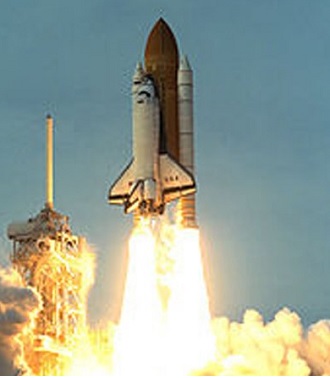
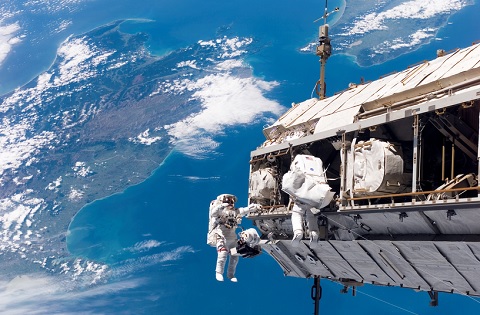
Comparison with getting down to Earth from the ISS 2011 with the Shuttle The International Space Station, ISS, is, we are told, in a low Earth elliptical orbit that varies from 320 000 m to 400 000 m above the Earth's surface. The speed needed to achieve a stable low Earth orbit is about 7 800 m/s, but reduces with (higher) altitude. The Shuttle below allegedly visited the ISS 25 times before being phased out 2011 and sent to the California Science Center museum as an exhibition piece of a heap of scrap: ![]() How to get away from the ISS down to Earth alive since the US Shuttle flights were cancelled 2011 is not really clear.
How Capt. Mark Kelly (video is a fake) landed the last Shuttle on Earth The Shuttle return flights, in the old days, were something as follows as NASA can provide very little how the Shuttle returns and lands on Earth: To slow the Shuttle down from its extreme orbit tangential speed, 7 800 m/s, (same as the ISS) we are told the Shuttle flipped around and actually flow backwards for a period of time. Source: http://sphotos-f.ak.fbcdn.net/hphotos-ak-snc6/188586_10150116474323710_309913_n.jpg Above
(fake) photo is of US Air Force captain Mark Kelly
floating in space of the ISS (or in an airplane
against a green screen!) just prior to return to
Earth in the last Shuttle. It is very simple to
return to Earth from the ISS! Jump into the
Shuttle, speed away from the ISS and then step on
the brakes all the way down. But easier to trick
film it at Hollywood. Then remember to kiss your
wife Gaby Giffords on her head on arrival; the head
that was hit by a bullet earlier. How to play
guitar in the ISS swimmingpool =
here! The orbital maneuvering engines (OMS) then
thrust the Shuttle out of orbit and toward
Earth. Due to loss of potential energy the
Shuttle total speed now increases to about
9 000 m/s at an altitude of 130 000
m. Reason being things drop faster the longer
they drop due gravity. The vertical speed is of the
order 1 800 m/s and increasing and you would
expect the Shuttle to crash in 60 seconds.
The horizontal/tangential speed is of the order 8
800 m/s However, during reentry and landing, the
Shuttle then was not powered by engines or
gravity, NASA announces. Instead, it flow like a
high-tech glider, relying first on its steering
jets and then its aero surfaces, i.e. the small
wings with flaps at back edges to control the
airflow around it. Note that no Apollo 11 type
heat shield is used. NASA must have done model tests in a wind tunnel
or full scale tests to establish wind forces acting
on the high-tech Shuttle glider, as no wind
tunnel exists that provides 9 000 m/s winds
... of different densities and very low
pressures.
Maneuvering of the Shuttle for re-entry Early in reentry, the Shuttle's orientation was
controlled by the aft steering jets, part of the reaction
control (?) system. When it is moving at about 9 000
m/s, the Shuttle starts hitting air molecules in the
atmosphere and builds up heat from friction, approximately 1
650°C, according some source.
If 40.5 MJ/KG energy would be applied to concrete, it
would heat up 46 000°C, though! The Shuttle
is covered with ceramic insulating materials designed to
protect it from this heat. The materials include reinforced
carbon-carbon (RCC) on the wing surfaces and underside,
high-temperature (sic) black surface insulation tiles on the
upper forward fuselage and around the windows, white Nomex
blankets on the upper payload bay doors, portions of the
upper wing and mid/aft fuselage and low-temperature (sic)
white surface tiles on the remaining areas. These materials
are designed to absorb large quantities of heat without
increasing their temperature very much, we are told. In
other words, they have a high heat capacity (Source).
It is of course very well! Nobody wants to burn up at
re-entry. How the high- and low-temperature tiles manage
to reduce the speed of the Shuttle is;
however, not clear. And why they are not simply
ripped off the surface, they are attached to. We do
not know how they were attached. Glue? Cement? What
we know is that the whole Shuttle was a joke! During re-entry, the aft steering jets help to
keep the Shuttle at its 40 degree attitude,
we are told. The hot ionized gases of the
atmosphere that surround the Shuttle prevent
radio communication with the ground for about 12
minutes (i.e., ionization blackout). After this phase of the re-entry is successful,
the Shuttle finally encounters the main air
of the atmosphere and is able to fly like an
airplane. The velocity is reduced as per figure
right during the 5 000 km landing
trajectory Then, therefore, the Shuttle flies less
like a spacecraft and more like an aircraft, we
shall believe. Its aero surfaces -- the wing flaps
and rudder -- gradually become active as air
pressure builds. As those surfaces become usable,
the steering jets turn off automatically. But how
do you really brake? ![]() Above NASA "long (1 second) exposure" photo (http://www.nasa.gov/images/content/573233main_image_2014_946-710.jpg) shows the space shuttle Atlantis, appearing like a bean sprout against clouds and city lights, on its way home braking through the atmosphere, as outlined above and below. It was allegedly long exposured taken by the Expedition 28 crew of the International Space Station. Airglow over Earth can be seen in the background if you have sharp eyes. I can just see clouds. The photo does not look real in my view, i.e. it is another NASA fake. One of my ex NASA PR-agents Daggerstab wonders "Ever heard of "long exposure", Björkman?" He is another stupid NASA SF writer trying to make ends meet in Arizona! Try to make a long exposure of Earth below photo from a space vehicle at 7 800 m/s speed? Thanks for the PR! Zakalwe is another Apollohoax fool, ex NASA, believing that taking 6 hrs exposure photos from Earth through a, probably stabilized, telescope (if the photo is real) is same as clicking one second faked photos from a non-existing ISS. Back to subject. Any high speed, 7 800 m/s, ISS photographer must come back on Earth and stop at 0 m/s and show his photos ... how is it done? To use up excess energy whilst braking from 9 000 m/s to below 300 m/s velocity, for which Apollo 11 needed a heat shield, the Shuttle performed a series of four steep banks, rolling over as much as 80 degrees to one side or the other, to slow down, NASA suggests. The series of banks gives the Shuttle's track toward landing an appearance similar to an elongated letter "S." How that produce brake force is not clear. Here are three (100% fake) videos, 1, 2 ,3 of what happens inside the dark Shuttle cockpit at re-entries. It seems they fly forwards while looking out through the windows that don't melt due to friction or is pushed in due to high external pressure, etc. The cockpit is probably a simple mock-up fixed on the ground in a NASA studio as part of the cheap hoax. The last US pilot allegedly doing these remarkable, impossible maneuvers 2011 was US super hero Capt. Mark Kelly, whose wife US Congress woman Gaby Giffords had been shot in the head some time earlier at a Tucson, AZ, supermarket. Crazy world, to say the least, isn't it? Actually the pilot Mark Kelly did nothing at this stage but watched the show strapped in his seat with 0.51g acting on him. The Shuttle was on auto-pilot. If the pilot was not strapped, he would fly through the windows in front of him. See Mark Kelly at the ISS in a fake video prior re-entry! As the Shuttle sliced through the atmosphere faster than the speed of sound (say 340 m/s), the sonic boom -- really, two distinct claps less than a second apart -- could be heard across parts of Florida, depending on the flight path, we are told. Yes, we could, according NASA, both see (at least from above if you were on the ISS!) and hear (a double sonic boom!!) when a space ship was re-entering Earth atmosphere from space, e.g. a shuttle from the ISS: "Although it is possible to view a spacecraft reentry with the unaided eye, it is not possible to see the Shuttle reentry if the reentry flight path is in broad daylight since the plasma trail created as the Shuttle passes through the atmosphere is not bright enough to contrast with the sky. Naked eye viewing of the reentry itself is best when the observer's site has very clear skies, and the observer is in complete darkness or very close to local sunrise or sunset if you know precisely where to look. OK, a plasma trail, whatever it is, can maybe not be seen - what is it?, and of course, that clouds, rain and fog will make seeing difficult is obvious. But hearing? As noise cannot propagate in vacuum and propagates extremely slow in a thin atmosphere, e.g. 1 000 times slower than a landing space ship itself at 130 000 m altitude, how can a sonic boom or two claps (?) from a shuttle propagate from space to ground? A sonic boom only occurs when a jet plane, close to ground, accelerates and pushes air waves ahead of it that cannot escape and then the air produces a sonic boom, when the plane accelerates beyond the local speed of sound. Typical sonic boom overpressure of a space Shuttle is only 1.25 pounds at speed of Mach 1.5, i.e. abt. 450 m/s at 18 000 m (60,000 feet) altitude at landing approach, NASA tells us. You wonder of course what the overpressure was at 9 000 m/s speed? Wouldn't it tear the Shuttle apart? Or at least break the front window? No! The Shuttle's original velocity of 9 000 m/s then eased, we are happy to be told, below the speed of sound (340 m/s at sea level and 20°C) about 25 statute miles (40 000 m) from the runway. As the Shuttle nears the Shuttle Landing Facility, SLF, the commander, i.e. the pilot, e.g. super hero Kelly, finally takes manual control, piloting the vehicle to touchdown on one of two ends of the SLF. The above apparently applies to the Shuttle getting back in one piece from the ISS to Earth using very advanced, impossible (?) braking maneuvers using friction and air turbulence, believe it or not. It seems very complicated compared with Apollo 11's heat shield ... and equally impossible. Maybe the Shuttle was just launched from an airplane at 10 000 meter altitude, made a short supersonic flight to produce a sonic boom and then landed on the SLF with cameras recording the show 30 minutes later? It never went to the ISS. Somebody should ask Capt. Kelly (retired) about it. Nowadays you allegedly fly to the ISS and back (re-entry!) using a Russian Soyuz space capsule. How it manages to get down on Earth undamaged is not clear: "There are 3 different types of descent profiles (sic) for the Soyuz. The normal type of landing is a controlled descent, where the automation software constantly orients the descent vehicle (i.e. the Soyuz space capsule) by its flat lower part to the Earth, ensuring lift due to the incidental airflow, and also inflicting minimum overloads on the crew up to 4 gravities. If for whatever reason the automation fails (as has happened in the TMA series to date with Soyuz TMA-1, TMA-10 and TMA-11) a backup program prompts the capsule to enter on a shorter and more severe ballistic trajectory. The capsule is rotated around its axis to mimimize the g-forces on the crew (it would otherwise fall like a stone and possibly kill them), though they still experience up to 8.5 gs." It sound easy Automatic or using a back-up!
Another Soyuz
re-entry description is: Early Soyuz spacecraft would then have the
service and orbital modules detach
simultaneously. As they are connected by tubing
and electrical cables to the descent module,
this would aid in their separation and avoid
having the descent module alter its orientation.
Later Soyuz spacecraft detach the orbital module
before firing the main engine, which saves even
more propellant, enabling the descent module to
return more payload. In no case can the orbital
module remain in orbit as an addition to a space
station, for the hatch enabling it to function
as an airlock is part of the descent
module. Re-entry firing is done on the "dawn" side
of the Earth, so that the spacecraft can be seen
by recovery helicopters as it descends in the
evening twilight, illuminated by the sun when it
is above the shadow of the
Earth. According NASA the propulsion compartment of a Soyuz space capsule: ... contains the system that is used to perform any maneuvers while in orbit, including rendezvous and docking with the Space Station and the deorbit burns necessary to return to Earth. The propellants are nitrogen tetroxide and unsymmetric-dimethylhydrazine. The main propulsion system and the smaller reaction control system, used for attitude changes while in space, share the same propellant tanks. How much fuel is carried and how much fuel is used to de-orbit are not clear anywhere (of course)! A Soyuz space capsule return from the ISS takes
only 3 hours 23 minutes, we are told. For a small body
orbiting another, very much larger body (such as a satellite
orbiting the earth), the total energy of the orbiting body,
i.e. the Soyuz capsule, is the sum of its kinetic energy and
potential energy. The Soyuz capsule may have a mass of
3.000 kg and an initial speed
of 7.500 m/s at
400.000 m altitude and probably
7.850 m/s at
121.920 m altitude (the total
energy remains same in spite of the de-orbit burn) ... i.e.
orbital speed increases at lower altitude, when you
re-enter. When Apollo 11 re-entered from the Moon in 1969
it went straight into the atmosphere at 11 400 m/s
speed, then up again and then down again and
landed. The Soyuz space capsule apparently takes it
easier using its rocket engine to de-orbit Hohmann
style during three hours 15 minutes and get down to
a lower altitude ... but then is goes into the
atmosphere at say
7.850 m/s speed and 8
minutes later parachutes are deployed. The Soyuz spacecraft is thus released from the
ISS at a suitable time and 3 hours 15 minutes
later, after a de-orbit burn ,it reaches atmosphere
Entry Interface at 121 920 m altitude and probably
7 850 m/s velocity and Russian
re-entry starts. Only 8 minutes later
parachutes are deployed, probably at 230 m/s
velocity and 15 minutes later the space craft
lands. But how is it done? The deceleration during re-entry and parachute
deployment is
7.620/480 = 15.88
m/s² and with average velocity 4 040 m/s
during 480 s, the trajectory during re-entry is 1
939 200 m. You should of course wonder what kind of
Russian heat shield can perform such a deceleration
without burning up? Neither NASA nor the Russian
space agency will inform how the braking - the
reduction of speed - in atmosphere takes place and
what type of heat shield is used! PICA stands for Phenolic Impregnated Carbon Ablator. Like all the other ablative heat shields, PICA-X is salvageable rather than truly reusable, SpaceX tells us. The improved and easier to manufacture version called PICA-X was developed by SpaceX in 2006-2010 for the Dragon space capsule. The first re-entry test of a PICA-X heat shield was on the Dragon C1 mission on 8 December 2010. The PICA-X heat shield was designed, developed and fully qualified by a small team of only a dozen engineers and technicians in less than four years. PICA-X is ten times less expensive to manufacture than the NASA PICA heat shield material. Imagine that - 10 times less expensive to manufacture! But does it really work? There is no evidence available anywhere. So what idiots are up there at the ISS using heat shields getting down that have not been tested, you should ask? Answer is probably nobody. The whole thing is a stupid joke, i.e. a hoax, mainly paid for by US tax payers with the Russians chipping in some kopeks or rubels. It is interesting to note that the same asskosmonites are now going back up there to the ISS ... to keep the number of people in the know to a minimum.
The Mars Science Laboratory, MSL, space craft is described at http://en.wikipedia.org/wiki/Mars_Science_Laboratory and the landing on Mars (?) at http://www.bis-space.com/2012/08/03/642 ... pdate-no-4. The Mars Science Laboratory, MSL, spacecraft had an entry-descent-landing (EDL) system (2 401 kg + 390 kg of propellant) and an 899 kg (1,980 lb) mobile rover with an integrated instrument package, total weight 3 690 kg. It had been dispatched from Earth at great velocity months earlier direction Mars. During trip to Mars the start velocity was slowed down by Sun gravity. The MSL apparently was approaching planet Mars at velocity about 6 000 m/s due to Mars gravity working on it for some time prior arrival and no braking was taking place, so the kinetic energy involved was 66.42 GJ (which is quite a lot - 18 450 kWh) at entry Mars atmosphere. On 5-6 August 2012 the Mars Science Laboratory (watch the stupid video) space ship allegedly landed on Mars according NASA/JPL (watch the stupid reportage). The below figure (based on info from links above) of the parabolic descent is evidently not to scale. The spacecraft enters the Mars atmosphere at a very small angle of inclination and then travels over 1 200 kilometers in the Mars atmosphere before reaching the Touchdown area:
When the Mars atmosphere was reached a parachute was reportedly deployed to start braking the space craft at 125 000 meter altitude ... at speed 6 000 m/s. You really wonder what magic parachute can do that! The parachute, allegedly built by Pioneer Aerospace, South Windsor, Connecticut, had 80 suspension lines, measured more than 50 meters in length, and opened to a diameter of nearly 17 meters. It is the largest disk-gap-band parachute ever built. If it really worked in the thin Mars atmosphere is not proven anywhere. Mars' atmosphere is 100 times thinner than Earth's and I have doubts that a parachute will work there. 7 minutes of terror The space craft rover landed 420 seconds later at virtually 0 m/s speed. Imagine that! The MSL space craft landed 4 times quicker on Mars than Apollo 11 on Earth 43 years earlier. There is progress. JPL called it seven minutes of terror. You wonder why? It was all automatic. The Mars atmosphere is pretty thin and light; atmospheric pressure on the Mars ground is only 10 hPa compared with a pressure of 1 000 hPa on Earth. In spite of this, we are told the parachute worked. The last 20 seconds rockets assisted the braking. Mars gravity is also much weaker than Earth gravity. The entry velocity was 6 000 m/s. How NASA knows the velocity of its space crafts is not explained anywhere (but it was by another sputnik orbiting Mars). Time from Entry into Mars atmosphere until Touchdown at Ground Zero was then 420 seconds. The average speed in Mars atmosphere was thus 3 000 m/s during 420 seconds. It means that the MSL space craft travelled 1 260 000 meter in the Mars atmosphere or 1.260 kilometers hanging in a parachute that was slowing down the descent. The vertical travel down was only 125 000 meter through the Mars atmosphere. The average vertical velocity during the 420 seconds decent was thus 125000/420 = 297.62 m/s. The angle of entry into the thin top Mars atmosphere must have been something like 5.67°or close to horizontal. The average horizontal velocity during decent was 2 985.2 m/s and the horizontal displacement during decent was of the order 1 253 754 meter! Imagine if the one and only parachute had been deployed 15 seconds too late and that braking had started 15 seconds late. What would be the result? Right - the space craft would have landed 90 kilometers away from the planned Touchdown position in the 150 kilometers diameter Gale crater! Only 90 kilometers. It might have hit the side of the 5 000 meters high mountains around the Gale crater then. Imagine if the parachute was less effective than expected (as it had never been tested in a thin atmosphere) and the average vertical velocity was 10% greater or 330 m/s during decent. What would be the result? Right - the space craft would touch ground after 379 seconds at high absolute velocity. The space craft would probably crash. On the other hand imagine, if the average vertical decent speed was 10% less, you would stop high above ground and drop down vertically below the parachutes at the end. No rockets would be required at all! NASA/JPL cannot use average velocities to predict the location of Touchdown. They must use an algorithm that calculates absolute positions and velocities in 3-D all the time, while the spaceship is decelerated by the parachute ... and adjust if something goes wrong! Let's face it. There is no way that a parachute of any kind can be used to stop a space craft with 3 690 kg mass and 6 000 m/s entry velocity after a 1 260 kilometer ride through thin Mars atmosphere at a given, pre-planned spot on Mars. It only happens in SF fairy tales. Prove me wrong and earn €1M! As above was not possible, JPL has published another scenario: Sources: http://www.futura-sciences.com/uploads/RTEmagicP_curiosity_detailDescente_mex_nasa_txdam31215_386971.jpg and http://www.futura-sciences.com/fr/news/t/astronautique/d/curiosity-la-nasa-et-lesa-preparent-larrivee-du-robot-sur-mars_40302/
Above is another fantastic suggestion how the Mars Science Laboratory spaceship landed on Mars during seven minutes (and 12 seconds) of terror. Time of Event Occurrence at Mars (PDT) http://www.nasa.gov/mission_pages/msl/news/edl20120809.html [10:10:45.7 PM] Atmospheric Entry [10:15:04.9 PM] Parachute Deploy (259.2 seconds later! at 11 000 meters altitude) [10:15:24.6 PM] Heat Shield Separation (seen from the Rover - http://www.nasa.gov/multimedia/videogallery/index.html?collection_id=14661 + clicking) [10:17:38.6 PM] Rover Separation (from Descent Stage) (2 minutes 14 seconds later) [10:17:57.3 PM] Touchdown (18.7 seconds later) (Scrap around the Curiosity Rover - http://www.nasa.gov/multimedia/videogallery/index.html?collection_id=14661 + clicking) Time Event Occurrence Received on Earth (PDT) i.e. 13 minutes and 48.5 seconds later: [10:24:33.8 PM] Atmospheric Entry [10:28:53.0 PM] Parachute Deploy [10:29:12.7 PM] Heat Shield Separation [10:31:26.7 PM] Rover Separation (from Descent Stage) [10:31:45.4 PM] Touchdown Let Mars atmosphere slow down the spaceship! Here the MSL spaceship arrives into Mars carbon dioxide atmosphere at altitude 125 000 m at 5 900 m/s velocity at time 0 sec and doesn't brake at all and no parachute is deployed! JPL has no idea at what angle the spaceship must arrive at ... and how to adjust it. If the angle is 90°, the spaceship will hit ground after only 25 seconds or so or burn up before and that is not funny. No, the space ship must arrive at a small angle, ~5°, and decelerate due friction, while Mars gravity pulls it down to ground. It is the very thin Mars atmosphere that manages to reduce the speed of the spaceship by friction (!) and when velocity is only 405 m/s 259.2 (or 454?) seconds later, the famous parachute is deployed at only 11 000 meter altitude.
Of course the spaceship must have travelled a 817 128 meters trajectory or 817 km (and descending 114 km) then through the Mars atmosphere ... like a bullet ... during that time ... all predicted by the spaceship board computer and at JPL control center 14 light minutes away. Isn't it strange? There are four basic physical models of a gas that are important to aeronautical engineers who design heat shields ... but none can be used to explain the MSL deceleration entering Mars' mostly carbon dioxide atmosphere. Or from the JPL press kit pp 28. "During EDL, more than nine-tenths of the deceleration before landing results from friction with the Mars atmosphere before the parachute opens. Peak heating occurs about 75 seconds after atmospheric entry, when the temperature at the external surface of the heat shield will reach about 3,800 degrees Fahrenheit (about 2,100 degrees Celsius). Peak deceleration occurs about 10 seconds later. Deceleration could reach 15 g, but a peak in the range of 10 g to 11 g is more likely." The unit kinetic energy transformed into heat in 259.2 seconds is 17.32 MJ/kg and if the space ship's heat shield is of concrete with C = 880 J/kg °K, its temperature will rise by 19.685°K. JPL thinks it only heats up 2 100°C. Evidently it will burn up and disappear long before that or the brake forces rip apart the heat shield. But on film above it drops off undamaged at 10:29:12.7 PM or 13 minutes and 48.5 seconds earlier on Mars. Just behind the heat shield is the Rover! JPL suggests it is unaffected by the heat and forces of the heat shield. Mean values of various parameters are as already stated above very useful to get a feel of what is supposed to have happened.
Such strong braking force due friction and turbulence in thin Mars atmosphere is not possible and a clear evidence of a hoax. Because you should really wonder why the parachute then was used on Mars? To reduce speed further from 405 to 80 m/s during 110 seconds? Mars atmosphere friction would do it much faster - actually in (405-80)/21.2 = 15.3 seconds just going the extra time and distance through the atmosphere! But the spaceship has burnt up long before. JPL thinks the parachute can only decelerate the spacecraft to 200 mph or ~80 m/s and then rockets are needed. So this happens: The parachute ride #1. The parachute was allegedly deployed at 11 000 m altitude 254 (or 259.2) seconds after entry into Mars atmosphere. Space craft velocity was then 405 m/s at an unknown angle of inclination. There is no means to control the parachute. The spaceship just hangs on to it. It is filmed by a US sputnik that happens to pass (sic) in orbit around Mars. #2. The heat shield was dropped off automatically at 8 000 m altitude 278 seconds after entry into Mars atmosphere, i.e. 24 seconds after parachute was deployed. The Rover is now exposed. Velocity was then 125 m/s. Average speed during these 24 seconds (events #1 and #2) was 265 m/s, average deceleration was 11.67 m/s² and total distance travelled 6 360 m. Vertical drop was about 3 000 m. Average vertical velocity was 3 000/24 = 125 m/s. Average inclination was about 28°. The 50 kg parachute was apparently subject to 43 000 N shock load after event #1 lasting 24 seconds. #3. Back shell separation and end of parachute travel took place at 1 600 m altitude 364 seconds after entry into Mars atmosphere, i.e. 86 seconds after heat shield was dropped off. Velocity was then 80 m/s. Average speed during these 86 seconds (events #2 and #3) was 102.5 m/s, average deceleration was 0.52 m/s² and total distance travelled 8 815 m. Vertical drop was about 6 400 m. Average vertical velocity was 6 400/86 = 74 m/s. Average inclination was about 47°. #1-#3 are just JPL science fiction fantasies. The Sky Crane The last stage of the Rover trip to Mars was via a Sky Crane designed by a certain Marc Rober of Team-X. No details are really available about the magic Sky Crane from JPL management and NASA because they are secret at the request of the Missile Defense Agency (sic) of the US Department of Defense, who has "a substantial interest" in the NASA records. Another simple analysis of the alleged NASA/JPL Mars Rover landing Below figure shows planet Mars with radius r = 3 386 km and its atmosphere with depth a = 125 km (not to scale or proportion). The Mars Science Lab spaceship was said to arrive at top of the Mars atmosphere at 5 900 m/s velocity and, if the approach angle is15.34°, the Mars horizon is d = 929 km straight away, because the Mars ground is curved (like Earth!). Can the MSL space ship stop and land within that distance on the curved Mars? With average speed 2 950 m/s during landing it takes 929 000/2950 = 315 seconds (6 minutes, 15 seconds) to displace 929 km on a straight line, but during that time Mars gravity will pull the MSL towards ground and you will apparently land or touch ground earlier following a curved trajectory. The course will follow something like the green line, and the approach angle then was much less than 15.34°. It would appear safe to approach Mars at an intermediate approach angle - the red line - and decelerate slower in the Mars atmosphere - like Apollo 11 - but then you will land far beyond the horizon and no other NASA/JPL satellite orbiting Mars can follow the show from above as happened with the MSL landing. The MSL speed was reduced from 5 900 to 405 m/s in only 259.2 seconds in the Mars atmosphere due friction/turbulence we are told by JPL and then the green trajectory seems to have been used. The total distance passed should be of the order 817 km. Then most of the trajectory is in the very, very thin Mars atmosphere top layer that cannot possible reduce the speed of the MSL space ship. NASA/JPL staff suggest they, or the computers, can predict and calculate the curved trajectory from entry into the Mars atmosphere at 125 000 m altitude and landing on ground after 7 minutes of terror, i.e. by choosing the position of entry at 125 000 m altitude they can pinpoint the landing area ~800 000 m away, but there is no evidence for this suggestion. ![]() Compare the Apollo 11 re-entry by NASA 1969 that during 1 761 seconds Apollo 11 Control Module speed was reduced from 11 200 m/s to 50 m/s only due to turbulence and friction (sic) in the Earth's atmosphere ... and then parachutes were opened. Apollo was decelerating for almost 10 000 km or 1/4 of Earth circumference ... and we know it was a hoax. The MSL stopped much, much faster in much, much thinner atmosphere, according to NASA/JPL. But it is fantasy. It is impossible to land on any planet using the NASA/JPL method. I would therefore conclude that the NASA/JPL story of the MSL landing is a hoax - like the Apollo 11 one 43 years earlier - and that the responsible NASA/JPL people involved are simple crooks stealing money from the US tax payers (assisted by various other US agencies). I always invite the public to prove me wrong and earn €1 000 000:- at http://heiwaco.tripod.com/chall.htm .
Summary Atmospheric friction deceleration on Mars was average 21.20 m/s² and could apparently reduce speed to 405 m/s according NASA/JPL, when a parachute was required, which initially decelerated the spaceship at 11.67 m/s² to 125 m/s velocity, later becoming average only 0.52 m/s² deceleration and only 80 m/s final velocity at 1 600 m altitude but still too much to land according JPL. At 1 600 m altitude apparently the parachute was suddenly no longer effective as speed was too high and rockets had to be used to bring velocity to 0 while flying around a little to avoid getting entangled in the parachute and for show - all automatically while the Rover filmed the decent into the Gale crater and added some video game instruments for JPL to enjoy 14 minutes later.
Common sense overlooked ... as usual It would evidently have been much better to use a little bigger parachute that decelerates the spaceship a little faster, so that absolute velocity had been say only 20 m/s in lieu of 80 m/s at 1 600 m altitude, so that, with final deceleration, say 0.125 m/s², you land at 0 speed 160 seconds later ... with the parachute. Or something like it. No need for rockets (!) that just complicate things. A well designed parachute should have done the job alone! But, sorry - the show must go on! Rockets add to the drama - that never took place. It seems the JPL/NASA SF writers lack imagination. They make believe that the very fast MSL spaceship managed to decelerate from 5 900 to 80 m/s velocity in 6 minutes 4 seconds first by very thin Mars atmosphere friction and a heat shield, never tested in any wind tunnel lab or anywhere, and then by a big parachute that had never been tested in so thin atmosphere and that it can be predicted and controlled by 500 000 lines of software and a board computer! JPL/NASA failed to realize that they had to brake to 20 m/s in lieu of 80 m/s because then the parachute would also finish the job. Sorry, it is physically impossible to stop a spaceship with speed 5 900 m/s as suggested. As impossible as a weak top of a tower crushes the stronger bottom by gravity. The Mars spaceship + equipment burn up in the atmosphere after already 100-120 seconds due to friction regardless of entry angle. No heat shield can prevent it. So all footage of the MSL landing above and celebrations at JPL/Pasadena control center by clowns in blue T-shirts are just Hollywood propaganda ... as usual. And all pictures of Mars crater surface ... and old lake? ... sent later are fake, fake, fake. And the faking cannot stop! US tax payers pay. Soon there will be more fake pictures of Mars. I look forward to them. They will no doubt show traces of some sort of life on Mars 3 billion years ago. God also created life on Mars! Jesus! And towers that crushed themselves from top. What a joke! But US of A trust in God. Why not? If a country wants to waste its money, go ahead. Summary of three US and one Russian space ship re-entries:
The Shuttle is the heaviest space ship - 78 000 kg - managing a re-entry. Apollo 11 had the highest re-entry speed - 11 200 m/s and therefore most kinetic energy (MJ) per mass (kg) - 62.72, but the Shuttle's total kinetic energy to transform into friction heat is the biggest - 3 159 (GJ). Those energies would increase the temperature of any space ship and the surroundings >19 000°C due friction and turbulence! Manned Apollo 11 and Shuttle do a re-entry in about 30 minutes with a mean deceleration of 0.64-51g and distances travelled in atmosphere are very long 8 000 - 10 000 km (1/4 of the Earth's circumference), while the unmanned MSL does a total re-entry at Mars in 'seven minutes of terror' at mean deceleration 2.15g and travelling only 817 km, which is quite long too. Apollo 11 and MSL use a heat shield to absorb the kinetic energy as friction of the order 200-250 MJ/s or less (depending on the turbulence), while Shuttle is doing acrobatic flying causing turbulence to absorb 1 755 MJ/s energy. Little footage exists from the cockpit of a Shuttle during manual (!) re-entry maneuvering (how can you film with deceleration 0.5g during 30 minutes with all crew strapped to their seats and the pilot trying to fly the Shuttle?). Existing footage seems a joke. The Shuttle was subject to a mean brake force (due friction and turbulence) of 390 000 N during re-entry or more than 10 times Apollo 11. The MSL mean brake force at Mars was 78 228 N or more than double Apollo 11 and you wonder how it is possible in the thin Mars atmosphere. Can a heat shield produce such big brake forces? It seems NASA/JPL cannot provide any scientific evidence for it. The Mars' atmosphere is 100 times less dense than Earth's with a ground pressure 60 times lower, but Mars' atmosphere seems to be able to slow down re-entry for MSL twice quicker than for Apollo 11. NASA/JPL cannot provide any scientific evidence for it. I have a distinct feeling that all types of known US space ship re-entry to any planet are hoaxes. The US space ships would just burn up or break up like a meteorite. Prove me wrong and earn € 1 000 000:-.
|
||||||||||||||||||||||||||||||||||||||||||||||||||||||||||||||||||||||||||||||||||||||||||||||||||||||||||||||||||||||||||||||||||||||||||||||||||||||||||||||||||||||||||||||||||||||||||||||||||||||||||||||||||||||||||||||||||||||||||||||||||||||||||||||||||||||||||||||||||||||||||||||||||||||||||||||||||||||||||||||||||||||||||||||||||||||||||||||||||||||