|
|

scientifically explained by Anders Björkman, M.Sc., president Heiwa Co, to help you not being manipulated and brainwashed
|
Summary: US political and scientific Authorities like
the White House, Departments
of Commerce and War, FBI, CIA, ASCE, etc., suggest
2001-2014 that any man made structure, e.g. a
skyscraper tower, will be subject to
global progressive collapse
from top down, when supporting elements in the top
are locally damaged. They suggest that the
mass of the structure above
the damaged elements will come loose, drop down and
destroy all structural elements below and that the
complete, intact, strong structure below the
damaged elements in seconds becomes
dust and
smoke and a heap of
rubble of structural elements.
That theory is false and unscientific and
apparently made up by mad criminals brain washing
people. Strangely few structural engineers
in Europe and Asia have reacted and should
study below article where the US hoax is explained.
If you can prove me wrong, I pay you €1 000.000:-
. SEC. 1021. AFFIRMATION OF AUTHORITY OF THE
ARMED FORCES OF THE UNITED STATES TO DETAIN COVERED
PERSONS PURSUANT TO THE AUTHORIZATION FOR USE OF
MILITARY FORCE. (a) IN GENERAL.- Congress affirms that the
authority of the President to use all necessary and
appropriate force pursuant to the Authorization for
Use of Military Force (Public Law 107-40; 50 U.S.C.
1541 note) includes the authority for the Armed
Forces of the United States to detain covered
persons (as defined in subsection (b)) pending
disposition under the law of war. (b) COVERED PERSONS. - A
covered person under this
section is any person as follows: (1) A person who planned, authorized,
committed, or aided the
terrorist attacks that occurred on September 11,
2001, or harbored those responsible for those
attacks. (2) A person who was a part
of or substantially supported al-Qaeda,
the Taliban, or associated
forces that are engaged in hostilities against the
United States or its coalition partners, including
any person who has committed a belligerent act or
has directly supported such hostilities in aid of
such enemy forces. It would
appear Prof. Z. Bazant
(left), reporters Burkett,
Hogger and Torres
and
others mentioned below suggesting towers collapse
from top and become dust are COVERED
PERSONS to be detained as per above US law.
You wonder why they are still at large. Is the
President or the staff of the Armed Forces of the
United States sleeping? Again? There was
no investigation of 9/11. Indeed, the White House
resisted any inquiry at all for one year despite
the insistent demands from the 9/11 families. NIST
did not investigate anything. NIST simply
constructed a computer model that was consistent
with the government's story. The 9/11 Commission
simply sat and listened to the government's
explanation and wrote it down. These are not
investigations. Carol K.O. Lee, Special Agent in Charge of FBI Albuquerque Division "9/11 was a psyop (psychological operation) - a military operation of deception and denial. This operation was a total, complete event conceived years in advance and designed to be managed over generations." 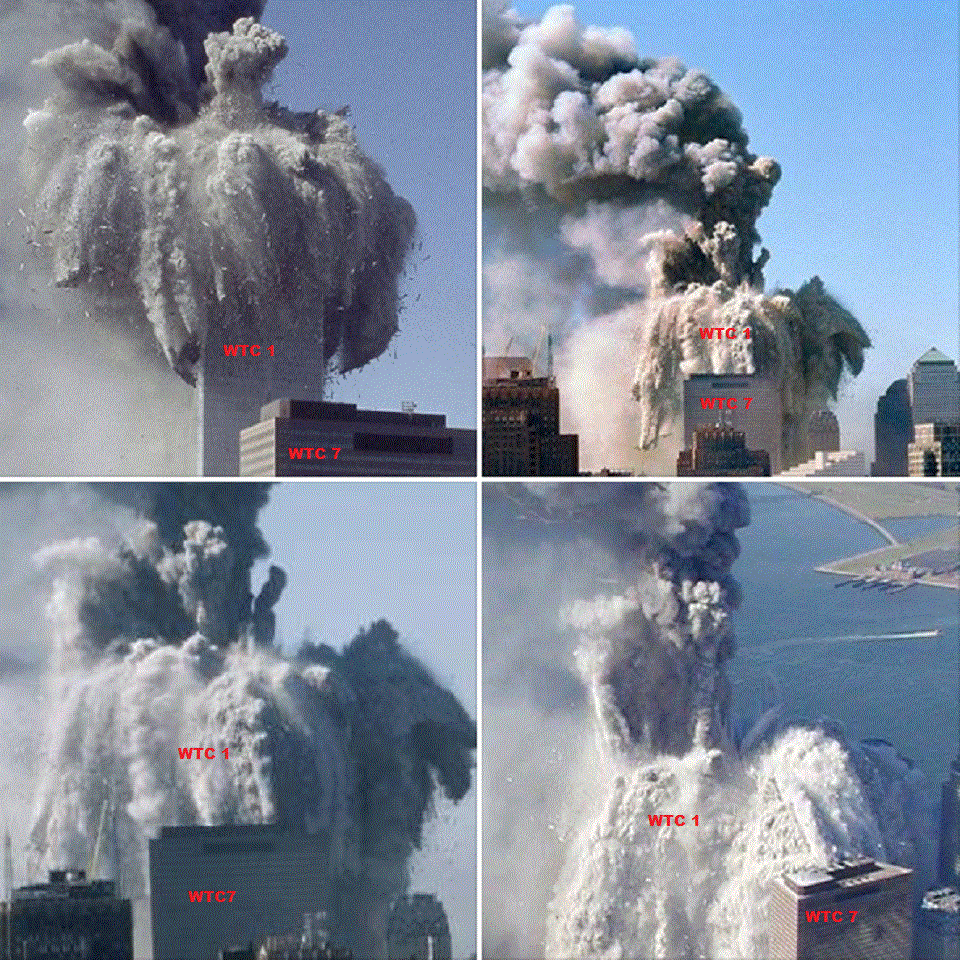 Look
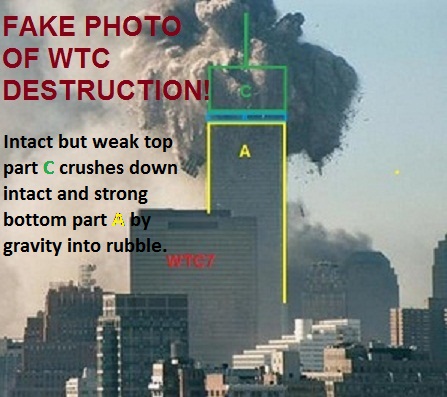
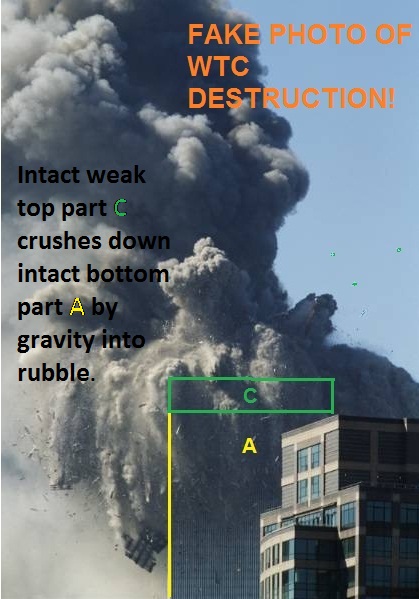
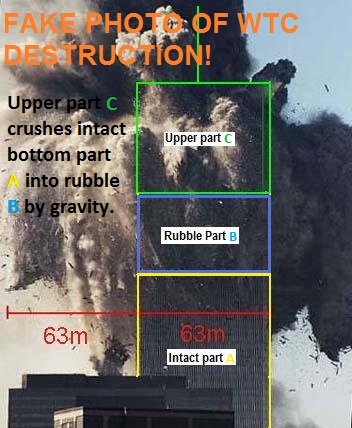
at the fake pictures of an intact top part crushing the
bottom part into dust and smoke by gravity. The pictures are
false like all pictures taken from the sky on 911. You
should wonder who produced the pictures. After WTC1 and WTC2
had been destroyed by controlled demoltions,
WTC7
was suddenly destroyed from bottom
up. Look
at the fake pictures of an intact top part crushing the
bottom part into dust and smoke by gravity. The pictures are
false like all pictures taken from the sky on 911. You
should wonder who produced the pictures. After WTC1 and WTC2
had been destroyed by controlled demoltions,
WTC7
was suddenly destroyed from bottom
up.
Many people believe silly things because they are manipulated by propaganda becoming brainwashed in the process!
It cannot happen in the real world. The footage is fake - the collapses in the backgrounds are added by photo shop. It was clearly all pre-recorded propaganda to manipulate you. Reason? No structure of any type can collapse from top by gravity and become dust as seen in the backgrounds of this propaganda footage. The collapses in the backgrounds are 100% fake and thus inserted there to create action - an illusion to twist the mind of the observers. Very easy to produce in a film studio! Simple brainwash! Brainwash. 100%. Four different companies, three foreign owned, 'cleaned' up the crime scene!
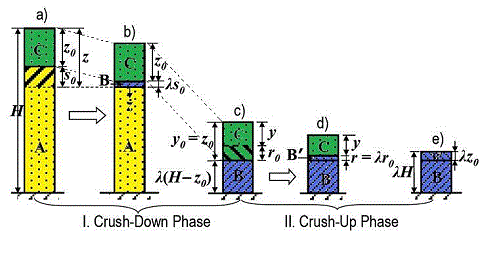
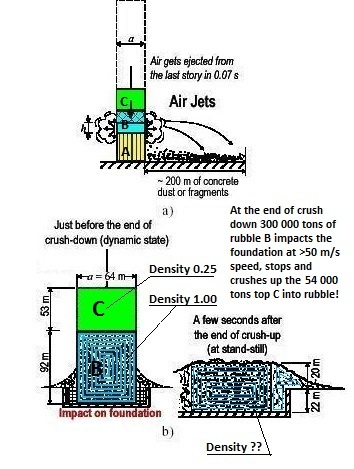
Or - first upper part C one-way Crushes-Down bottom part A top into a thin layer of debris B with thickness ls0 and then the complete bottom part A into a thick layer of compacted debris B with thickness l(H-z0) and then the thick layer of compacted debris B Crushes-Up upper part C bottom into a thin layer of debris B' with thickness r=lr0 and then the complete upper part C into a thick layer of debris B' with thickness lz0 and then there is only a tick layer of debris B+B' with thickness lH left of bottom part A and upper part C. l is the compaction ratio! Very nasty Greek letter! Apply it to any structure and l will compact it. First down, then up. And then there is nothing left but rubble! It is very simple according Bazant [5}: "When the upper floor crashes into the lower one, with a layer of rubble between them, the initial height h of the story (below) is reduced to lh, with l denoting the compaction ratio (in finite-strain theory, l is called the stretch). After that, the load can increase without bounds." Nothing happens to the
upper floor element or any other structural elements in
upper
part C! Its
height z0 is constant
during the complete Crush-Down
Phase!
Simple
people have even less capacity to avoid being
fooled, i.e. brainwashed by the authorites or
criminal professors or terrorists and thus fall
victims to pure propaganda, Hitler style. Nazi
style. Fascist style. Crazy, stupid,
false, faked up scientific theories, e.g. that
structures collapse from top by gravity into dust,
published by terrorists like
professor Z.
Bazant
(left) at Northwestern
University,
create serious risks to mankind. They do not merely
undermine democratic debate; in extreme cases, they
create or fuel violence, like US agressive,
illegal, military attacks and wars on Afghanistan
and Iraq killing millions and also making nervous
wrecks of 100.000's
of US veterans. The US government
is not interested to dispel the 2001 fraudulous
information that structures collapse from top down
by gravity into dust due local failure up top. No,
the US government ordered torture
to be used to find anyone willing to admit having
destroyed the Towers and, when it didn't work, the
US government ordered the murder
of someone having destroyed the Towers, they
said. On 11th September
2015 it was fourteen years since US terrorists
destroyed the WTC-complex at New York and blamed it
on another party - Usama Bin Laden and Al
Qaida. On Oct. 7, 2001, the US Global War On
Terrorism started and is still on globally with
millions killed. The US terrorists overlooked one
important matter: No
structure or tower bottom section can be destroyed
by gravity from above initiated by local structural
failures up top caused, e.g. by a plane crash +
fire. In order to fool
the public the US terrorists asked Hollywood to
produce a movie showing the WTC towers being
stricken by planes and
collapsing (sic) from top down,
etc, that the terrorists then broadcasted 'live
on TV' assisted by US media, when the WTC-
complex was destroyed from bottom up. As the rubble
would reveal how the towers really were destroyed
(from bottom up) the area was fenced off and fake
pictures also of the rubble were
published. I
have prepared a Power
Point
Presentation
(you have to open it with Microsoft PowerPoint)
from footage shown "live on TV" how the WTC1
(North Tower) roof (above floor #110) of
top
part C
drops
six floors to floor #104, while at same time
nothing happens to the structure below floor #92,
i.e. bottom
part A.
Fake smoke on top of the roof also drops six
floors, while more smoke is added to simulate
ejection of smoke of the top six floors being
compressed. Officially
the complete top
part C
remained intact and crushed the intact bottom
structure. Here the roof drops into the top that is
compressed and nothing happens below floor #92.
Actually the footage is simple
Computer
Generated Images
done
by the terrorists to impress the president, CIA,
FBI and other stupid observers. The windows of the
top wall of the tower just below the roof are not
correct, either. You
should wonder why US TV media companies sent this
rubbish live on 11 September 2001. The Federal
Bureau of Investigation, FBI, is supporting the US
terrorists and will not review the below
information. I, living in France since 1980,
have called them at +33 (0) 1 4312 2222 (ask for
the legat or legat attaché) and always ended
up at some robot saying they will call you back.
Try it yourself. In the decade
since the 9/11 attacks, the FBI's
intelligence
program
has tripled in size, and FBI analysts work around
the world-from the war zone in Afghanistan to the
White House Situation Room-to help covering up the
Truth about 911. However, a simple fact
remains: The FBI has
failed the Heiwa
Challenge. The below article
is based on a scientific paper (Manuscript
MS
EMENG-1029)
submitted early 2011 to The Journal of
Engineering Mechanics, JEM, issued by the
American Society of Civil Enginers, ASCE. On 3
October 2011 the scientific paper was rejected
by JEM as per below e-mail: Message du 03/10/11
17:19 De : "Kaspar Willam"
Objet : RE: tr: re:
Decision on Manuscript
MS EMENG-1029 I have consulted with
two of my Associate Editors in order to review your
informal appeal. You are free to submit your article to another journal of your choice. Sincerely, Kaspar Willam, Chief Editor of JEM I replied the same day: Hello Kaspar, Thanks for long awaited reply due to consultating with your Associate Editors. Who are they? Anyway, an easy to understand, popular version of mine by you now refused paper to JEM is available on the Internet at https://heiwaco.tripod.com/tower.htm and if you or your Associates can find anything wrong with it, you can earn €1M at https://heiwaco.tripod.com/chall.htm . Note that my website has had > 1 000 000 downloads since start up = it is quite popular. But nobody has been able to prove me wrong. So Kaspar, I challenge you and your Associates. Prove me wrong and I give you/them € 1M. Looking forward to hearing from you and Glück auf, as we we say Anders Björkman PS - You are not supporting terrorism, are you? No reply has been recieved from Kaspar and his associates (7 January 2012) Many people ask how were the towers destroyed if they were not crushed from top down by gravity. The top down crush seen on TV was just an animation of computer generated images, CGI, done by Hollywood. The 110 floors steel frame WTC1&2 towers were brought down by controlled demolition, like the 28 floors tall Biltmore Hotel, October 1977: "Seconds after the final warning signal blared Sunday afternoon at a downtown redevelopment site in Oklahoma City, precisely placed explosive charges dropped a 28-story building almost in its tracks. When it fell, the 245-ft-high structure became the tallest steel-frame building to be demolished with explosives. The result was a big heap of steel frames showing that explosives had been used, so all footage of the rubble was faked too using CGI. Somebody suggests that you can explain a top down global collapse of a structure by dropping a bowling ball on panes of glass! "I have literally found probably ten websites using an example of dropping a bowling ball through panes of glass to explain why the Twin Towers is a conspiracy." It is evidently better to explain the matter as I do below:  |
|
A 407 meters tall tower structure A+C cannot be reduced to rubble B, when a small, 40-50 meters tall, light and weak top part C drops on big, intact, solid and 350 meters tall, strong bottom part A, where Abottom is 7-8 times stronger than Atop and Atop is stronger than top part C, as A carries C. All and every tower structure can only be
destroyed by gravity from bottom up (by controlled
demolition) and never by itself from top down.Anyone
suggesting that a light weight, weak top part C of a
tower can globally crush down the heavy weaight,
strong bottom part A into rubble B is a terrorist
that FBI should arrest at once. According to FBI at
http://www.fbi.gov/contact-us/when/when,
we citizens are requested to, please, contact our
local FBI office or submit a tip electronically (at
https://tips.fbi.gov/)
if we have information about: 1.
Possible acts of
terrorism, including violence, funding, or
recruitment; 2. Persons sympathetic to
terrorists or terrorist
organizations; 3.
Suspicious activities that
we believe threaten national security,
especially
suspicious
activities that involve foreign powers or
foreign organizations; There is plenty of information
about (1) verified acts of terrorism
(9-11 WTC destructions),
(2)
known
persons
sympathetic to
terrorists (prof. Bazant,
the staff of NIST
(National Institute of Standards and Technology))
and (3) suspicious activities (faked photos
and videos of the destructions) that I believe
threaten (US) national security and I have informed
FBI accordingly several times. RESULT? 0! Zero. It
seems Ground Zero at NY is named after the
FBI efforts so far. Zero. In several stupid, peer reviewed
articles in ASCE's Journal of Engineering
Mechanics prof. Bazant suggests that
(green)
light weight, weak top part C is rigid (!)
and crushes and compresses
(yellow)
heavy weight, strong bottom part A below
into
(blue)
rubble B by gravity. NIST in a 10 000+
pages report suggests that top C applies
energy on bottom A that bottom A
cannot absorb elastically ... part A is
crushed into rubble and dust. You find the
ridiculous Bazant/NIST reports on the
Internet web. The basic question is of
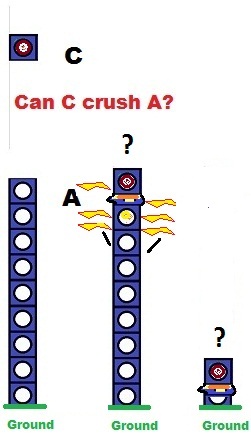
course: Can a big, 407 meters tall
skyscraper/tower, 10 times stronger and heavier at
1/10th bottom than 1/10th top, 'collapse'
from top down by gravity into a heap of rubble due
to small local damages up below 1/10th top and
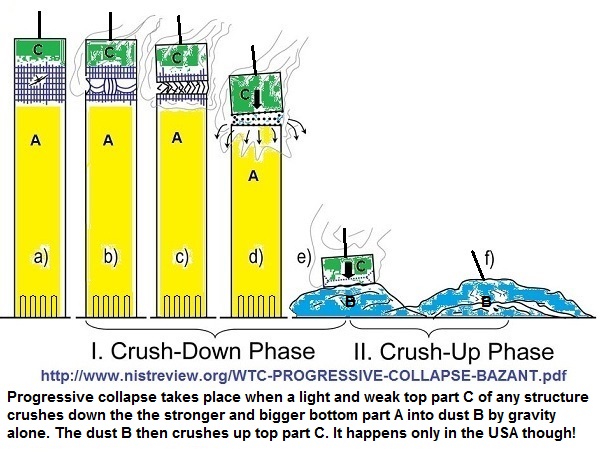
create a Ground Zero? Illustration
of 'progressive global collapse' from top to
bottom of a tower structure according prof. Bazant
and NIST and terrorists. Top C gets loose by plane
causing local failures and crushes down
bottom A into rubble B and rubble B then crushes
up top C into more rubble B. It cannot
happen in reality.
But when a plane collides with a skyscraper there should be plenty of plane parts bouncing off the skyscraper ... but there were none! On TV at 12:46 pm on 9/11 Mr. L. Paul Bremer explained that towers are destroyed from top down due to local failures and fires up top and named a few suspects. Bremer was Chairman of the US National Commission on Terrorism since1999 and he was 2001 Chairman and CEO of Marsh Crisis Consulting, a risk and insurance services firm which was a subsidiary of Marsh & McLennan Companies, Inc., a company that allegedly held offices on eight floors of the North Tower, WTC 1, of the World Trade Center, from 93 to 100. No one present in the offices allegedly survived the 911 attack, and the firm allegedly lost 295 employees and 63 contractors. In spite of this allegedly tragic loss Bremer was instead calmly talking about terrorists who had done it. Bremer apparently believed that structures collapse from top down.
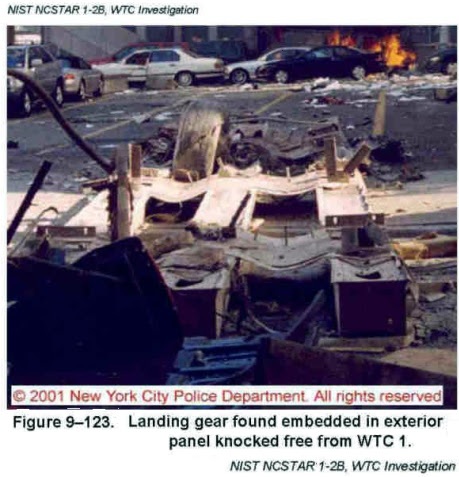
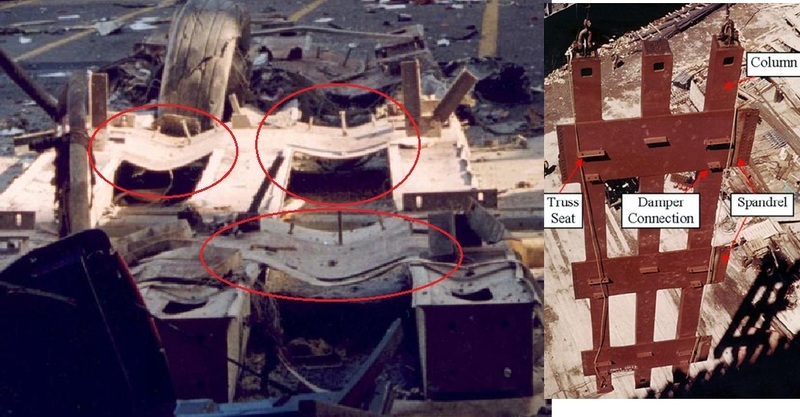
It looks really ridiculous and typical cheap Hollywood prop. It weighs about 100 kgs. You wonder why FBI or NY City Police Department cannot spot the difference between a 4 500 kgs steel wall panel and a 100 kgs Hollywood plywood prop.You should really wonder why the perpetrators placed a fake plywood wall panel in the WTC rubble ... or the photo is 100% fake and no panel ever existed.
It seems the US Navy Seals team of commando soldiers murdered the wrong person on 1st May 2011 because no skyscraper of any kind will collapse from top down due to damages due to planes up top. Sorry Obama, you made a small error. And murdering people is illegal, didn't your mother tell you that? Or Jesus? Below are two more faked, stupid photos you find on Internet of the same tower: It looks like the tower explodes ... by gravity? - with loose pieces flying around in all directions. You wonder why a big wall panel falling on side always is followed by a trail of smoke/dust. And why the smoke on top looks like coming from a volcano! It is though just copy/paste of different layers of animations! Really stupid actually.
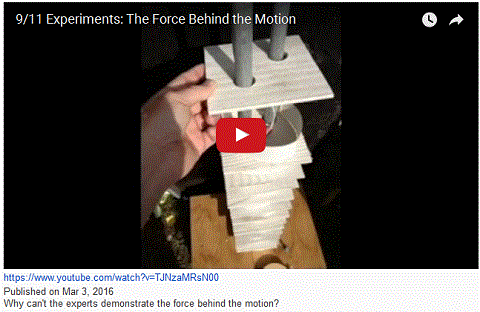
Scientific description why a tower cannot collapse from top down It is easy to demonstrate theoretically and numerically that a tower structure A cannot globally, progressively collapse by itself from top down, when a small top C of A drops on A by gravity. It will take you <10 minutes to read below and understand why. Consider a tower structure of N floors, each of mass m, labeled from top (i = 1) to bottom (i = N). Adjacent floors are separated by springs. Floor n is supported by n springs. The springs realistically represent the elastic walls and columns that support the floors of the tower. All springs are identical, weightless, have rest length L (m), and are perfectly elastic with constant stiffness k (N/m) until compressed longitudinally (i.e. vertically) and laterally (i.e. sideways) a realistic and critical longitudinal (vertical) displacement, say xC = 0.01L, when they compress plastically another vertical distance xP, after which they fail (and the vertical length becomes 0). The tower is placed in a vacuum on a very large inertial mass, i.e. ground, and is subjected to a uniform gravitational field directed downwards. g = 9.82 m/s². Static equilibrium The tower is in static equilibrium when Fn = nkx = nmg (N) . It follows that x = mg/k. In static equilibrium the displacement x due to elastic compression of a spring is everywhere the same and the same is true for the strain x/L and the stress in the springs. A real tower is likewise equally strained and stressed at top and bottom. Safety factor The n springs below floor n can each support a load of FC = kxC before plastic deformation starts. If the actual design load of a spring is F, then the safety factor S = FC/F. Elastic and plastic strain energy The work performed in compressing a spring elastically is E = kx²/2 (J). A spring can therefore elastically absorb ES = 0.00005kL² (J). If a spring is overloaded elastically and starts to deform plastically, the spring will develop plastic hinges, which absorb more energy EP and which takes a certain time tP - when its effective length finally becomes 0 - it is broken! Let's assume that EP = 2ES. Real value is easy to establish in a laboratory. Note that the connection between one spring above and two springs below do not fail before any of the spring fails, because, if that were the case, there is no way that load, force and energy can be transmitted between springs.
Can little top part C, 7.2 times smaller and 77 times 'weaker' than bottom part A, really crush bottom part A by gravity? In this little example crush means breaking the springs in overload from above by gravity. Question! Can something small and weak like little top part C really destroy something big and strong like bottom part A just by dropping C 3.7 meters by gravity on A? FBI, Albuquerque is investigating! Imagine! FBI! Investigating! Call them at (+1) (505) 889-1300 and find out what they do. And tell me! Spring details - same everywhere Force F in every spring is F = mg = 35.352 MN as the spring carries a weight of 3 600 tons. The spring may have cross area of about 0.5 m² if it is of steel. The stress in the spring is then about 70 MPa. Note that the stress is same everywhere - at top and bottom of the structure. Let's assume S = 3, i.e. the springs will commence plastic deformation or yield at 210 MPa. The material of the spring is steel. Note that the total cross area of removed springs below part C is 6.5 m² (13 springs each 0.5 m²) and that the total cross area of springs at bottom of part A is 55 m² (110 springs each 0.5 m²). The tower evidently gets 'stronger' with more springs added further down. All towers are designed the same way (i.e. they are stronger at bottom getting lighter higher up). The critical force FC of a spring is FC = 106.056 MN. After that it deforms plastically absorbing more energy and soon has length 0. Let's assume that spring stiffness k = 3 GN/m that is typical when core and perimeter wall structure of WTC is replaced by one spring (a bundle of steel elements) with cross area 0.5 m² that can deform in 3-D. Actual k is easy to establish in a laboratory (by just compressing the spring with a known force and measuring the compression) or by structural analysis calculations. Then xC = 0.037 m ES = k(xC)²/2 = 2.053 MJ x = 0.037/3 m E = kx²/2 = 0.228 MJ When the tower is in static equilibrium, each spring is compressed 0.0123 meter and 0.228MJ energy is stored in it elastically. However the spring can be compressed elastically to xC = 0.037 meter (or 1% of L) before it starts to deform plastically and the energy EC required to compress it is then 2.053 MJ. All springs in tower can absorb 12.53 GJ energy elastically. From an energy absorption point of view factor of safety is 9 (actually static S²). Top part C can absorb elastically totally 78 x 2.053 = 160.1 MJ energy! By dropping top part C a certain distance, e.g. L, a certain amount of potential energy ED is released, where ED = 13mLg = 1.7 GJ. It is 13.6% of what the tower itself can absorb elastically. Or 6.8% plastically. By simple structural damage analysis you can establish whether C can damage A, ground or itself C. Experiment 1: Structure part C collapses from bottom up Experiment 1 shows how something weak, part C, dropped on rigid ground, will be affected by the impact. The part C assembly of 13 m is dropped on ground from distance L. At the impact C/ground total 1.7 GJ is applied to ground and C. The ground does not damp the impact. It is rigid and can absorb plenty energy. Evidently C itself damps the impact - it becomes compressed and maybe damaged: As C is 44.4 m tall and consists of 13 m separated by springs, it is the bottom m of C that physically contacts ground and is arrested by ground at the impact. The remaining 12 m above continue to displace down and compress the springs below. A certain damping takes place, when the springs compress elastically and plastically. As the dynamic forces acting on C and ground at impact and later are equal and opposite (the dynamic force F, i.e. a static force displaced a little during the short time t of impact, is the energy applied, 0.5ED, divided by the displacement x of the force F - the structure is compressed and maybe damaged), it follows that C will absorb 0.5ED and rigid ground will also absorb 0.5ED in the impact. It would then appear that 0.85GJ energy is applied on C one way or another and as C can only absorb 0.16GJ elastically and 0.32GJ plastically, all springs in C will fail. Ground is rigid and undamaged. Top part C is, as seen, not very strong, and it is why its springs are 100% broken at impact with ground. In what order will the springs in C fail? It can be seen on videos of controlled demolitions of buildings, where the bottom supports are destroyed and structure above drops and hits ground that destruction is from bottom up, thus: The bottom 12 springs fail first at impact with ground, 12 floors m above then drop down L, 11 springs fail, 11 m drop down L, 10 springs fail, 10 m drop, etc, etc, until the last one top spring fails and the last m (the roof!) impacts ground from L. As can be seen C, 12 L tall, is destroyed from bottom up in 12 steps that takes a certain time. All the energy released by the failed springs apart from the energy absorbed by failed springs is absorbed by ground.
Thus, just adding 13 m on top of A nothing special will happen except that all springs in A are again under original design, static load. Now, the big question is what happens if, in lieu of slowly putting 13 m on A we drop 13 m on A from L = 3.7 m and we let 13 m impact A! Will the dynamic forces at impact crush A ... or C? Experiment 3: Structure A impacted on top damps impact due to elastic and plastic deformations Experiment 3 shows what happens when a rigid mass of 13 m impacts A dynamically from above. 13 m are dropped on the top m of A from L = 3.7 m. The 13 m are connected together without any interconnecting springs, and that assembly is here called D. D is thus rigid as it cannot deform. At impact D/A (a short lived event) 1.7 GJ is applied to A and D and, as in experiment 1 0.85 GJ is applied to A. A can totally absorb 10.974 GJ so you would expect rigid D to bounce on A. The dynamic force F applied on A/D is, as stated above, simply the energy applied divided by displacement x of force F during impact/compression. The initial impact will produce more impacts, if further m gets loose and drops, but energy released in each impact will be elastically (and maybe plastically) absorbed by intact springs in A. The beauty of a spring is that it can absorb and release energy multiple times, when loaded in succession. It is very strange that NIST suggests that little C (or D) can apply energy on big A that A cannot absorb! The figures say something completely different! Why does NIST lie and spread fake information to the public. Is it in order to support terrorism? It may be argued that the top 14 top springs and the 15 springs in the next layer of A may be destroyed locally in overload by the dynamic forces at impact with D and some extra energy released when D and one or more loose m displace down L. The 14 top springs of A can totally absorb elastically 14 x 2.053 = 28.74 MJ and maybe plastically totally say 86 MJ. The plastic destruction (failure) of springs takes time t, so in the mean time the dynamic impact force (i.e. energy divided by displacement) can be absorbed elastically by 6 000 springs below the 14 top spings and transmitted to ground (as a seismic wave). When one layer of springs is destroyed all m above displace down L and more energy is released - a second impact - and has to be absorbed by intact springs like a shock absorber. So D applies 850 MJ on A and about 86 MJ can be absorbed by destruction of the top layer of springs in A and the rest is absorbed elastically by 96 other layers of 6 000 springs in A and transmitted to ground. That D would destroy all 6 014 springs of A is unlikely. The springs of A will dampen the impact of D and loose m of A dropping, while only some local failures occur close to interface D/A. It is quite easy to verify experiment 3 in a laboratory. Just take the top C of any tower structure, compress it to a rigid block D, and drop D on the bottom part A and see what happens. Rigid D will always bounce and stop after producing some local failures at top of A, i.e. the weakest part of A! Experiment 4: Small top C cannot crush a bigger bottom A Experiment 4 shows what happens when part C impacts A from above. Part C is dropped on part A from L = 3.7 m. This is the famous WTC 1 event. 13 top floors m of WTC 1 drop on 97 intact floors/columns m below (and according videos of suspect origin the 97 floors/columns below are destroyed in a fountain of smoke, dust and debris - terrible! In reality, of course, it cannot happen). At impact C/A 0.85GJ is applied to C (with 12 springs at bottom) and 0.85GJ is applied to A (with 14 springs at top) as explained above. However, C does not impact rigid ground as in experiment 1 and A is not impacted from above by rigid D as in experiment 3. In fact only the top m of A supported by 14 springs below and the bottom m of C supported by 12 springs above contact each other in the impact and the dynamic forces are then transmitted via the 6 000 springs to other m in A to ground and via 66 springs to other m in C. The intacts springs behave elastically and dampen the impact. The impact, like in experiment 3, will be split in sub-impacts, when/if further floors m gets loose and drops, but energy released in each sub-impact will be elastically (and maybe plastically) absorbed by the intact springs. So in experiment 4 the initial impact will really be dampened, i.e. take longer time, as both A and C … and ground … will dampen (absorb the energy of) the local impact C/A. It also means that the dynamic forces are reduced. That small/weak top part C will crush big/stronger bottom part A at increasing speed and by gravity is impossible. That small top part C - that can absorb much less energy elastically and plastically than big bottom part A - can apply, via short lived dynamic forces, and release, via structural/spring failures, more energy on A and destroy A is impossible: C will destroy it's own springs first, before A is starting to get destroyed and then C cannot apply or release more energy to destroy A. In reality there will only be some local failures at interface C/A at impact, C and A then get locally entangled, friction develops and C will then just bounce on top of A. A arrests C! There is not enough energy for anything else. Numerical example: As seen above 0.85 GJ energy is applied to 12 bottom springs in C and 14 top springs in A at impact C/A. What happens if 0.065 GJ energy E is applied to one spring with stiffness k = 3 GN/m and 3.7 meter length L? Answer: the spring will compress x = 0.147 meter (as x² = E/k) due to the impact or 4% L. As one spring in our example can only elastically compress 1% it would appear that the spring plastically deforms or breaks at impact. However, our spring is not alone but supported by other springs above and below in the structure so you have to consider that. Evidently the 6 105 springs in A can easily absorb totally 0.85 GJ energy elastically (as shown in experiment 3). If the 78 springs in C can do it, is another matter (as shown in experiment 1). It is quite easy to verify experiment 4 in a laboratory. Just take the top part C of any tower, and drop it on the bottom part A and see what happens. My experience is that C always bounces on and is arrested by A, but I may be wrong. I have only tested a limited amount of towers. No smoke, dust, debris or ejections were produced when dropping C on A. I give Euro 1.000.000:- to anybody that can produce a tower/structure, where top C crushes bottom A! It is the famous Heiwa Challenge! It is actually impossible to win. Many people believe that scale or size of structure matters, e.g. that a small (model of a) structure cannot crush itself but that a bigger structure can or that material matters, e.g. that a structure of brittle elements will collapse but not a structure of more ductile elements. However, to believe things like that is unscientific, terrorist nonsense. Experiment 4 and its impact, elastic compression of springs and damping of parts can of course easily be modelled mathematically using FEM for any size of tower springs structure/elements/material. A linear spring-damper model of the form f(t)= k*x(t) + c*v(t), where x = input displacement, v= input velocity, and f(t)= output force can be developed (N off masses m connected by N(N+1)/2 off springs) based on test data in the time domain of the springs. The term k is the spring stiffness (Newton/meter, N/m) and c is the viscous damping coefficient (Ns/m). With k = 3 GN/m and c = 0.3 GNs/m the tower parts A and C become very flexible and will visibly deform/compress/oscillate, be damped, for several seconds after impact C/A. Plastic deformation and its time to develop failures of a spring are more complex to model mathematically (but it can be done). That a 407 meter tower structure will explode in smoke, dust and debris, rubble being formed and collapse from top taking place in 15 seconds as shown 'live on TV' Tuesday morning 11 September 2001 in the USA is not possible in reality. What was shown 'live on TV' was just a stupid movie made by disaster animators Hollywood style! Imagine that! FBI cannot understand such a simple thing. It is a pity. The writer's attempts to crush a structure by dropping its top on it have, naturally, always ended up with no springs failing in A and C and only bouncing/arrest of C taking place. Conclusion The writer has never seen a top part C of a tower impact and destroy the bottom part A due to gravity. Reason is that such a destruction is physically impossible! A always arrests C.
August 2011 message from Wikipedia about above article: "Welcome to Wikipedia. Although everyone is welcome to contribute constructively to the encyclopedia, your addition of one or more external links to the page Progressive collapse has been reverted. Your edit here to Progressive collapse was reverted by an automated bot that attempts to remove links which are discouraged per our external links guideline. The external link(s) you added or changed (https://heiwaco.tripod.com/tower.htm ) is/are on my list of links to remove and probably shouldn't be included in Wikipedia." Wikipedia incorrectly describes the WTC total progressive collapse as follows: Any attempts to correct the
relevant Wikipedia articles are
impossible! So Wikipedia supports
terrorism!
Illustration
of 'progressive collapse' from top to bottom
of a tower structure according Wikipedia, prof.
Bazant and NIST and terrorists.
Top
part C
gets loose by plane causing local failures and
crushes down intact
bottom
part A
into rubble
B
and rubble
B
then crushes up
top
part C
into more rubble
B.
A Ground Zero is created! It cannot happen in
reality. |