The Coulombi Egg Oil Tanker - The M/T 'Prestige' Incident 2002-2016 Better protection, safer and more economical than Double Hull
|
|
|
Start
page |
|
Structural Failure caused Ballast Tank Flooding and heavy Listing
The M/T Prestige was a 1976 built Pre-Marpol single hull crude oil tanker that had later been converted only to carry crude and products oil in dedicated cargo tanks and to use some wing tanks for segregated ballast. Cargo in the remaining wing tanks could only be part loaded for hydrostatic balance. She was 26 years old. |
Photo Anders Björkman |
|
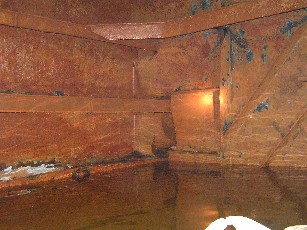
At the time of the accident the M/T Prestige carried 77 000 tons of heavy fuel oil (products) and the segregated ballast wing tanks were empty. The cargo wing tanks were part loaded for hydrostatic balance. Very little or no cargo oil spilled out at this time. The damage may have looked like the picture above right! I took it myself inside the side ballast tank of a damaged tanker similar to M/T Prestige. I was an expert of finding cracks in tankers then, so they could be repaired in port.
|
 |
|
The preventive action is evidently to immediately seek a calm port of refuge, where the cargo can be transferred , offloaded, to another tanker.
Spanish Authorities caused the Oil Spill |
|
|
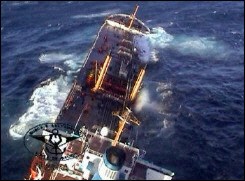
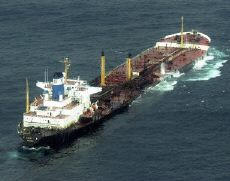
They refused the loaded tanker a port of refuge and ordered it further out to sea. The result could only be what followed, even if the heavy weather spell calmed out. The fractures in the tanker side structure extended in all directions and on the 18 November about 40 meters of the complete shell shell and 8-10 meters width of the main deck fell off the tanker. Probably the same part of the bottom fell out. Then the global strength of the hull beam was severely reduced and the fractures could easily develop across the full beam - cargo oil started to leak: on the 19 November in the morning the tanker broke into two halves and soon both halves and 77 000 tons were lost. This product (heavy) oil is now slowly leaking out and will pollute the Spanish and French coasts for several years. |
|
|
Capt Mangouras, the Master of the M/T Prestige was arrested by Spanish authorities immediately upon arrival ashore accused of causing the oil spill. He spent 83 days in prison and was only released (and put into house arrest) upon payment (by the London P&I club) of bail amounting to €3.000.000. Evidently the Master could not himself pay the enormous bail! As the Master evidently did not cause the oil spill, the Spanish authorities had then to delay any court proceedings ... for almost 10 years! See end of this article. Double Hull not the Solution
The Accident Investigation
The Coulombi Egg Tanker is the only Solution
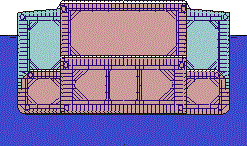
Double Hull Tankers are not the Solution to prevent future 'Prestige' Type Spills There is no guarantee that double hull tankers will corrode and fracture less than single hull - rather the opposite. Anybody stating that double hull solves the problem does not know what they are talking about. Old single hull tankers are today subject to Condition Assessment Schemes, CAS, and/or Enhanced Survey Procedures, CAP. Both manadate close-up survey of about 100% of the structure in the ballast spaces and 30% of the total structure in the cargo spaces - a very big and difficult job - and everbody knows that you cannot possibly spot all cracks. Double hull requires even more close up-survey as the structure in the double hull ballast space has increased three times. The only - and the best - solution is the IMO approved Coulombi Egg tanker.
'Prestige' Master and officers in dock 10 years after sinking (Oct 19 2012) Some 10 years after the sinking of the tanker 'Prestige' off the Spanish coast, four men, including the vessel's Master, went on trial this week (October 19 2012) in a northern Spanish Court. --- But will we ever know what caused the oil spill, i.e. why the tanker started to leak oil. Did the Master Mangouras make the hole in the tanker himself? Has the 'Prestige' Spanish accident investigation ever identified the real circumstances of the casualty and established the proximate cause of the incident and any contributing factors so that similar incidents are prevented in the future? The answer is simple. No. I wonder what the 133 witnesses and 100 experts have to add? I was wrong! November 15 2013 we finally learnt: A Spanish court has found the crew of the tanker ‘ Prestige ‘ and the Spanish Merchant Navy not guilty for criminal responsibility of the sinking of the oil tanker on 13th November, 2002. What a pity that the port of refuge was denied. Therefore never tell shore that your tanker is leaking when seaking a port of refuge. Better tell that you have engine/generator problems or that a seaman is ill. However, September 2015 Spain's state prosecutor asked the Spanish Supreme Court to overturn the lower court's decision to acquit three men over the 2002 Prestige tanker spill, one of Europe's worst environmental disasters. And January 2016 the Supreme Court agreed! The Master was again found guilty of the oil spill and sentenced to two years in prison. This was clearly against the DIRECTIVE 2009/18/EC OF THE EUROPEAN PARLIAMENT AND OF THE COUNCIL of 23 April 2009 para (9) which says: Seafarers are recognised as a special category of worker and, given the global nature of the shipping industry and the different jurisdictions with which they may be brought into contact, need special protection, especially in relation to contacts with public authorities. In the interests of increased maritime safety, seafarers should be able to rely on fair treatment in the event of a maritime accident. Their human rights and dignity should be preserved at all times and all safety investigations should be conducted in a fair and expeditious manner. To that end, Member States should, in accordance with their national legislation, further take into account the relevant provisions of the IMO guidelines on the fair treatment of seafarers in the event of a maritime accident. So never ask for a place of refuge when your tanker leaks. Ask for a place of refuge beacuse you have a generator problem or similar.
Back to the Coulombi Egg start page!
|

 The M/T Prestige suffered a fracture in the
side shell on 14 November 2002 during a spell of very severe
weather outside Spain. The Master aboard, Captain Apostolos
Mangouras, was not responsible for it.
The M/T Prestige suffered a fracture in the
side shell on 14 November 2002 during a spell of very severe
weather outside Spain. The Master aboard, Captain Apostolos
Mangouras, was not responsible for it.