|
|
|
|
|
|
Start
page |
|
|
|
Not one penny has been used to reconfirm the IMO decision 1997, e.g. that the COULOMBI EGG tanker is much better than double hull, etc. Strange? Well, you get the impression that the responsible parties do not care one way or another. The US Congress has adopted laws to the effect that first - a COULOMBI EGG tanker (or any IMO approved alternative but the Egg is the only one) cannot trade to the US and second - that the USCG shall evaluate alternative designs to the US OPA double hull. But the USCG has never evaluated the COULOMBI EGG - only told the Congress that the COULOMBI EGG may spill oil. Without having done a proper evaluation!
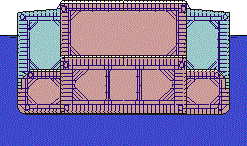
The Secret - Read about the secret of the COULOMBI EGG. IMO Approval - The IMO approval was given by the MEPC 40th Session 18-25 September 1997 and is described in MEPC circular letter no. 336. Heiwa Co was grateful to the Swedish Maritime Administration (Roger Sundström) that sponsored the application to the IMO and to the Egyptian administration that also assisted. No other design has for twenty years been presented to the IMO to outperform the COULOMBI EGG tanker and the much inferior Double Hull standard. It is clear evidence that the COULOMBI EGG tanker is the best design. Only the USA/USCG strangely disapproves of the COULOMBI EGG tanker since 20 years. No scientific reason has ever been given. USCG Approval - The COULOMBI EGG tanker may however any time be approved by the USCG! It is very simple! The USCG must only follow the recommendations of the 11-member Committee on Evaluating Double Hull Tanker Design Alternatives convened by the National Research Council's (NRC) under the auspices of the Marine Board. The Coast Guard Authorization Act of 1998 mandated the Secretary of Transportation to commission the Marine Board of the NRC's Transportation Research Board (TRB) to develop a rationally based approach and method for assessing the environmental performance of alternative tanker designs relative to the double-hull standard. It has now been done - the committee report is reviewed and the recommendations are very favourable for the COULOMBI EGG tanker. However the USCG does not follow up the recommendations and, e.g. no US university has shown any interest to apply the principles to the COULOMBI EGG. General Arrangement and Structure - The COULOMBI EGG tanker uses conventional single hull construction and an innovative interior structure to reduce oil spills in collisions and groundings (and also in explosions and due to structural failures). The total amount of oil spills compared with double hull is reduced 3-4 times. As Double Hull spills very little in collision and grounding accidents, the COULOMBI EGG protection reduces total oil spills to virtually nothing. The reason for this is that the COULOMBI EGG was developed to be adapted according to actual damage statistics. Operations - The COULOMBI EGG tanker is operated as a single hull tanker. Read about cargo operations and leaks, explosions and fires on tankers and how the COULOMBI EGG reduces the associated risks. Collision Protection - Collision damage is more frequent, deeper and longer above waterline and in the upper side and the COULOMBI EGG collision protection - structure and a deformation zone - is located there: top side ballast tanks. Collisions with tankers are often followed by fire and explosions and loss of human life, so Heiwa Co considers that collision protection is more important than grounding protection, where few human lives are lost. The collision protection is also arranged to reduce the risk of oil spill due to strctural failures. The magic Egg - See why the COULOMBI EGG does not spill oil in collision even if the side cargo tank is breached (a little) at its top or if there is a structural fracture in the side shell. Grounding Protection - The simplest grounding protection is evidently hydrostatic loading of single hull cargo bottom tanks. The COULOMBI EGG improves on that, i.e. the outside hydrostatic pressure exceeds considerably the internal cargo oil pressure, so that cargo oil can be pressed up into the undamaged ballast tanks under controlled conditions in the event of grounding. The COULOMBI EGG tanker does not spill oil in a grounding. Safety - The main reason to use the COULOMBI EGG tanker protection system is SAFETY. There are no void double hull compartments (except a longitudinal cofferdam in the sides), so there are no safety problems associated with them - internal leaks, ventilation and cleaning of double hull cells, corrosion, cleaning, etc. When the COULOMBI EGG is in loaded condition, all ballast tanks are easily accessible for inspection.
M/T Erika/M/T Baltic Carrier - M/T Prestige - The COULOMBI EGG arrangement may have prevented the M/T Erika accident 1999 and the M/T Baltic Carrier collision spill 2001 and the M/T Prestige accident 2002. The VLCC Limburg accident 6 October 2002 highlights the risks of Double Hull in tankers, even if the Limburg explosion was probably due to a terrorist attack. Terrorist attacks seem to be focusing on the loaded waterline area, where the COULOMBI EGG arrangement provides maximum protection. Thus another good reason to opt for the COULOMBI EGG arrangement ... 2012. The concept is approved by all maritime nations except the USA. Better Tanker Safety at Sea - let the IMO take the lead. The IMO will not do it, but I suggest it anyway.
Contact anders.bjorkman@wanadoo.fr
|

 The COULOMBI EGG oil tanker design is the
only alternative to Double Hull tankers
approved by the
The COULOMBI EGG oil tanker design is the
only alternative to Double Hull tankers
approved by the