The Coulombi Egg Oil Tanker - General Arrangement and Structure Better protection, safer and more economical than Double Hull
|
|
|
Start
page |
|
The COULOMBI EGG tanker spills oil in collision only if (i) the longitudinal bulkhead is damaged or if (ii) the damage extends into the lower 0.25D above BL due to the topi side ballast tank crush zone. |
The forepeak will not be used for ballast so it becomes a void space. To prevent the fore peak to be flooded in groundings it is suggested to fit it with a double bottom.
The forepeak will probably not be used for
ballast and will become a void space. It is
recommended to fit a double bottom in the
forepeak. In a Double Hull tanker internal or external damage generally leads to flooded (by cargo or sea water) double hull spaces, which in turn may affect the transverse or longitudinal strength - the residual strength is reduced as the tank boundary plates are main strength members of the transverse forces and moments - the inner cargo tank plate supporting the outer shell plate and vice versa (and no web face flats).
Towards a safer Supertanker: the Coulombi Egg The French-based naval architect Anders Bjorkman continues the campaign to promote his special mid-deck type VLCC and argues its merits over double hulls. The concept is said to be applicable to small tankers as well. The era of the single-hull tanker comes to an end on 6 July 1993 when Marpol 73/78, regulation 13F enters into force. At that point, all new tankers over 5 000dwt must have double hulls, mid-decks with double sides, or an alternative arrangement of equivalent environmental protection. The 280 000dwt COULOMBI EGG tanker described below is an alternative design, which uses well-known single hull technology as much as possible to this end and introduces some new features developed over the past three years. Smaller tankers would have identical arrangements.
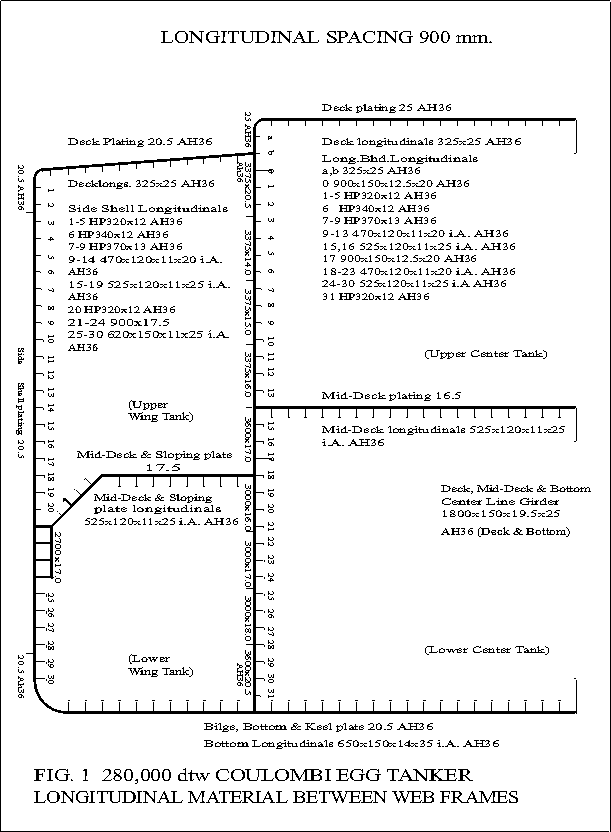
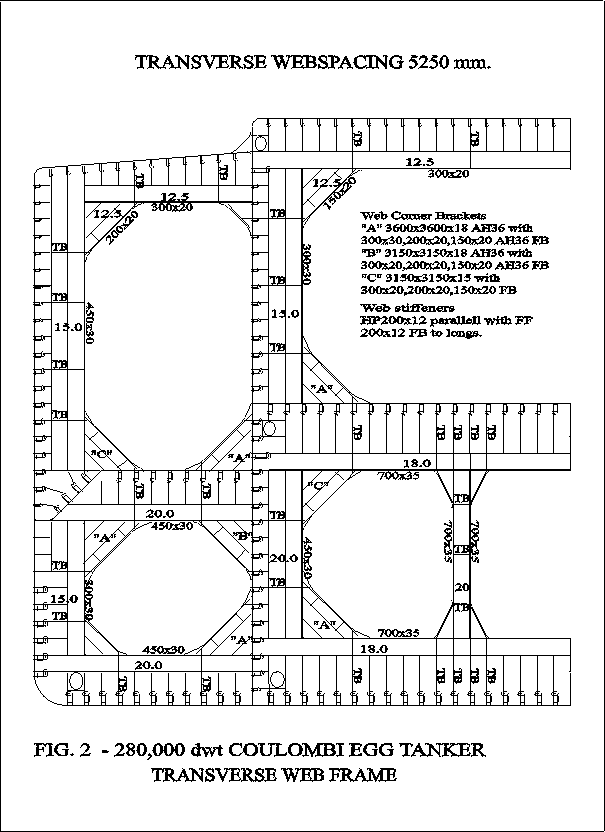
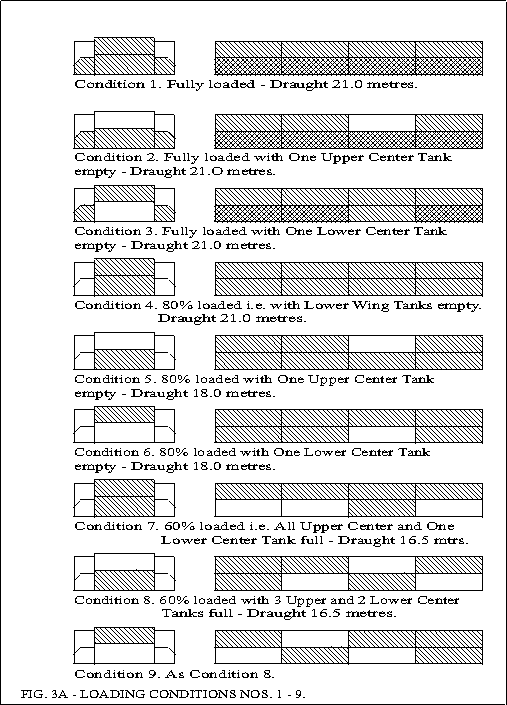
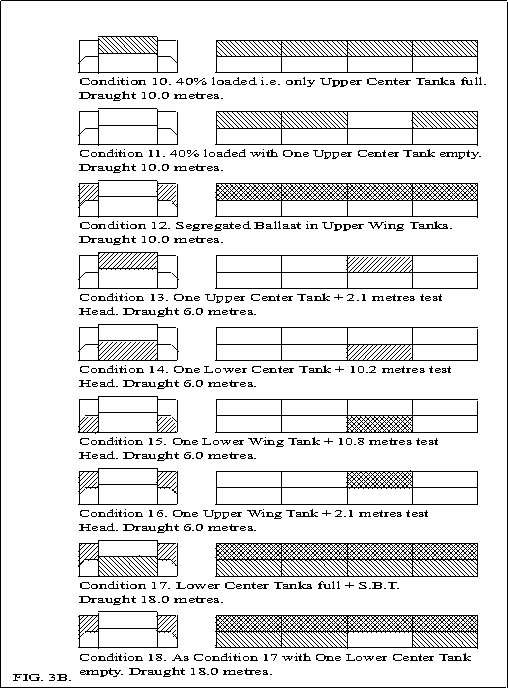
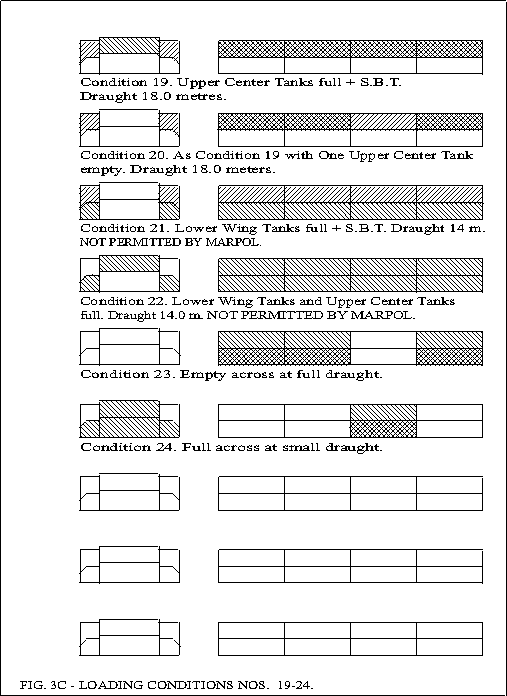
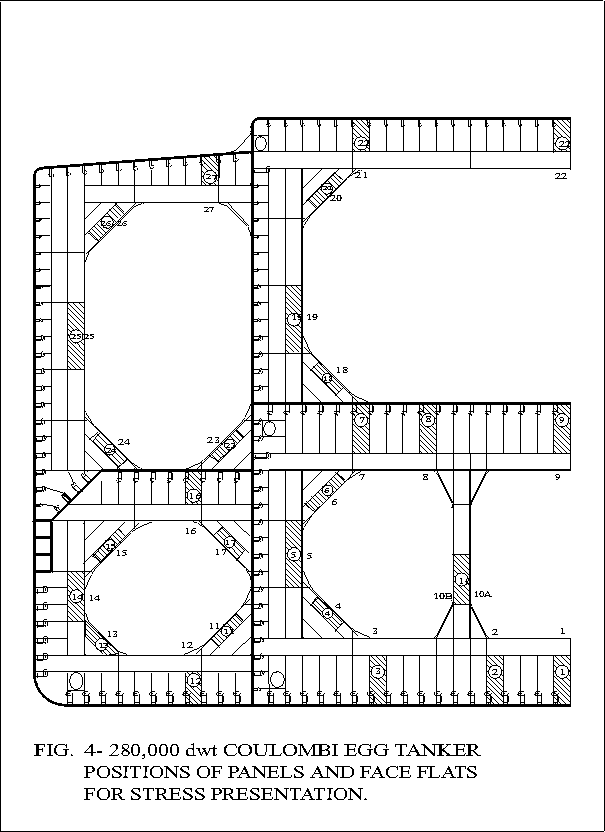
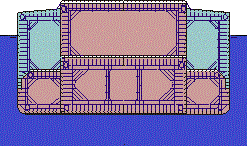
The tank body can be broken down in building blocks as shown in Fig 5 (not included here but described as follows: the bottom of the lower centre tank + long. bhds is the first block. The bottom of the upper centre tank + long. bhds is the second block . The lower side tank (three panels) blocks P+S are the third and fourth blocks. The upper centre deck + long.bhds is the fifth block. The top side tank (two panels) blocks are the sixth and seventh block). Each block consists of flat plate panels with stiffeners and rectangular open webs adapted for fully automatic fabrication and welding in panel and web lines. Corner brackets are fabricated in a separate line. The full width mid-deck is a very good platform for erection welding and dimensional control, and application of coatings to the upper wing ballast tanks can take place during block assembly or after assembling the blocks in the building dock. Safety aspects Cracks and fractures of various types always occur in a tanker structure, but operators must ensure that they do not occur in the oil/ballast boundary structure, to avoid cargo leaks into the ballast spaces. The COULOMBI EGG tanker will perform very well here as the structure concerned - the upper part of the longitudinal bulkhead - is minimally stressed and is not subject to corrosion either too difficult to control or too aggressive. If a leak occurs, it is easily spotted, and oil will collect in the outboard corner of the ballast tank from where it can be transferred to another tank. Environmental protection The Egyptian maritime administration has agreed to sponsor a submission to the 34th MEPC session from 5-9 July 1993 to the effect that the COULOMBI EGG tanker be accepted according to regulation 13F as an alternative design to a double bull. In a comparative study, it was shown that three sizes - 50 000dwt, 150 000dwt and 280 000dwt - of COULOMBI EGG tanker have much lower mean and extreme outflows in accidents than reference double-hull tankers. (Note - the IMO delayed its approval of Guidelines to approve alternative designs until 1995 and then Sweden accepted to sponsor the submission. Approval by the IM0 was not until September 1997 thus four years after this article was published). The reason for this is that grounding protection is provided by the side-to-side mid-deck which effectively reduces outflows to very low figures if the bottom shell is breached. Collision protection is provided by the patented COULOMBI EGG system, which takes into account the non-uniform probability of side damage in collision. It is a fact that deep penetration of the side is more frequent above the waterline, where the COULOMBI EGG tanker has B/5 wide wing tanks and more structural protection than a 2 m wide double side shell. The B/5 wide main deck can absorb a substantial amount of collision energy. The lower 0.25D part of the side is protected by an automatic cargo transfer system. When there is a hole in the lower side, the inflowing water pushes up cargo oil into the access trunks of the lower wing tanks and from there, it flows, through air, to an undamaged upper wing ballast tank on the other side. This overall combination of grounding and collision protection bas been shown to provide superior protection than a 2 m wide reference double hull. Cargo operations The COULOMBI EGG tanker is very suitable for handling three grades of cargo by free flow in the natural segregations provided by the upper and lower cargo tanks. Cargo suction piping is not necessary and three pumps can take direct suction from the aft most tanks. Another cost-effective situation is to use electric driven deep well pumps: four in the upper centre, four in the lower centre and one each in the lower wing tanks. Such an arrangement saves energy during discharge as the cargo in the upper centre tanks only need to be lifted half the tanker's depth. Then all cargo piping is on deck! Tank cleaning of the lower tanks is accomplished by submerged machines. The structural arrangement in the lower centre tank with its rather narrow side webs and two slender struts means that only five or six machines are required for 100% direct washing coverage of the whole structure. Tank cleaning is similar to a single-hull tanker. Operational draught limitations have been mentioned earlier. Clearly, the arrangement with upper and lower tanks requires a new understanding of cargo planning - the order of loading and discharging cargo parcels and the distribution of cargo differ from a conventional double or single hull with full depth tanks. Stability Intact stability is always in order under normal condition numbers 1-12 (Fig 3). Damage stability is also in order. There are no ballast spaces in the tank body adjacent to the bottom to be flooded in grounding, so the analysis is very simple. In part-loaded conditions, an operator may flood a lower cargo tank, but the COULOMBI EGG tanker should always survive, according to the regulations. Beginning of a new era The new Marpol 73/78, regulation 13F, which allows alternative designs to double hulls, is the challenging beginning of a new era. To develop a new tanker is not easy, considering the total influence of any one modification on the structure, fabrication, safety, environmental protection, stability, ease of maintenance and operation of tankers of various sizes. The original COULOMBI EGG vessel was conceived in 1989 and has since evolved with the side cofferdam, the sloping mid-deck at the side, a mid-deck in two levels, the trunked deck design to locate the main deck at the side to act as a fender to absorb collision energy, and the automatic wing tank cargo evacuation system which handles holes in the side. Production costs should not differ too much from a single-hull tanker, although there is approximately 10% more steel in the tank body, which might add 4~5% to the initial cost. Underwriters must appreciate the reduced risk that a COULOMBI EGG tanker offers compared with double-hull. It spills less oil in accidents and does not have the safety hazards of a double-hull tanker. Double-hull tankers have now become the standard reference type, thanks to OPA 90. However, there have been major developments in tanker design since OPA 90 was enacted in August 1990. Therefore, the new Marpol rule providing for safer tankers is a logical consequence of these developments. As a party to the Marpol 73/78 convention, the USA has not objected to regulation 13F. As a consequence, regulation 13F tankers should be allowed to enter US waters. However, the US Coast Guard has indicated that it will not accept regulation 13F tankers and that OPA 90 remains the overriding law relating to bull design, i.e., double-hull tankers only. In effect, the US Administration is in the dubious position of legislating one design and being a party to another. It remains to be seen whether, at the same time, a member of IMO can adopt and adhere to an international convention and maintain that the same convention contradicts national law. The incoming Secretary of Transportation, Federico Pena, faces a difficult decision during his first months. He can maintain the outdated, double-hull only requirements of OPA 90, thereby denouncing Marpol, or he can uphold Marpol and move to amend OPA 90. By opting to denounce Marpol, he closes the door forever for the development of designs that are, I believe, safer anti protect the US environment better than double hulls. By moving to amend OPA 90, he leaves the door open to develop the safest anti most effective means of environmental protection for the entire world. The COULOMBI EGG tanker is one such safer design generally based on well-established single-hull technology, and its mid-deck as grounding protection is an old idea. The challenge has been to develop and to introduce better collision protection in the design without adding the safety hazards of a narrow double side shell. It is my sincere wish that, all parties responsible for the legislating and administering safe transportation of oil by sea will now appreciate that, uniform width double side is not the optimal collision protection anti that the COULOMBI EGG system is expected to better reduce oil spills and fires due to collisions. JUNE 1993
The COULOMBI EGG tanker is a very good design based on single hull technology. In a logical world the development of technology and methods should of course govern the regulatory frame work, but when it comes to oil tankers the political double hull standard (2 meters wide double hull regardless of size of tanker and actual accident statistics) initiated by the OPA 90 still governs the IMO. Nevertheless - as most VLCC's do no trade to US continental ports, they are not governed by the OPA90 so there is nothing to prevent COULOMBI EGG VLCC's to be built and to trade worldwide. Contact anders.bjorkman@wanadoo.fr
|

 COULOMBI EGG
Oil Tanker Design - Structure
COULOMBI EGG
Oil Tanker Design - Structure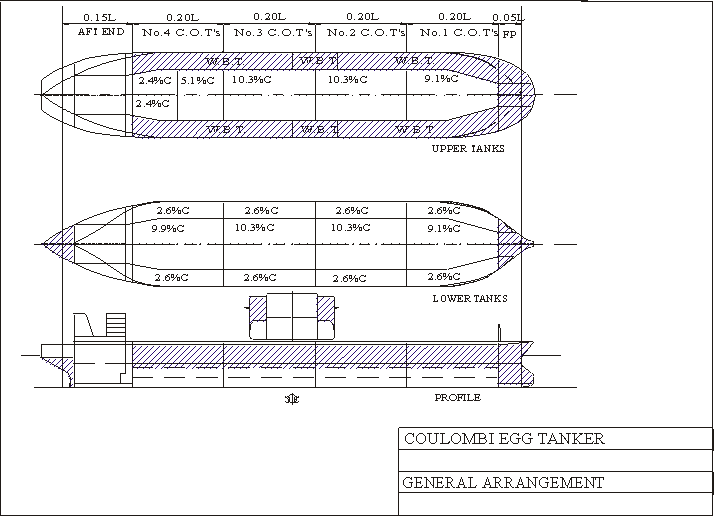
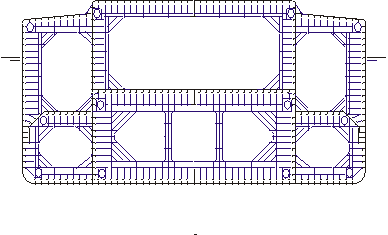
 The tank body structure consists generally of flat
stiffened panels with webs made in a panel line and that are
later assembled into long volume blocks in the workshop. The
volume blocks are then brought to and welded together in the
building dock. The mid-height deck constitutes a good
platform for dimensional control during the block assembly
in dock.
The tank body structure consists generally of flat
stiffened panels with webs made in a panel line and that are
later assembled into long volume blocks in the workshop. The
volume blocks are then brought to and welded together in the
building dock. The mid-height deck constitutes a good
platform for dimensional control during the block assembly
in dock.