|
|
|
|
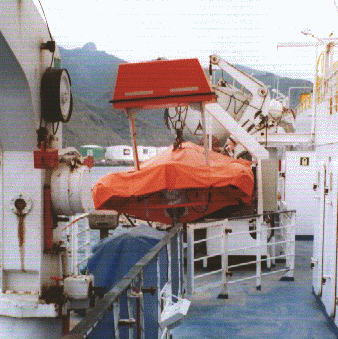
Welcome to this Heiwa Co web page. It is very popular and downloaded >10 000's times. Hopefully it has also saved lives. According PART A, MANDATORY STANDARDS REGARDING PROVISIONS OF THE ANNEX TO THE STCW CONVENTION, Chapter VI: Standards regarding emergency, occupational safety, security, medical care and survival functions, Knowledge, understanding and proficiency, all seamen should know and be trained about, e.g.: (i) Safety precautions during launch and recovery of a fast rescue boat, FRB, (ii) Launching and recovery of fast rescue boat, FRB, in prevailing and adverse weather and sea conditions. I explain here all about a SOLAS Fast Rescue Boat, FRB, and why it is useless, unsafe, no means of rescue and kill seamen in spite of IMO recommending not to train with an FRB or that Port State Control, PSC, should not penalize ships not training with an FRB, etc. And why the IMO is doing nothing to improve the very bad situation since many years. IMO first made FRBs mandatory on certain ships (ropax). Then seamen were killed using them and IMO recommended that you should not train with them and finally IMO told its members not to fine ships at Port State Control for not training/using the FRBs. How not to launch an FRB ... in calm weather ... is shown here! >100 000 persons have watched this on Youtube. And nothing happens ashore. Or at the IMO. In order to save time FRBs are launched, when the ship proceeds at forward speed. In this case the FRB crew forgets to release the FRB from the davit hook - it is manual - while also forgetting to speed away and the FRB thus keeps hanging in the davit wire, while the poor FRB crew is swept away from it. Or the release equipment didn't work? Do not laugh! Imagine to train this with car ferry passengers aboard the FRB as per SOLAS III-30.2 requirements on a dark night in the Baltic between Sweden, Finland, Estonia, Germany and Denmark. Of course, the IMO has later recommended (?) that ferries need not train FRB launcing/recovery at sea at all but ... it is still a SOLAS requirement ... that kills seamen. The whole thing is evidently STUPID. Another example here! Any seaman reading this and then being ordered to attend an FRB launch/recovery exercise and believing it is dangerous is recommended to refuse attending the exercise and report it to the relevant authority. Fast Rescue Boats are mandatory on ropax vessels since 2000 but are 100% useless in severe weather and have killed more seamen than people rescued. Fast Rescue Boats are not mandatory on cruise vessels like Costa Concordia. If anybody falls overboard from a cruise vessel, you have to use an ordinary lifeboat. It is logical, isn't it?
Much easier to save people with a real lifeboat that need not be recovered at sea. Look again how not to launch an FRB ... in calm weather ... as shown here! Don't you think it would be better to stop the ship and launch a real lifeboat that hangs in two hooks? What's the hurry? It is a result of the falsified 'Estonia' accident investigation 1994-1997, that the IMO decided that all roro-passenger ferries should be equipped with Fast Rescue Boats, FRB, year 2000 in spite of the fact that all available information showed that FRBs would not have saved anybody at the 'Estonia' accident or any similar accident. FRBs should be re-named DRBs. Dangerous Rescue Boats! Or SRBs! Stupid Rescue Boats. IMO doesn't care, except that IMO has confirmed in April 2011 that nobody is interested, if the equipment, FRB, davits, means of rescue - the whole lot - actually can be used in severe weather because it is not necessary to train with it in severe weather! It is evidently better to use a slow boat that can be safely launched in any weather in rescue operations ... but if you have an FRB ... use it ... and kill your self. Funny mishaps happen at FRB training. After launch, the engine dies and the FRB drifts away ... and must be rescued by a stand-by vessel! Not too bad, nobody dies! Not so funny is launch and recovery at sea in severe weather and in real situations. It is impossible both to launch and recover the FRB safely at sea and thus not trained at any courses, etc. Many seamen have died training with FRBs at sea! The Classification Societies have many rules for FRBs but ... no requirements for safe launch and safe recovery of FRBs from/to ships at sea. GL is a typical example. National administrations, e.g. USCG, often delegate inspections and tests to class societies or independent companies ... that do not have any requirements ... as none exists! Nobody cares ... about safety at sea in this particular case. Since 2000! 12 years! DNV has detailed requirements ... but no ideas about how to really (4.5.11) Demonstrate recovering the boat safely, both by day and night, in adverse conditions, as the onboard equipment on any real ship is not suitable for it. Many courses by private enterprises, approved by authorities (!), have apparently been designed to meet the requirements of STCW section A-V1/2 and are based on the guidelines of IMO Model Course 1.23. But no course trains launch and recovery of FRB at sea in severe weather from a real ship. Reason? It cannot be done safely. The courses are just jokes! You drive around in an FRB in calm weather starting from a jetty. Ridiculous. Today, 2016, FRBs are mandatory on all ro-pax ferries and other ships ... but useless in severe weather. And in good weather it is much better to launch a lifeboat to rescue people. So why does IMO/SOLAS/STCW mandate and encourage dangerous, unsafe, useless FRBs? Based on information from the falsified 'Estonia' accident investigation 1994-1997, the IMO decided that all roro-passenger ferries should be equipped with Fast Rescue Boats, FRB, year 2000 in spite of the fact that all available information showed that FRBs would not have saved anybody at the 'Estonia' accident or any similar accident. Very soon FRB crewmembers were killed or hurt training with FRBs in severe weather at sea. The IMO then recommended (sic) that roro-passenger ferries should not be arrested at Port State Controls, when it was established that the crew did not practice with the dangerous FRBs as per SOLAS rules, i.e. in severe weather. Later it has been decided not to use the FRBs at all on roro-passenger ships as recommended by the IMO! At IMO/STW 35 - January 2004 - the matter with the dangerous fast rescue boats killing seamen was discussed as so many seafarers had died or been injured using them:
So it was decided January 2004 that DE 47 should finalize the design and equipment specifications of dangerous fast rescue boats before additional training requirements had to be developed! So what happened at DE 47? In 2004 the IMO/DE 47 decided that FRBs should not be regarded as means of rescue! No specifications were really required! But according to SOLAS you must still equip a ferry with an FRB! And passengers are recommended to attend the drills!
Thus, the two countries Finland and Sweden that produced the false 'Estonia' report 1997 and earlier, 1995, recommended that all ships should carry fast rescue boats, now suggested, 2004, that fast rescue boats are useless, killing people, and should not be regarded as means of rescue. And the DE Sub-Committee agreed! No design and equipment specifications of the FRBs were necessary - but training was still required. Crazy - isn't it? Fast rescue boats are very good means of rescue, e.g. on fixed offshore platforms and at shore life rescue stations. But on ro-ro passenger ferries at sea fast rescue boats are death traps! So what will happen now? The DE Sub-Committee deleted the subject from its work programme! Will the IMO Marine Safety Committee now recommend that fast rescue boats shall be removed from all ro-ro passenger ferries, as they are no means of rescue? Well - a year later STW 36 - January 2005 completely forgot that FRBs were not means of rescue and recommended further training with these means of non-rescue:
You wonder if the IMO/STW is serious? Do they still think that risks are minimized with more training with something that is no means of rescue? Haven't they realized that an FRB is not only dangerous but useless in severe weather. Training will not change anything. IMO Circular Letter MSC/Circ.1161 about GUIDANCE ON TRAINING FAST RESCUE BOATS LAUNCH AND RECOVERY TEAMS AND BOAT CREWS (adopted on 20 May 2005) states, i.a. : " So as not to expose the fast rescue boat crew to undue risk, the Masters/operators of ships, in conjunction with the trainers, should take the following into account while undertaking training in the launch and recovery of such craft: .3.1 Master and person in charge of the fast rescue boat should consult prior to any launch (and recovery!) and give due consideration to:.1 reliability, type and complexity of the fitted equipment;, etc, etc." As no reliable FRB launch equipment exists, you do not have to use it! To train in port in calm weather can never replace training at sea in severe weather. It actually just fools the poor seaman attending the training. Nobody has so far (November 2013) explained to Heiwa Co why it is necessary to train with something that is not a means of rescue and which has been taken off the PSC check list for compliance with SOLAS. The answer was given early 2006 - IMO model course 1.24 "Proficiency in Fast Rescue Boats - Not Means of Rescue". This was a three day course with 50% drills probably done ashore in calm weather! No realistic training in severe weather was evidently possible. Fast rescue boats fitted on ferries do not contribute to safety at sea at all. They only kill the crew trying to use them - a good reason to stop them. But why are they required?
Specifications for Development of the new Concept of Rescue on RoRo Passenger Ships This report is part of a 'scientific' program to improve safety at sea. So far Vinnova has wasted SEK 40 million on worthless research to improve safety at sea. The report is reviewed below. The authors are: Roland Steen, Landsort Maritime VINNOVAs dnr: 2001-06226
"The Fast Rescue Research Project was initiated in August 2001 by Swedish rescue research and training company Landsort Maritime (project leader). A project group was formed with ferry operator Destination Gotland and Royal Institute of Technology. In the autumn 2001 also ferry operator Silja Line joined the project. Scottish trainer Maritime Rescue International in Aberdeen has been associated to the project. The project was in October 2001 granted external financing from the Swedish government, through the Swedish Agency for Innovation Systems (VINNOVA), and also from the Swedish Mercantile Marine Foundation. Eleven ferry operators in Sweden, Denmark, Norway, Finland, Estonia, Latvia, Poland and Germany have supplied the information on which the conclusions and recommendations are based. These companies operate altogether some 60 RoPax ferries. Installations on twenty ships have been thoroughly analysed. Twenty practical exercises and tests have been documented. Masters, crews and company safety managers have contributed with their experiences. Additional information has also been supplied by the International Chamber of Shipping covering another six European operators, operating some 40 RoPax ferries. The Swedish Maritime Administration has also submitted background information and comments on some aspects of the project. The project was at its start presented at the IMO STW committee meeting in January 2002. Also the preliminary findings were presented to the IMO STW committee in January 2003 and to the IMO DE Committee in February 2003. In the project group have participated prof Jan Forslin and prof Lena Mårtensson, Royal Institute of Technology, Bertil Skoog, Chief mate/master mariner Silja Line, Rolf Karlsson, Chief mate/master mariner Destination Gotland, Kåre Eksell, Base manager Landsort Maritime Training and Roland Steen, CEO Landsort Maritime (project leader). Associated to the project has also been Alan Hurry, CEO Maritime Rescue International, Aberdeen. "  The launching (SOLAS III-35.3.3) from and
recovery to a ferry of rescue
boats (SOLAS III-35.3.13) in severe
adverse weather conditions
shall be explained in detail in
a training manual.
The launching (SOLAS III-35.3.3) from and
recovery to a ferry of rescue
boats (SOLAS III-35.3.13) in severe
adverse weather conditions
shall be explained in detail in
a training manual.
The reality is as follows, and the report fails to say so: No existing arrangement, appliance and crew can launch and retrieve a fast rescue boat from any ferry in severe adverse weather conditions (Beaufort 6 and mean wave height 3 metres) without the risk of the crew itself - and the person having been rescued - being killed. In more severe weather it is even more dangerous/impossible. The whole idea of fast rescue boats on ferries is 100% wrong. The reason is that the ferry is rolling and pitching in severe adverse weather and that the rescue boat will be thrown against the ferry side during launch and/or retrieval. The fast rescue boat on a ferry is totally unusable to rescue persons in the water or distress in severe weather. This is a proven fact. The IMO has 2002 recommended its members not to arrest (sic) ferries at Port State Control for not having trained and drilled with the rescue boats - as the training is dangerous. The IMO on the one hand mandates fast rescue boats on ferries and on the other supports the crews that do not want to train with them as they are dangerous. Isn't it stupid? First the IMO says you shall fit a rescue boat, then the IMO recommends that you don't use it! And finally, in 2004 the IMO decides that a fast rescue boat is not a 'means of rescue' so no specifications of it are required! Therefore any Administration at present, including the Swedish one, approves today any (stupid) arrangement and appliance assuming that the crew shall handle any impossible difficulties. The Administration is simply not responsible if the arrangement and/or the appliance can or cannot fulfil the requirements as nothing is specified. The Administration will simply put the blame on the crew. A big problem is that this shall be explained (sic) in detail in a training manual - how can you explain the launching of a fast resuce boat in severe adverse weather, if it has never been done, and if it were done, that the crew would kill itself? Another problem is that launching/retrieving shall be trained every week, but who has heard about any Scandinavian ferry company training fast rescue boat drills every week … with passengers? Figure 3.1 in the report is typical - it shows the numbers of accident with fast rescue boats until the year 2000 - but not for years 2001 and 2002, when the number of accidents increased ten-twenty times because then fast rescue boats became mandatory and ignorant crews tried or were forced to drill with dangerous and substandard arrangements and appliances - approved by the Administrations. The authors of the report should be ashamed of themselves for not telling the truth about the useless fast rescue boats, but they are not, as the report is part of the Swedish Vinnova and Swedish Maritime Administration attempts to cover up the Estonia accident 1994. The Estonia accident took place in Beaufort 7 with mean wave height four metres, so not one newly fitted rescue boat would have saved one person then in 1994. Actually not one newly fitted fast rescue boat on 400+ ferries has saved any person in distress since year 2000 that could not have picked up by a slow rescue boat or a life boat or by existing equipment. The whole fast rescue boat on ferries business is a farce - and the report fails to say so. But a positive word of the report - it points out many risks and deficiencies with the boats, the launching and retrieving installations and the training of the boat crews. It is clear from these descriptions that the whole concept is wrong - to launch an FRB from a ro-pax ferry is unsafe in severe and even fair weather and to retrieve it - forget it! But in lieu of concluding these simple facts the report suggests a number of recommendations to reduce the risks but no recommendation will solve the basic problems. It is much better to locate the fast rescue boats ashore, where they can be launched safely and where a trained crew is always available. Thus, all ferry operators should donate their fast rescue boats to land based rescue organizations! Then they can probably save people - what they are intended for. Not to hang useless on ferries at sea, where they are never used! And how to save a person falling overboard from a roro-pax ferry? Easy! These ferries are fitted with GPS and when the man-over-board alarm is raised the position should immediately be recorded by the GPS. This should be done automatically - the alarm buttons on the ship should be connected to the GPS and activate the position recording function. Unfortunately this is not a SOLAS requirement but easily done by some extra wires on the bridge. Then the ferry can easily return to the exact man-over-board position (even in fog or darkness), lower a lifeboat and pick up the person. No need to recover the lifeboat at sea (it is extremely difficult) as it will proceed to shore itself. A national maritime administration has studied above info and on 19 April 2011 advised: Re launching and retrieving an FRB in severe weather (B6, wave height 3 m) from a ropax ferry or other ship there exist no requirements in SOLAS to verify if it is possible and therefore it is not checked or tested. Re crew training of FRB usage in severe weather there exists no requirements in SOLAS that it is done! The administration allows crew training to be done in protected waters or in port, i.e. training in severe weather is not done. So IMO/SOLAS mandates FRBs since 2000 but has 2011 no requirements that FRBs can be launched/retrieved in severe weather or that crew training of it is required. To Heiwa Co start
page
|