|
Appendix 1
The writer was invited to the Design for Safety Conference at Glasgow 1999: The below paper was presented:
|
|
Introduction
The Estonia accident 1994 was the catalyst in the recent developments on ship safety and is still exercising the minds of the maritime profession. Many questions about the accident are outstanding. It is of vital importance to establish the real reasons, why the Estonia sank so fast and why so many passengers and crew - 852 - died. I am grateful to participate in this Debate and I hope Mr Karppinen, who was a member of the investigation commission, will be in a position to clarify three outstanding questions, which bothers me still. Hopefully DELTAMARINE can also contribute to clarifications of the issues.
Within only three weeks of the accident its cause was announced - it was stated that heavy weather had ripped apart the visor locks at about 01.00 hrs and for 10 minutes the visor moved up and down around the deck hinges hitting the fore peak deck; at about 01.10 hrs the visor hinges broke apart, the visor moved forward and dislodged the bow shell ramp from its six locks; by 01.14/01.15 hrs the visor fell off and sank to the bottom of the sea, the weathertight ramp was pulled fully open and water started to enter the car deck in the superstructure about 2.5 m above the waterline. While the vessel continued its course about half a mile west at 14-15 knots, the vessel heeled suddenly to starboard, then stopped heeling for a while, so that about 230 persons could get out, then the vessel allegedly turned 180° to port (not proven), the engines stopped, but the ship moved on an easterly course one and a half miles for about 30 minutes, when she was filling up with water and listing more and more to starboard, so that she sank one mile east of the visor position at about 01.51 hrs. Sometime during the accident the ramp closed. The official history of the tragic accident is shown in figure 13.2 of the Final Report about the accident published in December 1997, which is included at the end of this paper. Apart from the visor locks defective design and manufacture 1980 the ship was otherwise reported seaworthy in all respects 1994., i.e. the ship and crew were in perfect condition.
I have previously written two books about the accident investigation and the new SOLAS safety rules which followed: -
(1) 'Lies and Truths about the M/V Estonia accident', 128 pages, Editions EGC, Monaco February 1998, ISBN 2-911469-09-7. Price FF 100: - incl. postage.(2) 'Nya Fakta om Estonia. Rapport om Estoniautredningen', 60 pages (in Swedish), Beausoleil, March 1999, Price Euro 15: - incl. postage.
Both publications are available from Björkman, 6 rue Victor Hugo, F 06240 Beausoleil, France. My views have also been published in many newspapers and magazines and are therefore well known and I will not repeat all of them here.
The Estonia investigators did not know the basic Stability Facts
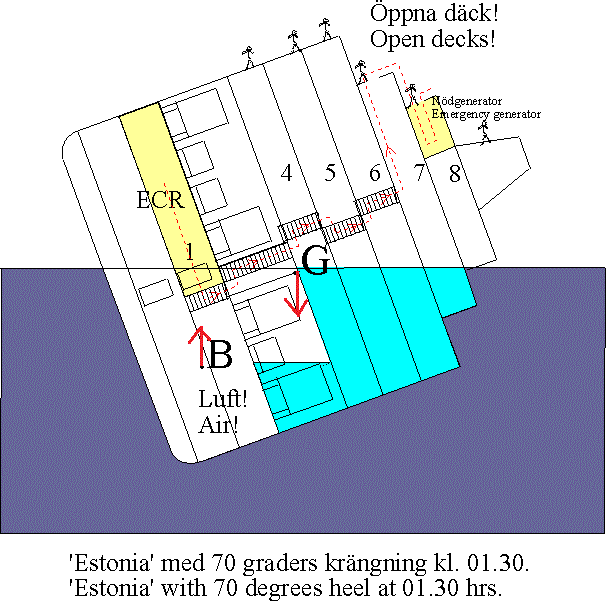
Everyone involved with ship's stability knows that water on a car deck in a superstructure of a roro-passenger ship is only extra, lose weight, which trims and heels the ship; the water shifts and flows to the lowest position on the roro car deck.
In the case of the Estonia 2 000 tons of water on the main roro car deck in the superstructure should have trimmed the ship 1.5 meter on the bow (or the stern) and should have caused a list of about 33 degrees. As the water would be loaded below the Vertical Centre of Gravity, VCG, of the ship, it would lower the VCG. As the ship's metacentrum M remains about constant, when extra cargo is loaded, the metacentric height GM actually increases due to extra cargo on the car deck! 2 000 tons of water also increases the ship's draft by 0.8 meter.
However, and this is critical, the water, which heels the ship as it collects in the side of the ship on top of the watertight car deck in the superstructure, reduces the righting arm GZ, as the Centre of Gravity is shifted sideways.
With 2 000 tons of water in the side GZ<0 for any angle of heel, i.e. the ship capsizes and floats upside down on the undamaged hull below the superstructure (and the water on the car deck flows out into the sea). The effects with water on a car deck in a superstrcuture above waterline are very simple to simulate with, e.g. a Napa Onboard stability computer.
The Estonia never capsized with water in the superstructure nor floated upside down on an undamaged hull. According to the Final Report the Estonia sank slowly on the stern after 37 minutes.
The righting arm curves with water on the car deck included in the Final Report of the Estonia accident report (figure 12.12 on page 162) suggests however that GZ>0 for heel angles >40-60 degrees with <2 000-4 000 tons water on the car deck in the superstructure. It shows that for three years the investigators did not understand the basic stability issues (they assumed that the ship floated on the non-watertight deck house on top of the superstructure), when they analysed the accident.
(Addendum 3 January 2001 - on 15 December 2000 the Swedish National Maritime Administration, SNMA, confirmed in a letter to the Swedish government that you are not permitted to include buoyancy in a superstructure type deck house when calculating damage (and of course intact) stability as the deck house is assumed to be non-watertight. However, the SNMA added that in the case of the 'Estonia', there was apparently a large amount of buoyancy in the superstructure which prevented capsize. What this bouyancy consisted of was not stated).
I will however here concentrate on three other questions, which have not been properly answered in the Final Report about the Estonia accident.
· Was the bow ramp to the car deck ever open?
· Were the watertight doors below the car deck closed?
· Why did the Estonia sink so fast?
Question 1 - Was the Bow Ramp to the Car Deck ever open?
According to the official report the bow ramp of the Estonia was ripped fully open by the visor, when it fell off at 01.15 hrs. Reportedly the ramp locks were ripped apart and it is assumed that the ramp then fell down on the car deck below it. Water could enter the car deck, so that the ship would heel, trim and increase its draft. Later during the accident - before or after the sinking is not known - it is suggested that the ramp closed. The reason for this is that the ramp was found closed on the wreck by a Remote Operated Vehicle, ROV, with a TV camera sent down to investigate the wreck early October 1994.
According to e-mail to me from Tuomo Karppinen, VTT, Finland, on 6 May 1998 the accident investigators sent a written memo in November 1994 to the divers, which inspected the Estonia 2-4 December 1994, to confirm that the closed ramp had actually been open during the accident. The divers apparently reported that the ramp had been locked before the accident and opened and closed during the accident, but how they reached such conclusions is not clear. No photos, broken parts or similar proof have ever been shown that the ramp was ripped open.
The following are facts:
· According to the Final Report three crew members in the engine control room saw the ramp closed on the car deck monitor two minutes after the ship heeled, i.e. the ramp was closed after the visor had fallen off (figure 6.1 on page 66 in the Final Report).· According to the watch keeping seaman, at a hearing 17 October 1994 at Tallinn, he saw the ramp closed at 01.30 hrs, when he was in a life raft just outside the bow. Other survivors in the water also saw the ramp closed.
· The early official statements never suggested that the ramp had been fully open or ripped open by the visor. Instead it was officially stated that the ramp had been partly open or leaking to let water in. It was only later officially stated that the ramp had been more open during the actual accident and that the ramp later closed itself as found on the wreck.
· The Final Report is contradictory - on the one hand it says that the ramp was pulled fully open at 01.15 hrs, on the other hand it says that three persons saw the ramp closed two minutes after the ship had started to list.
If the ramp had been ripped open by the visor, you would expect that the visor locks were damaged.
Unfortunately the Final Report does not include any details (drawings, scantlings, etc) whatsoever about the ramp locks, e.g. their design and strength. The ramp was in fact the weathertight door in the side shell as called for by the ICLL66, reg. 21, whose structural integrity should be commensurate with the surrounding shell plating. According my opinion, based on ships with similar ramps as Estonia's, the six ramp locks had a break strength exceeding 25-40 tons each, so that they could never have been ripped open by a 55 tons weight of a lose visor falling off the ship. The Final Report just states, as a matter of fact, that the visor ripped open the six ramp locks, but this is not proven. Furthermore - the forepeak deck below the ramp and the underside of the ramp itself are completely undamaged, indicating that the ramp never hit the forepeak deck. My conclusion is simple - the bow ramp was never open during the accident.
The German Group of Experts has studied the condition and maintenance of the ramp. Their conclusions will be made public in a report to be published at the end of this year. According to the Germans the ramp was twisted and not weathertight; some locks could not be engaged and weathertighness was ensured by mattresses, etc. pushed into the gap by the crew. Little water therefore leaked continuously into the car deck through the ramp in bad weather at sea. It was probably this water the crew saw at the closed ramp after the ship heeled. But the Germans probably agree with me that the ramp was never pulled open by the visor. Probably the ramp was never locked.
The answer to question 1 is thus that the bow ramp was never open!
Question 2 - Were the watertight Doors below the Car Deck closed?
Intact and damage stability calculations assume that all watertight doors are closed. The Final report does not include any details whatsoever about the watertight doors in the bulkheads below the car deck on the Estonia, their numbers, their design, their control and indication, and whether the doors were actually closed prior to or after the accident. The reason for these serious omissions can only be that the doors did not comply with SOLAS II-1, reg. 15. Several facts support this suspicion:
· The Estonia had total 20 watertight doors in 12 watertight bulkheads. One watertight bulkhead had totally three doors, several bulkheads had two watertight doors and all other bulkheads had one door. This situation was in complete contradiction with the requirement (reg. 15.1) that the number of openings in watertight bulkheads should be reduced to a minimum compatible with the design and proper working of the ship. The Estonia should have had only maximum six watertight doors for work and escapes in the engine room spaces. All other watertight doors were not required for the working of the ship.· Most or all of the watertight doors were kept open at sea in contradiction with reg. 15.9.1 that all doors shall be kept closed during navigation. The reasons for keeping the doors open were, i.a. to enable passengers to move between the sauna and conference rooms on deck 0 and passengers in cabins on deck 1 to go to the public toilets on the same deck (but in an adjacent watertight compartment) and to enable the crew to easily visit five main, auxiliary engine, pump and compressor rooms on two deck levels 0 and 1. Several surviving passengers and crew and shore staff have testified that the watertight doors were always open at sea.
· The remote and local closing control system of the watertight doors were wrong. The Swedish maritime inspector G. Zahlée, Malmö, who PSC inspected the Estonia on 27 September 1994, has testified that it was not possible to close the doors locally, as the local closing function was overruled by a signal from the central control console on the bridge (deck no. 9). In fact - if you tried to close a door locally, it immediately jumped open! The reason for this was apparently to prevent, e.g. passengers from closing the doors. The investigators censured the testimony.
· The indication system of the watertight doors on the bridge was manipulated. Several persons have testified that green lights indicated open watertight doors to make the impression, that the doors were in fact closed. Red light normally indicates an open door and as all doors should have been closed at sea, all indication lights should have been green on the bridge.
· Finally, the watertight central control console was not as per reg. 15.8.1, which provides remote closing of doors only. As shown above it was possible to open or to keep open the watertight doors from the bridge, a practice that evidently was both illegal and dangerous.
It is therefore very likely that all watertight doors were open on the Estonia prior to the accident. According to the Estonia emergency procedures a person on the bridge in the event of collision or grounding should then close the watertight doors. The Final report states that the doors were closed after the first heavy listing, but there is no proof for that. In any event the emergency procedure was wrong - the doors should have been closed already when leaving port. My conclusion is that most watertight doors on the Estonia were open at the accident, i.e. the ship had no internal watertight integrity in case of leakage and flooding. This may explain the sudden listing of the ship.
The answer to question 2 is that the watertight doors were open, when the ship sank!
Question 3 - Why did the Estonia sink so fast?
This question is not answered at all in the official Final Report. As stated in the introduction the vessel allegedly sank between 01.14/01.15 and 01.51/01.52 hrs due to water on the car deck. It is also suggested that water entered the deck house through broken windows at deck 4 and 5, when the ship listed. This water allegedly flowed through the gas tight (sic) car deck ceiling (deck 4) down into the car deck space, and the water also flowed through the watertight (sic) car deck 2 and filled the 12 watertight compartments below the car deck, so that the ship actually could sink. As it is impossible that water flows through gas tight and watertight decks, the sinking process suggested by the Final Report is simply impossible.
As already pointed out above the Estonia should have capsized and floated upside down on the undamaged hull with only 2 000 tons of water on the car deck in the superstructure. It would have taken one or two minutes.
So why did the Estonia sink so fast? Captain Werner Hummel of the German Group of Experts has informed in an interview in the Swedish daily newspaper FinansTidningen 12 August 1999 that several survivors noted water on deck no. 1, which apparently flowed up from the sauna/pool compartment, just prior to the ship lost its stability already at 01.02 hrs. According to Hummel the sauna was flooded and in contact with the open sea, i.e. the ship was leaking. Several survivors have given a completely different description what happened than what is stated in the Final Report. According to many surviving passengers there were a number of heavy impacts - explosions?, collisions? - in the ship prior to 01.00 hrs; at 01.02 hrs the vessel suddenly lost its initial stability and heeled 40-50 degrees to starboard, when people and lose furniture and equipment were thrown down to starboard lee, many persons broke arms and legs, and then, about 01.05 hrs, the vessel uprighted and became stable with about 15 degrees list, which enabled about 230 (or more) persons to evacuate the ship (almost all survivors were inside the ship, when it lost its stability) during several minutes, when the ship was rolling and the list was temporarily was reduced.
Hummel does not know, why the sauna was flooded or what caused the leakage. According Hummel it is possible that explosive devices caused it, as intact explosive charges were found, but not reported, on the wreck and are shown on video films. This was reported on the first page of Lloyd's List 12 August 1999. Hummel also suggests that the visor was blown off by one explosive charge after the sudden listing.
What everybody seems to forget about the fast sinking is that the Estonia sank with the stern first and with the bow high above the water (with the ramp closed, but with the visor allegedly missing - water could therefore not enter through the bow opening. Some survivors state that the visor was seen at the bow).
(Addendum 3 January 2000 - the visor apparently was still attached to the hull when the ship sank and was then adjacent to the bow on sonar pictures of the wreck area taken 30 September 1994 - up-dated web page!).
A massive leak into one compartment aft below waterline explains the fast sinking.
There are three store rooms on deck 1 aft connected by watertight doors and three engine room spaces on deck 0 (cp-propeller equipment, compressors, pumps) below, also connected by watertight doors and with access to the main engine room. If the watertight doors were open - which I assume was the case - a leak aft would quickly flood three or more compartments. The result would be sudden loss of stability, as observed aboard at 01.02 hrs, uprighting, more listing while sinking on the stern, which actually happened.
I therefore suggest that the Estonia simply sank due to a leak aft. The possibility has never been investigated - actually the only cause, which has been investigated, is the one about the lost visor and water on the car deck in the superstructure.
(Addendum 8 June 2001 - the writer believes today that the leakage was in fact i.w.o. the sauna/pool compartment, which later extended into the empty, starboard heeling tank - open watertight doors on deck 0 made then sinking possible).
The answer to question 3 is then that the 'Estonia' sank fast due to a heavy leak and open watertight doors.
What went wrong with the Estonia Investigation?
The Estonia accident investigation 1994-1997 was sloppy, unscientific and unprofessional. The marine investigators never interviewed the passengers. Two investigators died and five or six investigators resigned or were sacked or replaced. The investigation was secret for 38 months. Nobody from the public had any insight. The only outsiders permitted were five observers from the Danish, Estonian, Finnish, Norwegian and Swedish maritime administrations. Advice from outside master mariners, naval architects, insurance and safety surveyors was always ignored. The reason was that the official investigators had decided and publicly announced already 19 days after the accident, what they thought had happened. When real facts then contradicted the erroneous ideas of the investigators, the facts were ignored. It seems that the truth often is the first victim in an accident investigation. As the investigation was secret, the investigators could tell media whatever they wanted. The media could not check any facts. It seems that all information given to the media was false.
The investigators stated, e.g. that the visor had hit repeatedly up and down against the forepeak deck for 10 minutes, while all photos of the forepeak deck showed that it was undamaged! When it was certain that the ramp had never been open, the investigators chose to ignore that fact and stated the opposite. When it was virtually ascertained that the watertight doors were always open, which caused the fast sinking, when the ship was leaking and not as per SOLAS, the investigators chose not to mention the doors at all. And when it was clear to the investigators that a ship does not sink fast due to water on the car deck, they just made up the story - the fairy tale - that ships sink due to water on the car deck and censored all correct stability calculations stating the opposite. No roro-passengership, as far as I know, has sunk due to water on the car deck; the Herald of Free Enterprise capsized in 2 minutes and never sank, the Jan Heweliusz capsized also quickly - a few minutes - and floated upside down for several days.
One reason why so many died was that the Estonia lacked proper liferafts launched by davits. The ship had mainly throw-overboard-rafts for wet evacuation - all survivors had to jump overboard and swim to a raft, which was incorrect standard in 1994. Had the accident taken place in December-March, when the water was colder, all persons would have frozen to death. It seems that the Estonian and Nordic maritime administrations want to cover up this fact, so therefore it is not mentioned in the Final Report. It is also clear that three surviving engine crew members are not telling the truth - they maintain that they remained in the engine control room, ECR, for at least seven minutes after the listing and then left the ECR on deck 1 and took the stairs to deck 8. However it was not possible to use the stairs at that time due to the heel angle.
The IMO panicked when the Estonia sank. An 'expert panel' was quickly put together in 1994 but there were only a few stability experts in the panel and they never checked the Estonia's stability with water on the car deck. The 'expert panel' made a number of not very clever rule change proposals in 1995 and they were quickly adopted without normal vetting in the MSC subcommittees using FSA, etc. The IMO did not follow its own work procedures after the Estonia and haste makes waste. The interested party should read my book for more details about the new SOLAS rules after Estonia!
Obvious Faults in the official Final Report
Figure 13.2 - Course of events - of the Final Report is shown below: -
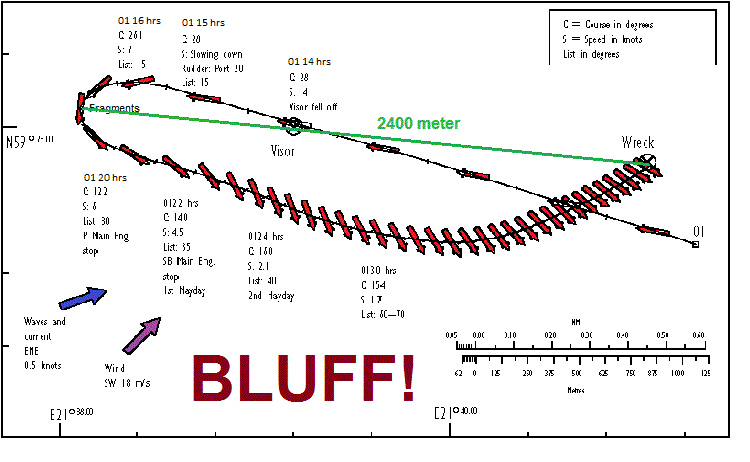
Figure 13.2 in the Final Report is a sloppy modification of figure 4.12 in supplement no. 522 to the Final Report by Michael Huss, Ph.D., 'Simulation of the Capsize', which in turn was a theoretical failure trying to reconstruct the accident by the Marine Academy of Kalmar. The modifications between Huss (H) and the Commission/Final report (5) concern, i.a. the angle of heel and the amount of water on the car deck at various times after the visor was lost as shown in the below table: -
|
Estonian
Time |
Time after Loss of Visor (min) |
Water in the Super-structure as per Huss (tons) |
Inflow as per Huss (tons/ minute) |
List as per Huss (degrees) |
Wave Direction (°) |
List as per Final Report (degrees) |
Velocity of Heel (degrees per min) based on (5) |
Diff. in List between Huss and Final Report |
Speed acc. Huss (knots) |
Speed acc. Final report (knots) |
|
01.14.00 |
0.0 |
0 |
400.0 |
0 |
135 |
0 |
15.0 |
0 |
14.5 |
14.0 |
|
01.14.30 |
0.5 |
200 |
400.0 |
6 |
135 |
- |
15.0 |
- |
14.5 |
~ |
|
01.15.00 |
1.0 |
(340) |
285.7 |
(10) |
~ |
15 |
15.0 |
(+5) |
~ |
~ |
|
01.15.12 |
1.2 |
400 |
250.0 |
11 |
150 |
15 |
0 |
+4 |
13.0 |
~ |
|
01.16.00 |
2.0 |
(571) |
250.0 |
(15) |
~ |
15 |
0 |
±0 |
~ |
9.0 |
|
01.16.24 |
2.4 |
700 |
83.3 |
17 |
*180 |
- |
5.0 |
- |
8.5 |
~ |
|
01.20.00 |
6.0 |
1 000 |
38.5 |
22 |
~ |
30 |
5.0 |
+8 |
5.5 |
6.0 |
|
01.22.00 |
8.0 |
(1 077) |
38.5 |
(23) |
~ |
35 |
2.5 |
(+12) |
~ |
4.5 |
|
01.24.00 |
10.0 |
(1 154) |
38.5 |
(24) |
~ |
40 |
2.5 |
(+15) |
~ |
2.1 |
|
01.27.00 |
13.0 |
(1 269) |
38.5 |
(26) |
~ |
(50) |
(3.3) |
(+24) |
~ |
~ |
|
01.30.00 |
16.0 |
(1 385) |
38.5 |
(27) |
~ |
60-70 |
3.3-5.0 |
(+33/43) |
~ |
1.7 |
|
01.33.00 |
19.0 |
1 500 |
55.6 |
29 |
255 |
80 |
6.7 |
+51 |
0.0 |
2.2 |
|
01.40.00 |
26.0 |
(1 888) |
55.6 |
(35) |
255 |
110 |
2.5 |
(+75) |
0.0 |
2.2 |
|
01.42.00 |
28.0 |
2 000 |
55.6 |
37/180! |
255 |
115 |
4.0 |
+78/-65 |
0.0 |
2.2 |
|
01.43.00 |
29.0 |
2 056 |
- |
180!! |
~ |
(119) |
4.0 |
(-61) |
0.0 |
2.2 |
|
01.51.00 |
37.0 |
- |
- |
180!! |
~ |
(150+) |
4.0 |
(-30) |
- |
2.2 |
a"During the port
turn water continued to enter the car deck and the list
increased to 20-30 degrees where the vessel for some minutes
stabilised as the water inflow decreased". (Chapter
13.2.6 of (5))
b"By about 0120 hrs all four main
engines had stopped ... The main generators stopped about
five minutes later.
After the main engines stopped, the 'Estonia' drifted with a
list of about 40 degrees and the starboard side towards the
waves". (Chapter 13.2.6 of (5)).
Expert Huss 'scientifically' established based on model tests, assuming that the ship turned 180° back to Tallinn first into and later away from the waves, that it took 6-19-28 minutes to fill the car deck in the superstructure with 1 000-1 500-2 000 tons of water (inflow 166.7-38.5-55.6 tons/min). In that time the angle of heel increased to 22-29-37 degrees (velocity of heeling 3.67-0.54-0.89 °/min). It took the Estonia 19 minutes to stop in the water at 01.33 hrs according to Huss. Then Huss calculated that the vessel, immobile in the water, scoped up another 500 tons of water on the car deck in the superstructure during 9 minutes (inflow 55.6 tons/min) and capsized at 01.42 hrs. Unfortunately it seems that Huss forgot to consider, that water on the car deck trims the ship - all the water would collect forward and push the bow downwards and increase the inflow, so that the ship would quickly stop, capsize and turn upside down - like the Herald of Free Enterprise. Another suggestion is that the water should have flowed out by itself due to the bow trim, when the ship stopped with 1 000 tons on the car deck and that the ship would upright itself.
However, the official investigation just changed the Huss reconstruction report completely, e.g. it first stopped the water inflow between 01.15 and 01.16 hrs to enable the survivors to evacuate the ship. Then more water was added on the car deck in the superstructure, but the trim was ignored. It is shown, without any scientific base, that the angle of heel increased to 40 degrees in 10 minutes, to 60-70 degrees after 16 minutes and to 110 degrees at 01.40 hrs, as a result of allegedly increasing amounts of water on top of the car deck. The water on the car deck increased to 600-1 400-2 100->4 000 tons of water in 2-6-10-16 minutes, but the ship's speed never stopped, even if the car deck was filled with > 4 000 tons of water - the speed was 2.2 knots when the ship sank, which was physically impossible. Ships stop, when filled with water and when the engines are stopped.
The falsification of the Huss data by the investigators is easy to demonstrate. Huss computed, based on model tests, that only 2 000 tons of water could have entered the car deck in the superstructure 2,5 meter above the waterline in 28 minutes. The average inflow was about 71,4 tons/min. Without any scientific base at all the official investigators changed the data and stated that >4 000 tons flowed into superstructure in only 16 minutes. The average inflow was >250 ton/min, which is more than 3 times the inflow rate from Huss model tests! According all model tests the inflow never exceeded 55 tons/min, when the bow was pointing away from the waves and the speed was less than 5 knots. How the hull was filled with water neither Huss nor the official investigators explained.
The official report says that the ship sank at about 01.51 hrs, but the time is not proven - the ship may have disappeared earlier. It is also assumed, that it is proven, that the Estonia should have turned 180 degrees after the accident back to Tallinn. Assisting ships however noted that the Estonia was almost immobile in the water when Mayday was sent 01.24-01.30 hrs (close to the sinking position). The Final Report chapter 12.5 states that it has been discovered by sonar investigations of fragments on the seabed, that the Estonia made a port turn after the visor was lost. What the fragments are and why they fell off the ship half a mile west of the visor has never been stated. According to media reports in October 1994 the 'fragments' were found East and South of the wreck - 3 000 metres away from the turning point! According to the official report the ship had >4 000 ton of water on the car deck at 01.30 and should have trimmed >3 meter on the bow and should have capsized much earlier. According to the official report the sinking ship moved sideways about 700 meter to NNE between 01.40 hrs, list 115 degrees, and 01.50 hrs, when the ship sank. It is of course not possible that a sinking ship moves with 2.2 knots speed. According Huss the speed was zero already at 01.33 hrs.
Thus - Dr. Huss tried to reconstruct the accident with water on the car deck in the superstructure but his times did not tally with the actual sinking. According Huss the vessel should have stopped after 19 minutes and capsized after 28 minutes. The writer thinks the ship should have capsized and stopped after one minute and floated upside down on the undamaged hull. However - the official report changed the times, heel angles and water inflow of the Huss report to tally with observed times and heel angles, but then the data do not make physical sense. In spite of the fact that the official report increased the average inflow rate more than three times, it took the vessel 37 minutes to sink without capsizing. The errors are obvious. So neither Huss nor the investigators could explain how the hull was filled with water.
Conclusions
The official Final Report of the Estonia accident contains many errors.
· The suggested accident time history - figure 13.2 - evidently cannot be correct.· The bow ramp was probably never open during the accident but was only leaking, so little water entered there. The ship did not sink due to water on the car deck.
· The ship probably sailed with all watertight doors open; the watertight doors were never closed when the ship sprang a leak, so the ship sank due to open watertight doors. This suggestion has not been investigated.
· The ship sank very quickly on the stern. It would appear that a leak aft below the waterline sank the ship. This suggestion has never been investigated.
Recommendations
I strongly recommend that the investigation into the sinking of the Estonia be reopened (as already requested by the ITF, 32 Swedish survivors and many others). I recommend that a new underwater survey be done to establish that the ramp was closed, the watertight doors were open and that there is a hull damage, which sank the ship. I recommend that Bureau Veritas and the Estonian maritime administration open their records, so that it can be confirmed that the watertight door system did not comply with SOLAS. I finally recommend that the IMO review its latest rule changes, which were only adopted as a panic reaction, based on the wrong assumption, that water on the car deck caused the Estonia accident.
About the Writer
Mr Anders Björkman graduated from Chalmers University of Technology in 1969 with a M.Sc. in Naval Architecture and Marine Engineering. He spent a year in the Royal Navy i.a. with conversions of ferries and other ships into minelayers. Mr. Bjorkman has worked for Lloyd's Register as a class surveyor and for Scandinavian Underwriters Agency as an underwriter's surveyor. Since 1989 Mr Björkman has assisted the El Salam shipping company, Cairo, Egypt to be the leading roro-passenger shipping company in the Red Sea and lately the Mediterranean with today 14 roro-passenger ships transporting > 1 000 000 persons annually. When the Estonia sank Mr Björkman evidently immediately started his own investigation into the sinking, as per Company ISM instructions, so that similar accidents would not occur in his own fleet. The findings have been published in book form and received good reviews by, e.g. the Naval Architect magazine and national newspapers. The findings were brought to the attention of many maritime administrations and the IMO in 1997.
Mr. Björkman has developed the Coulombi Egg oil tanker protection system, which is the only alternative design system to double hull according to Marpol I/13F(5) approved by the IMO in 1997. It is the only ship design purely developed according to damage statistics and FSA.
Mr Björkman has made many written contributions about ship's safety and works as a ship safety consultant.
Appendix
I will here summarise my ideas how the Estonia accident took place. My observations are based on talks with three survivors, with the German Group of experts, with the official investigators Huss, Karppinen, Stenström, Forssberg, Schager and Eksborg and on basic stability and floatability theories and steering performance data of my own roro-passengerships.
Most survivors suggest that the ship experienced a number of heavy impacts before the sudden loss of stability, i.e. when the time was 00.50-01.00 hrs. Most survivors suggest that the ship suddenly lost its stability at about 01.02 hrs and heeled 40-50 degrees to starboard. Lose furniture and persons not holding on to fixed objects were thrown down into the lee. Many persons broke arms and legs. Most survivors agree that the vessel then uprighted, but not to even keel but only to about 15 degrees list at say about 01.05 hrs, and that the ship remained stable in that position for a few minutes enabling people to get out. Most survivors agree that the vessel then heeled and ended up on the side while trimming on the stern, i.e. the ship sank with the stern first. Most survivors had to jump into the water from the upper decks at abt. 01.25-01.35 hrs, some survivors walked out on the flat side and down to the bilge keel and jumped into the sea from there when the ship superstructure sank below the water, say at 01.35 hrs.
I am fully aware of several testimonies to the effect that the sauna on deck 0 forward was flooded and that water spilled up on deck 1 forward, where it was observed. However, assuming that the watertight doors to the adjacent spaces (conference rooms) were closed, the ship would not sink due to a flooded sauna space. If water had spread to several spaces forward, the vessel should have sunk bow first, and this did not happen.
Based on the simple observation that the ship sank stern first, I think that there was a leak aft and that three or more compartments aft below the car deck (the stores) were quickly flooded already 00.50 hrs, that this caused the loss of initial stability (GM<0) at 01.02 hrs and the sudden heeling, but that the ship retained stability at 15° list due to positive righting arm (GZ>0) at that list. Then the ship sank, stern first.
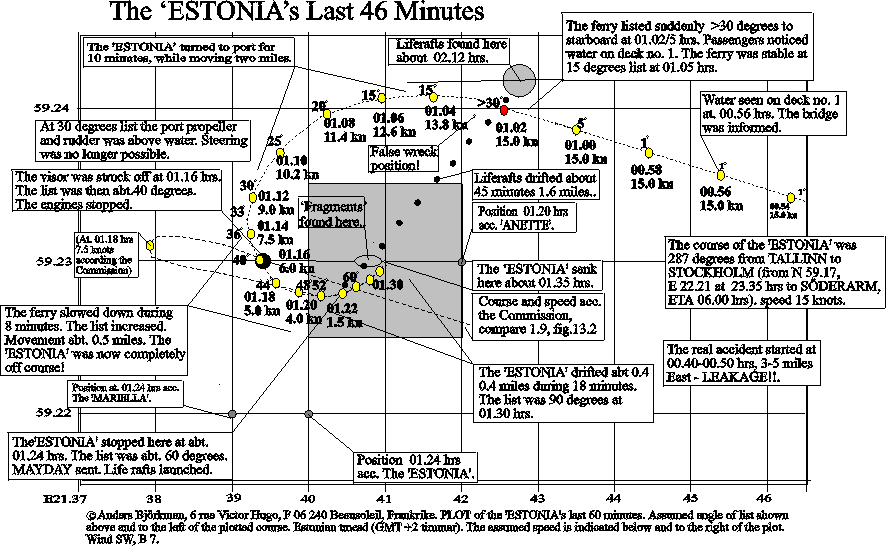
The vessel turned to port already at 01.02 hrs to counter the list. At 01.16 hrs the heel angle was 50 degrees and the visor was lost, but then the ship had already turned about 135° and was already almost heading back to Tallinn. During the turn the port engine stopped first at its propeller came out of the water. Soon after the starboard engine stopped and the ship was un-steerable. The ship virtually stopped 300-400 meters from the sinking (wreck) position at 01.25-01.30 hrs, when the Mayday was sent. The ship then slowly drifted - speed 0.3 knots - to the (wreck) position where she sank.
The course of events is shown in the below reconstruction of the accident. The times, the positions of the visor and the wreck and the ship at 01.25/30 hrs, when Mayday was sent, and the turn to port between 01.02/25 hrs make sense. Also the timing of the sinking makes sense - the inflow of water through a hole below waterline was say about 150 tons/min and spread through open watertight doors to several watertight compartments below the car deck. After 30-40 minutes all buoyancy aft below the car deck was lost; the superstructure was immediately flooded so that the ship sank - stern first. The car deck was still intact and contained buoyancy, but it was not sufficient to keep the ship afloat.
(Note 22 February 2001 - apparently the position of the visor shown below is false - the visor was attached to the ship when it sank. But it does not make this reconstruction less interesting. New information indicates that the ship had another course at the accident - towards Sandhamn, listed suddenly at 01.02 hrs and then just stopped. The visor was not properly locked and was ripped partly off during the sinking. Thus - the visor could not have caused the accident).
The shaded one square mile around the wreck is the diving exclusion zone proclaimed by Estonia, Finland and Sweden and accepted by Denmark and United Kingdom.
---