|
|
|
|
Research Study on the Sinking Sequence and Evacuation of the MV Estonia - Final Report HSVA Report No. 1663 (HSVA Auftrags Nr. 625007) Hamburg, May 05, 2008 Prepared by: HAMBURGISCHE SCHIFFBAU VERSUCHSANSTALT GmbH Dr. P. Valanto, J. Friesch http://www.surship.eu/sites/www.surship.eu/resources/project/Estonia2/public_report/HSVA1663FINAL.pdf Note: You can copy text from this document! Summary by Valanto & Friesch: "... to give light on the sinking sequence of the MV Estonia ...
Review of the HSVA/Valanto/Friesch Paper by Heiwa Co (21 December 2008) On 17 March 2005, the Swedish minister Mona Sahlin, responsible for MV Estonia matters, announced in the Parliament: 'We must proceed to do a major study of the actual sinking. How did the Estonia sink and why did she sink so fast? That experience may provide still more knowledge to improve safety at sea both in today's and tomorrow's shipping. Latest 1 February next year it shall be informed to the Government office what or which research institute or consortium that has been given this task'. This paper is more than three years later one result of this announcement and another scandal in the ongoing Estonia accident investigation done by Vinnova, Stockholm. The paper was published 5 May 2008 but has not received any attention at all since. The authors suggest only one cause and three mechanisms or events that produced the disaster and sinking, where the ship never capsizes! There is no evidence for any event! How and why the ship sank is not explained at all! "... all indicate that a significant amount of water had to come onto the vehicle deck, otherwise the reported large heeling angles could not be reached." HSVA/Valanto/Friesch suggest that the only cause for sudden heel, as observed by all survivors, must be water loaded on the vehicle deck (deck 2 several meters above waterline) in the superstructure. However, free water on deck 0 due to hull leakage below waterline would produce the same initial result. Sadly, it is not investigated at all! Don't HSVA/Valanto/Friesch know that ships float on the hull and lose stability with free water on deck 0 (the bilges!) due to leakage? "Once the watertight integrity of the bow was lost, this enabled large volumes of water to enter the vehicle deck". HSVA/Valanto/Friesch suggest that the first event was that the watertight integrity of the bow was lost at 00.55 hrs, i.e. 19 minutes earlier (!) than according official (JAIC) information. Actually the bow of the hull was never damaged at all. What HSVA/Valanto/Friesch mean is that the weather tight bow ramp of the superstructure above deck no. 2 several meters above waterline apparently opened (the visor had pulled the ramp open) at 00.55 hrs. HSVA/Valanto/Friesch do not suggest how big a large volume water is coming in and why the crew didn't take any preventive action before. The water inflow is, however, apparently not 2 000 tons/minute as suggested by SSPA/Safety at Sea Ltd producing a list >45° after a few minutes, because in the HSVA/Valanto/Friesch scenario everything goes much slower after an initial great angle of heeling, e.g. as per below track of the course copied from the report: 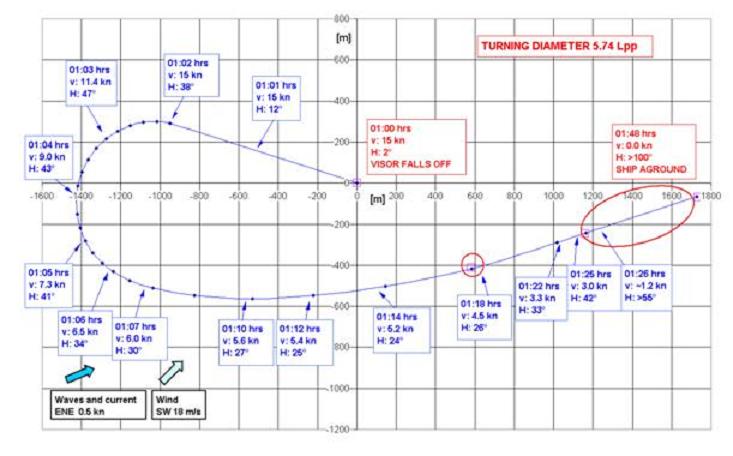
Another version is (according JAIC the loss of visor took place at 01.15 hrs - Valanto thinks it is 15 minutes earlier): 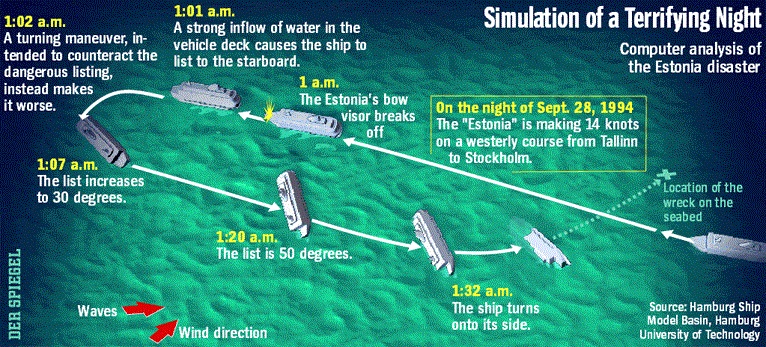 It is suggested that the vessel continues at 15 knots for two minutes and then turns 210° port back to Tallinn and that this sharp turn increases the list to 47°, but that the list is then is reduced to only 24° at 01.14 hrs when the speed is still 5.2 knots. When the Mayday is sent 01.22-01.30 hrs, i.e. 22 minutes after the incident started, the list increases from 33° to >55° and then the vessel is only 250 meters from the wreck position. The person sending the Mayday message thought the list was only 20-25°! There is however no evidence that the vessel ever turned at 01.02 -01.07 hrs (except mysterious suggestions that various things dropped off the ship and produced a trace of fragments (!) on the sea floor, e.g. 1 400 m due west of the visor position. JAIC suggest the sea floor was checked by ROV - 1 400 m west of the visor position and that the fragments were filmed! Can we believe that?). To suggest that "the second officer (E1) on watch onboard the MV Mariella tracking MV Estonia that night saw in the corner of his eye (sic) on the radar screen the track of a hasty, sharp turn to port made by MV Estonia" at 01.02-01.07 hrs, i.e. 20 minutes prior Mayday, is not based on the person's (E1) testimony! E1 might have seen something at 01.35 hrs after hearing the Mayday, when the ship sank. HSVA/Valanto/Friesch suggest inflow 100 tons/minute while SSPA/Safety at Sea, Ltd suggest 2 000 tons/minute! A list of 24° at 01.14 hrs corresponds only to about 1 500 tons of water on the car deck in the superstructure, i.e. HSVA/Valanto/Friesch suggest an inflow of only 100 tons/minute, while SSPA model tests clearly show that a realistic inflow is >2 000 tons/minute! Actually, if only 1.500 tons of water was on the car deck at 01.24 hrs, it would have flowed out by itself at that time! Or quoting the report: "The following case was studied: The ship advances at the speed of 6 kn without visor, ramp fully open, and has no other leaks. The ship has turned 180°, that is, the waves come from the starboard stern quarter. The ship has about 2000 tons of water on the vehicle deck and it advances straight ahead. This case was investigated to find out how the vessel would behave after the turn to port. Thus, after the vessel had turned, the list was reduced ... and the water should have flowed out. "When once a critical amount of water had entered the vehicle deck, this led to a drastic reduction of initial stability of the ship, which resulted in a rapidly increasing heel until an intermediate equilibrium floating condition of about 30° was reached. Due to this rapidly increasing heel, it was hardly possible for people to escape the ship". The second event is when a critical amount of water had entered the vehicle deck causing a list of 30°! As seen from fig. 31 of the report above it is suggested that the MV Estonia had 30° list - an intermediate equilibrium floating condition - at three occasions! First between 01.01 and 01.02 hrs before the turn starts, then at 01.07 hrs after the turn and then around 01.20 hrs just before the Mayday was sent. All three conditions are evidently stable and in equilibrium. HSVA/Valanto/Friesch however produce a strange Fig. 10 in the report (with SSPA/Safety at Sea Ltd and HSVA above data added by this writer) with a completely different Time Sequence of the Capsizing (sic) of MV Estonia. 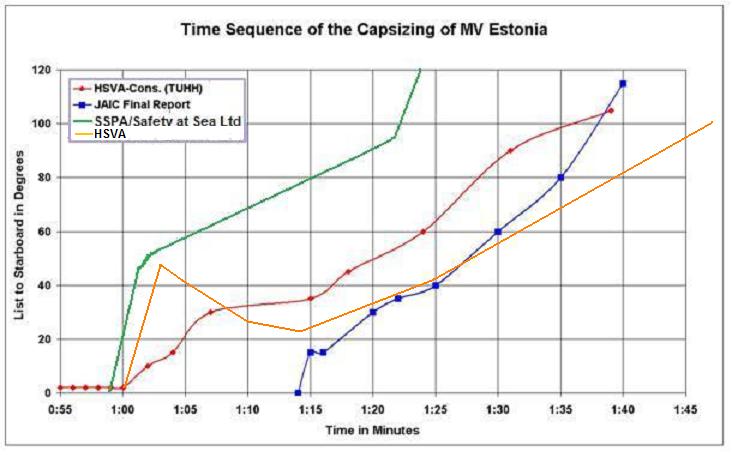
Fig. 10 Development of list to starboard during the MV Estonia accident. Here the list is say 5° at 01.01 hrs, 30° at 01.07 hrs and 50-90° at 01.22 - 01.30 hrs, when the Mayday was sent and heel angle 20-30° was reported. What happens after 01.40 hrs is not clear except that no capsize takes place (180° list). There is no evidence for this time sequence. It differs completely from the original JAIC one of 1997 and also from the SSPA/Safety at Sea Ltd 2008 model tests and computer simulations and the HSVA/Valanto/Friesch data above. According SSPA/Safety at Sea Ltd the heel is 47° at 01.02 hrs and 90° at 01.22 hrs. But let's assume that the list was 30° at 01.07 hrs (SSPA/Safety at Sea Ltd suggests it is >60°!). HSVA/Valanto/Friesch suggest it is hardly possible for people to escape at that angle. Actually it is impossible for anybody to move on a deck sloping at 30°! A more realistic limiting angle of heel for escape is 18° - after 01.04 hrs any escape would be impossible. HSVA/Valanto/Friesch include interesting, new information how the three crew members in the ECR on deck no. 1 escaped to deck no. 8 centre line. It is finally established that there are sloping ladders in the engine room uptake as seen in figs. 63 and 64 below. No vertical shafts with vertical ladders, etc, as suggested elsewhere by, e.g. Hummel and the crew itself, are fitted. 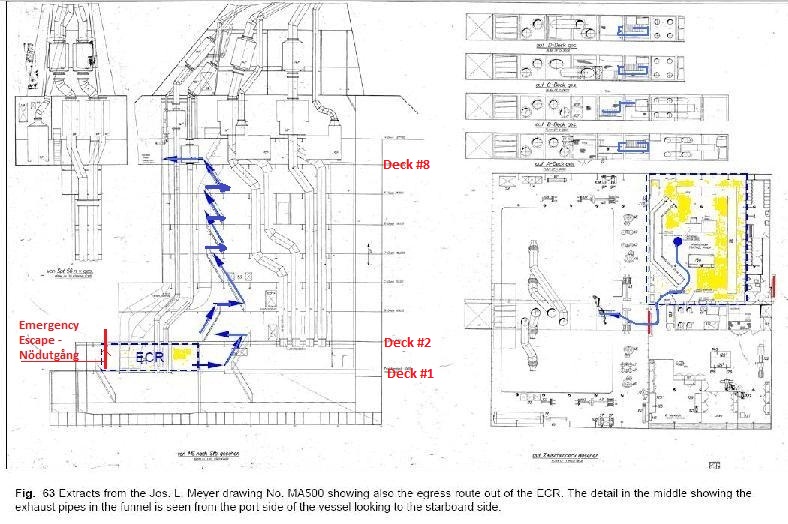
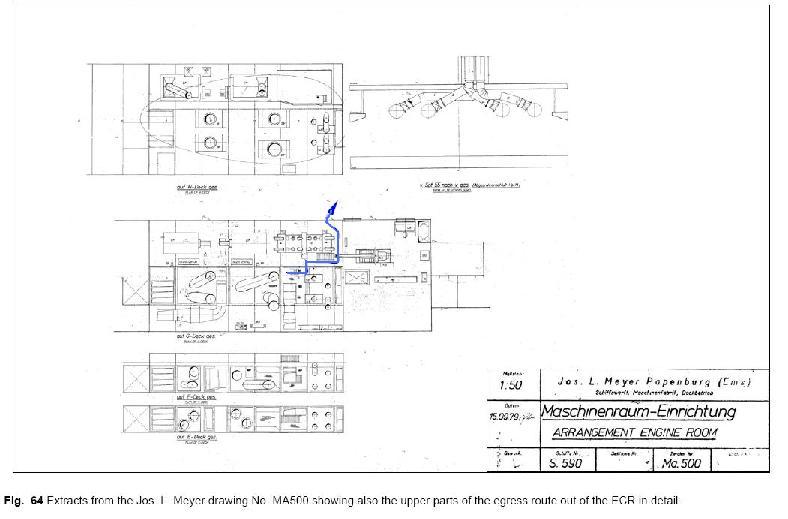 The three crew thus opened a watertight door on deck 1, and then used seven sloping ladders to reach deck 8 at centre line, when the list was >40°. This escape route is however not possible to use, unless the list is <15°, so it is now clear that the engine crew escaped from the ECR very early, around 01.03 hrs, to open decks port side. The HSVA/Valanto/Friesch report fail to show the last bit of the escape route on open deck - from the centre line to the port side, where two of the crew managed to get into a life raft at 01.30 hrs. It is impossible to move/evacuate from the centre line to the side, when the list is >15°. Many survivors observed two of the engine
crew on the port open side very soon after the heeling
occurred. Thus it is clear that the three engine crew
lied about their escape as outlined in the JAIC report
1997! Surviving
3/E
Margus Treu
explains 'In
the engine room, there was water to the
knees". According HSVA/Valanto/Friesch:
HSVA/Valanto/Friesch believe
they are correct in all respects! On the other hand
the report concludes that the three engine crew
must have got out latest at 01.07 hrs. According
JAIC they got out at 01.25 hrs (when the emergency
generator started) after a lot of heroic work down
in the ECR and multiple telephone calls with the
bridge. Sillaste suggests in his
testmonies that the bilge
pumps were started!
When and why do you start bilge pumps? Evidently
when the hull is leaking and when there is
water on deck 0. But HSVA/Valanto/Friesch do not
consider this! HSVA/Valanto/Friesch do not consider this possibility! "Once the side ventilation openings were submerged, this resulted in a domino-effect, where more and more water could enter the ship. Due to this water ingress, heel and trim increased until the vessel then finally sank". The final event in the HSVA/Valanto/Friesch report is that "once the side ventilation openings were submerged .... the vessel then finally sank". There is no evidence for this proposal in the report and no calculations of any kind to support it. The vessel must heel >40° for any side ventilation openings to be submerged - and it is not clear if they exist, and, if they exist, if they were open and undamaged! If the openings exist and if they ventilate spaces in the hull below the car/main deck, they must be fitted with fire dampers that can be locked closed, etc. so you can seal the space in case of fire, etc. However, HSVA/Valanto/Friesch suggest that any water (1 500 tons?) in the superstructure 2.5 m above waterline would have flowed out by gravity, when the bow opening was in lee after 01.07 hrs, list <30°. On the other hand, if the vessel heels >40° due to 2 500 tons loaded on the car deck, deck 2, the ferry would capsize due to GZ<0 and float upside down.
Conclusions The HSVA/Valanto/Friesch report Research Study on the Sinking Sequence and Evacuation of the MV Estonia - Final Report is another scandal of the Estonia saga. It does not contribute anything to clarify the sinking of MV Estonia on 28 September 1994. It in fact produces more lies about the accident than previously and invents a completely new story; sudden 45° heel due to a sharp port turn ... while, no water flows out of the superstructure after the turn, in spite of clear scientific evidence to the contrary, if water had actually entered in the first place, and heel is 33-55° when Mayday is sent, while the person sending Mayday reports 20-30° heel. When heel is 90° the ship evidently continues to 180° and floats upside down. It has capsized and floats. How can it sink then? 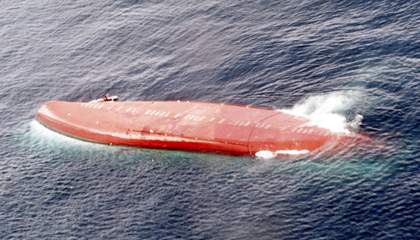
Ferry floating after capsize - it cannot sink! How the sinking took place is not explained at all except that side ventilation openings came under water (and no evidence that the ducts existed or were open or undamaged)! You wonder how an allegedly reputable company like HSVA can produce such fantasies 2008? What are they trying to achieve? Protect Karppinen? He is a good friend of Mr. Valanto! But it is good that the report shows how the JAIC key witnesses lied about their escape from the ECR. The report spends a lot of time on internal evacuation by/of passengers to open decks but fails to mention that evacuation had never been practiced on MV Estonia as the vessel simply lacked regulatory live saving appliances, LSA! Most passengers were supposed to jump into the water, if they managed to evacuate to open decks! HSVA/Valanto/Friesch fail to understand that evacuation does not end at open decks. Evacuation consists of mustering all persons in safe areas aboard, escorting them to LSA, dry embarcation of LSA, launching LSA and then using life boats to tow rafts away from the sinking ship. It is a pity that HSVA/Valanto/Friesch do not mention or even try to analyze the Heiwa Co sinking scenario , simple leakage of the hull below waterline. Heiwa Co has evidently informed HSVA/Valanto/Friesch about it ... and the result is silence. As usual! On 1 October 2008 the Swedish minister Sten Tolgfors, responsible for MV Estonia matters announced in the Parliament: "From the studies presented by the consortia SSPA Sweden AB and HSVA (Hamburgische Schiffbau-Versuchsanstalt GmbH) on 5 May 2008, can be seen that the sequence of sinking in all essential ways follows the scenario presented in the report of the Joint Accident Investigation Commission (JAIC). The consortia have had the possibility to enlarge the analysis of a number of points compared to what JAIC did. The consortia conclude, i.a.,that the sequence of sinking started earlier than concluded in the report of JAIC. The cause of the sinking of the M/S Estonia is not questioned in the studies of the consortia and they therefore confirm the conclusions of JAIC." Mr Tolgfors must have misunderstood the report of HSVA. Why the ship sank - lost buoyancy with intact hull - is not explained at all. And the survivors' testimonies are completely ignored as usual. Many survivors noticed a hard bang long before midnight (Swedish time) and decided to dress and proceed to open deck #7, i.e. evacuate. When doing this the ship suddenly heeled (loss of stability) at 01.02 hrs Estonian time preventing momentarily the evacuation. But then the angle of heel was reduced during about 10 minutes so that finally about 300 persons could reach open decks, where they were trapped while angle of heel increased. Mayday was sent 01.22 hrs when heel was 20-30°. No lifeboats or life rafts were launched. When the ship was on the side (90° heel), some rafts were activated and most people were thrown into the cold water. The HSVA report does not tally with the survivors' testimonies. It is written to cover up the truth of the incident.
Anders Björkman (21 December 2008)
In 2009 Valanto published a report that ropax ships like MV Estonia capsize and float upside down with water on the car deck! Ropax ships do not sink with water loaded on the car deck.
|