|
|
|
|
Six Phases of Sinking
1. The M/S Estonia was apparently underway when an incident occurred. It had nothing to do with the forward ramp on the no. 2 car deck (behind the bow visor) that was always leaking a little, so water flowed in in severe weather (Source - the German Group of Experts) in spite of efforts to make it tight by various means. The watchman was checking the ramp at hourly intervals. To enable the leaking water to flow out, the crew always operated the ship with a small, starboard list and stern trim. Therefore the small amount of water that leaked in at the bow ramp flowed aft along the starboard side of the car deck due to the stern trim and flowed out through the scuppers. This was 'normal' practice. The pilots often stepped into water when they embarked on the ship at arrival Sweden, we are told to believe. The watchman was at the ramp prior the incident. He did not observe any explosions at the ramp/visor, etc., so the suggestions that bombs exploded at the ramp/visor cannot be correct. But explosives were apparently used later by the Swedish Navy divers to remove the visor from the ship under water. Leakage develops 00.45-00.50 hrs 2. At 00.45-00.50 hrs the
writer thinks the ship suffered hull damage and
leakage below waterline - maybe in way of the
starboard stabilizer fin box room or the starboard
sewage tank compartment and
the room was flooded. Many survivors noticed sharp noises as
if the ship collided or something was broken or maybe an
explosion occurred. The water inflow might have been as
little as 50-100 tons/minute, i.e. the ship started to
sink! The effective open area of the
damage was about 0.2 m². Apparently the watertight
doors to the two forward or aft spaces were open - a
corridor space - so that three compartments were
flooded. Alternatively (less likely) the
starboard shell plating fractured in the bilge
strake at the swimming pool area. It was a rust
trap. Water always spilled out from the swimming
pool in the pool compartment and ended up in the
bilges, where the lower frame brackets became rusty
(even if the pool is located on the port side).
The crew knew that something
was wrong from the start of the accident, i.e.
00.50-00.55 hrs and 3/E Treu probably was out
of the engine control room to check. They reported to the bridge that
the ship was leaking - that several
compartments on deck 0 were flooded. It is
assumed that the engine crew started the bilge
pumps (one crew member, Sillaste, said so). In
spite of this, water started to rise up on deck 1
at about 00.55-00.58 hrs (through the down
flooding hatches in deck 1 and the stairwells down
to deck 0), where it was noted by some passengers
in the passenger compartments on deck 1 - there was
water in the centre corridor. The passengers also
noted that the watertight doors on deck 1 were
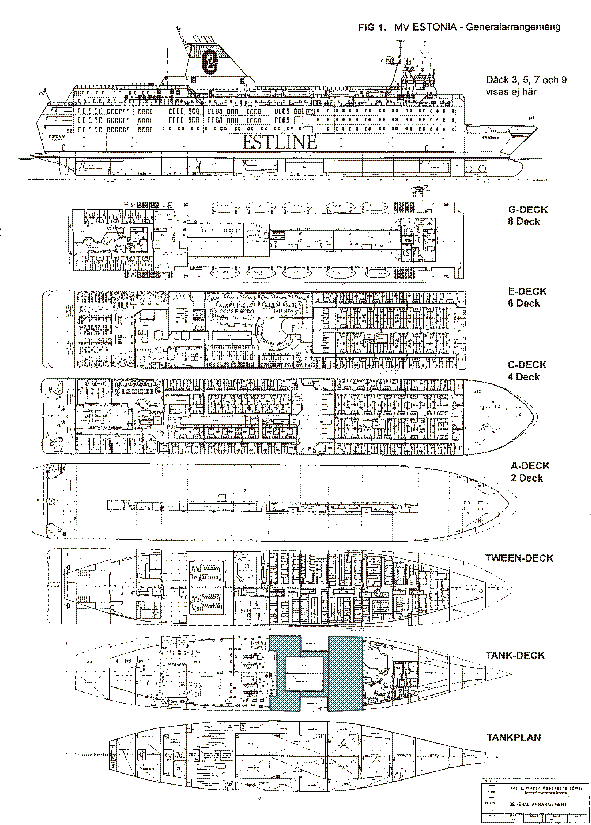
open. The situation was then as seen in the plan
right - grey colour indicates flooded
spaces: The sewage tanks room, the
corridors and the stabilizer room are assumed
flooded and the watertight doors to the swimming
pool room forward and to the generator room aft are
closed. Survivor CÖ was in his cabin above the
sewage tanks room. The engine crew was in the
engine room starting the bilge pumps. The official investigators
apparently modified the statements of the crew to
blame the accident on the visor. Water on Deck 1 - the sudden
List develops at 01.02 hrs 3. When the passengers on
deck 1 informed the bridge (via the information
counter on deck 5), that there was water on deck 1,
the crew - probably including the Master - on
the bridge panicked. The watertight door
control panel on the bridge was badly arranged
1.23
- some indication lights had been arranged to be
green, when the doors were open and some were red
when other doors were open, and, there was a
facility to open, and to keep open, the watertight
doors from the bridge (panel). It is thought that
the Master tried to close all watertight doors but
by mistake some doors (on starboard side) were
instead opened at about 01.00 hrs - to the
generator room aft and to the swimming pool room
forward of the flooded compartments on deck 0 (tank
top) causing two strong bangs.Thus the water - say
about
600-1.000
tons - in the flooded three compartments spread to
five compartments - 120-200 tons in each. Then
the ship lost its initial stability due to too
large free water surfaces causing negative GM
2.17
- the ship suddenly listed at 01.02 hrs and come to
rest at about 01.05 hrs with a 15 degrees list.
Alternatively it was the fracture in the shell
plate that developed forward and aft so that the
starboard heeling tank was suddenly flooded causing
the sudden list. The ship probably stopped at
this time and the engine crew on deck no. 1
decided to evacuate to deck 8. Passengers were also
evacuating. The ship was rolling strongly around
the 15 degrees list position due to small GoM and,
when the ship rolled to port, it was possible to
walk across decks and climb up in stairs.
When the ship rolled to 40
degrees starboard you had to hold on to something.
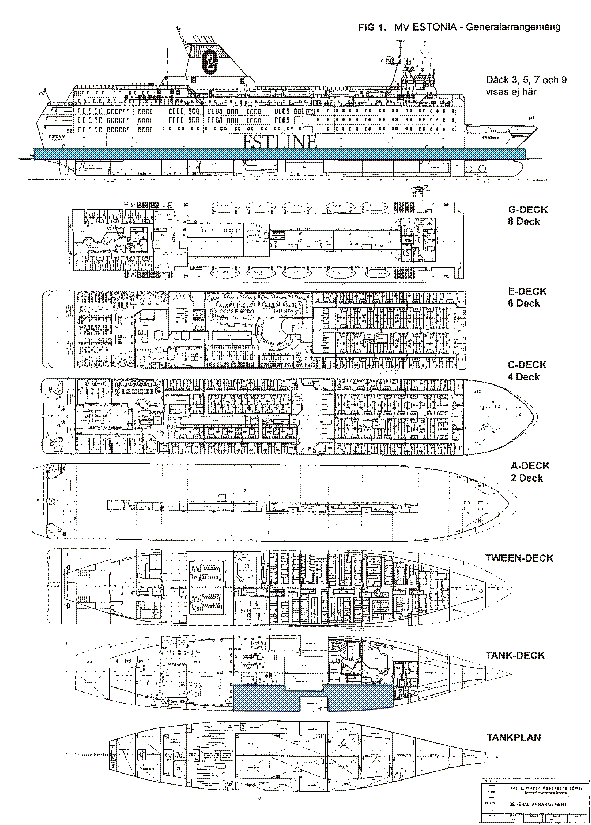
The situation looked like shown right with
floodwater indicated in grey on the tank top.
Andrzej Jasionowski of
Strathclyde university has kindly pointed out that
the ship cannot list more than 21 degrees in this
terrible five-compartments flooded condition and
this might be so. The ship would still have been
safe, albeit with a list, if the water could have
been contained by closing the watertight doors and
pumping the undamaged spaces dry. It tallies with
survivors observation - the vessel stabilized with
a 15-20 degrees list after the first deep rolls,
sudden listing to starboard. Stable Condition after the
sudden List at 01.18 hrs 4. It is then thought
that the watertight door in the center line on
deck 0 between the generator and engine rooms was
also open and that water spilled into the main
engine room at say about 01.18 hrs - six
compartments flooding! The ship listed more and had
30 degrees list - but it was still stable with say
800-1 200 tons of water on deck 0. The ship was now
floating with help of the superstructure -
the car deck between decks 2 and 4. Ramp and visor
were in place. Only little water flowed in at the
forward, leaking ramp. The visor must have been in
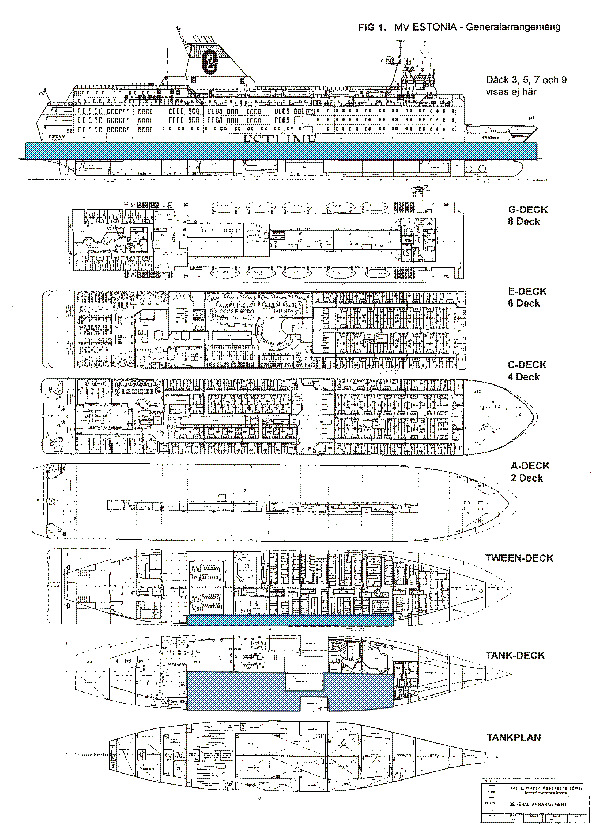
place. The situation looked as shown
right: Only now - around 01.20
hrs - the Mayday message was sent. The Ship sinks on the Stern
01.18-01.35 hrs 5.
But more water flooded in
through the leak and the list increased and deck 4
and above - the deckhouse - was flooded. The
deckhouse was of course neither water- nor weather
tight. What happened now was the following: as the
ship listed the ventilator openings, say open area
0.5 m², on open deck no. 4 aft on
top of the superstructure came under water
and water flooded down through them onto the car
deck no. 2 aft - say 200-300 ton/minute.
Alternatively the aft car ramps on deck no. 2 aft
were leaking. As a result the ship started to trim
on the stern, listed more and started to sink
quickly stern first. Evidently the ship had been
sinking since the leak started, but now the
situation was very serious. The water in the six
compartments on deck 0 flowed to the stern. The
situation at about 01.25 hrs may have been
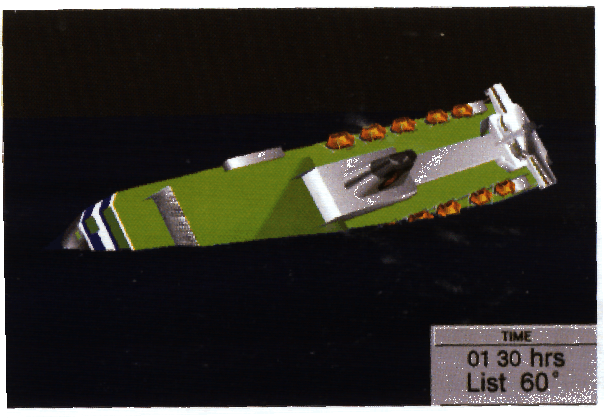
as seen right: The tragedy is that the ship
could have still been saved in this condition by
closing the watertight doors in the hull and pump
the intact compartments dry. But the writer thinks
that the hydraulic pressure in the watertight door
operating system was low due to stupid operations
from the bridge and the doors were blocked in the
open position. And evidently the engine crew had
abandoned their positions so nobody could start
pumps and open correct valves. The final Sinking 01.32 hrs
6.
Then the ship was
doomed. The deckhouse and car deck were flooded
more as seen on the figure right from the Final
report. A ship can evidently not float
in that position, but this the Commission suggests
- the ship should have sunk 22 minutes later!
In reality the ship probably
sank hitting the bottom already at say 01.32
hrs with the stern first, while the bow - with the
visor in place - was above the water a short while.
Officially the ship sank after 01.50 hrs but this
time was invented by the accident investigators to
allow the sinking ship to drift >1 500 meters to
the official wreck position. In order to verify the above scenario an associate of the writer informally inspected in August 2000 a ferry belonging to the owners of the 'Estonia' between Tallinn and Stockholm. All watertight doors below the car deck were open at sea. The Swedish Maritime Administration was duly informed - and decided to do nothing (except that the Director General - Mr. Anders Lindström - shortly afterwards decided to leave his position for other duties). It is sad that all parties do not encourage simple seamanship. Then similar accidents as the 'Estonia' will occur again, and again. It is quite simple to verify the above scencario. Many modern ferries have sophisticated stability computers that not only calculates intact stability but also damage stabiliy, e.g. the Finnish Napa Onboard range of computers. The latter can be programmed to calculate the stability with flooded compartments of the watertight hull and the weathertight superstructure (but not the deck house). Thus you only have to start with an original, intact condition and then add water to the compartments you assume damage or flooded. The Napa Onboard immediately calculates the relevant new equilibrium and the relevant new particulars, draught, trim, displacement, GoM, GZ and range, list, etc. It will inform when the margin line is submerged and when progressive flooding starts.The Napa Onboard computer can also be used to show what happens with water in the superstructure - at a certain angle of list the ship capsizes. Evidently the Napa Onboard computer assumes that the deck house does not contribute with bouyancy to float the ship - only to provide bouyancy to extend the range of positive heeling arm GZ (if the deck house is weathertight - which was not the case of the 'Estonia'). Why was the real cause of the 'Estonia' sinking covered up? Probably for multiple reasons: to protect the newly 'democratic' and poor Estonian state, where Finland and Sweden control 60-70% of all new investments, to hide that the 'Estonia' was used for transporting contraband of various sorts for the Estonian and Swedish governments, and to protect the Swedish Maritime Administration and its incompetent staff and the Finnish Coast Guard that did nothing to assist the sinking ship and knew that the ferry was not seaworthy before the accident. The states of Estonia, Finland and Sweden had many reasons to manipulate the investigation. And the real culprits were happy - they got away and could retire to sunny, southern Europe. Contact anders.bjorkman@wanadoo.fr
|