|
|
|
|
Most FPUs - Floating Production Units - are FPSOs - Floating Production Storage & Offloading units built similar to sea going oil tankers, i.e. enlarged pontoons. However an FPSO is not an oil tanker and the optimum design should be completely different. Like a life buoy - or a cake. And then it can be built on one or more 50x50 meters slipways. There is no need for a long building dock or similar. But you need a jetty and a free space of abt 200 meters outside the jetty to moor the complete, assembled unit for outfitting. It is also good to have 30 meters depth outside the jetty. Heiwa Co has the
pleasure to present a new arrangement of the
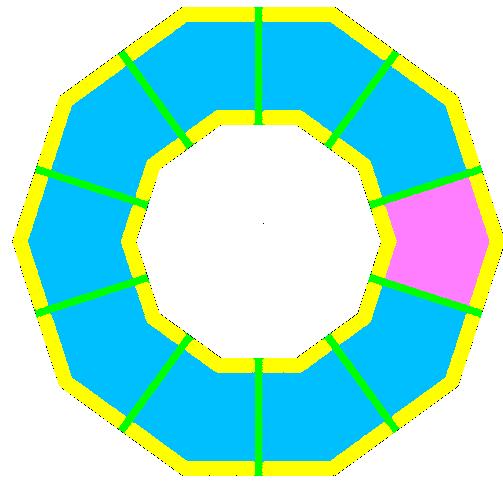
Coulombi Egg 2.2 Mbls FPSO. Particulars of the Coulombi Egg 2.2 MBls FPSO
(Pat. pend.) LOA 175.6 m BOA 167 m Depth 37 m Draft 28 m Cargo capacity 2.2 M barrels Ballast capacity 0 m3 8 cargo tanks and 2 produced water
tanks (BLUE in
General arrangement right) Engine room
(PINK in
General arrangement right). Cargo tanks and Engine room are protected by ten
double bottom and side tank void spaces
(YELLOW in
General arrangement right) and by ten transverse
voids with connection welding butts
(GREEN in
General arrangement right). All voids are 4 meters
wide. The Coulombi Egg 2.2 MBls FPSO
consists of 10 off 50x50 meter tank/ER units each
with steel weight 4 100 tons built on a
slipway. The transverse section of a Coulombi Egg 2.2
MBls FPSO base unit is shown right. It is box shaped 37 meters deep and 41 meters
wide. All plates are flat! All stiffeners are
straight! Stiffeners are interrupted at watertight
floors and bulkheads. The cargo
tank is 33x33 m surrounded by a 4 meters
wide double side and bottom voids. The deck and is longitudinally framed, s= 786
mm, supported by deck webs 5 meters apart. The deck
webs are supported by a centre line girder. There
shall be permanent means to inspect the deck
webs. The side voids are transversely framed
(except the top part), s = 800 mm, supported by
four horizontal girders for easy access and
inspection. The bottom void is longitudinally framed
supported by transverse floors 5 meters apart. All scantlings are based on local loads and
assumed wave loads and different tank loadings. One
severe load case is, e.g. all tanks fully loaded
except the tank opposite the engine room that is
empty, etc. The deck may be 12 mm, the bottom 20 mm
and the sides average 16 mm. The erection void between cargo tanks can
evidently be eliminated to save weight (double
bulkhead becomes single bulkhead between oil tanks)
and to gain storage capacity (but the oil tank
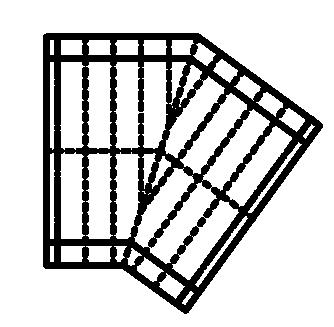
becomes more difficult to clean). Each base unit is banana shaped at an angle of
36° explained as follows: A typical base unit is shown right. It is about
50 meters long and 50 meters wide. A Coulombi
Egg 2.2 Mbls FPSO consists of 10 such
units. Two meters from each end is an oil tight
bulkhead and watertight floor in the double bottom.
The oil tight bulkhead is vertically framed and
supported by horizontal girders on the outside of
the cargo tank and a centre line web in the
erection voids. In the middle of the base unit is a swash
bulkhead and floor in double bottom fitted at an
angle of 18°. The other floors are fitted 5 meters apart
perpendicular to the sides. The base unit thus consists of a double bottom
block 4 meters deep, side blocks 4 meters wide, two
bulkheads, a swash bulkhead and a deck block. All
surfaces are flat for easy construction in panel
and block assembly lines. Total weight is about 4
100 tons, which can probably be reduced after
detailed structural analysis. The blocks are
painted at this stage. The bulkheads are also
tested with air at completion. When the base unit is launched it will float at
a draft of about 3 meters and can easily be joined
to other base units afloat. Cargo handling is one (or two) deepwell pumps in
each tank. There is thus no piping in the bottom or
penetrations of bulkheads (and no cargo pump
room!). As the complete FPSO will be spread moored,
outside waves may in rare occasions cause
transverse sloshing in some parts of some partly
filled tanks that are lined up with the (big)
waves. If there is a problem, it is easy to
transfer cargo from one tank to another. The structural area inside the tank is minimum
and very little scale will form. Tank cleaning, gas
freeing and access are therefore very simple. The
flush bottom will be epoxy coated in the standard
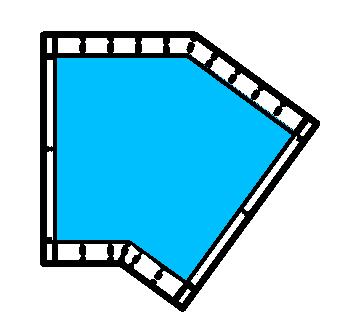
manner. The cargo tank is protected by a U-shaped void,
4 meters wide/deep all around it. Only structural elements inside a cargo tank to
inspect are the deck webs and the swash
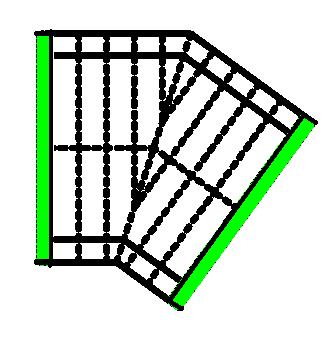
bulkhead. At each end of a base unit is a 2 meters wide
unit erection
void. When two units have been launched, they are
moored together at the end of the jetty and can be
assembled - welded together - afloat - from inside
these voids. The units float at a draft of about
three meters (on the double bottom void inside the
watertight end floor), so the bottom joint has to
be sealed from outside at the bottom. Then all
longitudinals and plates can be welded together
afloat. The final back welding of the outside,
underwater butts take place, when all ten units
have been joined and you can trim the complete unit
and weld above waterline. Another method to
complete the outside, underwater welding is of
course to fit a temporary skirt around the bottom
butt and weld from there. The final erection void space is 4 meters vide
and act as support of the transverse oil tight
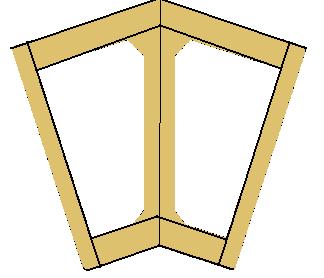
vertically framed bulkheads. A typical horizontal
girder ring is shown in the picture
right. There are four rings at various levels. As the sides and bulkheads are transversely
(vertically) framed, the loads on the sides and
bulkheads are directed down into the horizontal
girders and then via the girders to the bulkheads.
In order to reduce the load in the outside girder
the swash bulkhead is fitted and its girders
transmit load to the inside girder, etc. The
transverse bulkhead girder has a vertical web at
mid-length (centre line), so the loads are there
transmitted to deck and bottom. The design load cases are evidently with one
tank full and all other tanks empty at minimum
draft and full draft with one cargo tank empty. In
normal operations all tanks are filled at various
levels at bigger draft, so the stresses in the
girder ring will be much reduced. Inspection of voids is very easily done from
the horizontal girders. Cargo leaks are very
easy to spot. Topside Outfitting When all ten base units have been assembled
afloat and when the complete unit is moored at the
end of a jetty, you can temporarily ballast the
cargo tanks with sea water (also good for testing
the tanks) and lift on top side modules (up to 60
000 tones) and the deck house/helipad on top of the
engine room section, that has been outfitted
previously. The Coulombi Egg 2.2 MBls FPSO has no ballast tanks! Ballasting during transfer from yard to location, if required, is with water in the cargo tanks. At location the unit will always carry at least 500 000 bls of cargo after a typical 1 M bls offload, so no sea water ballast is required. UWILDS are not really required as all hull structure including erections butt joints can be inspected from the 20 off inside voids. Underwater outside may be, apart from coatings, protected by an ICCP system or anodes. The Coulombi Egg 2.2 MBls FPSO could in fact be fitted with propulsion - a pod thruster of certain size - to be used in an emergency (mooring system damaged) and fitted in the engine room. You never know what USCG requires in GoM! At Location The unit is spread moored from some of the swash bulkhead corners. Risers are brought up from inside the pool. Offloading is best done via an adjacent buoy but it can also be done directly from the Coulombi Egg FPSO. One area of the unit is to be arranged to receive supply boats. The movement of the Coulombi Egg 2.2 M Bbl FPSO in seaways is that of a buoy but due to its large size it will hardly pitch or heave. At end contract the unit can be towed to a jetty and the modules be replaced to suit another contract. At this time the underwater protection coatings + anodes) can be renewed by simply tipping the unit on one side. It is just a piece of cake! Enjoy it.
Contact anders.bjorkman@wanadoo.fr
|